C-390 Millennium vs Il-76 Candid
C-390 Millennium vs Il-76 Candid at a glance — top speed 980 vs 850 km/h, range 6,240 vs 5,000 km, max takeoff weight 72,000 vs 195,000 kg, built 15 vs 960 units.
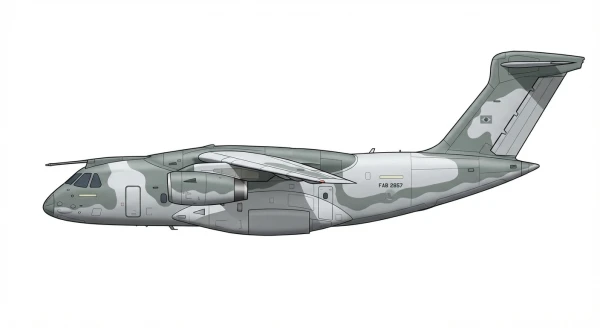
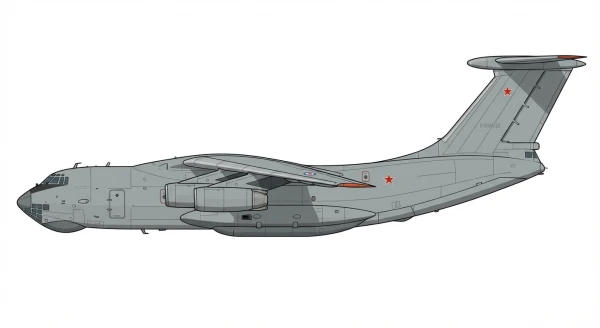
| C-390 Millennium | Il-76 Candid | |
|---|---|---|
| Origin country | 🇧🇷 Brazil | 🇷🇺 Ex-USSR |
| Category | Military Transport Aircraft | Military Transport Aircraft |
| Manufacturer | Embraer | Ilyushin |
| First flight | 30 August 2025 | 25 March 1971 |
| Year introduced | 2019 | 1974 |
| Number produced | 15 units | 960 units |
| Average unit price | $140 million | -- |
| Wing area | -- m² | 300.0 m² |
| Wingspan | 35.1 m | 50.5 m |
| Height | 10.3 m | 14.8 m |
| Length | 33.9 m | 46.6 m |
| Maximum speed | 980 km/h | 850 km/h |
| Operational range | 6,240 km | 5,000 km |
| Service ceiling | 11,000 m | 13,000 m |
| Max. takeoff weight | 72,000 kg | 195,000 kg |
| Empty weight | 35,000 kg | 92,500 kg |
| Total thrust | 2 x 13,154 kgf | 4 x 14,500 kgf |
Detailed Comparison
The Embraer C-390 Millennium and Ilyushin Il-76 Candid represent fundamentally different approaches to military airlift, defined by their respective eras of design and intended missions. The C-390 is a modern, twin-engine tactical transport leveraging commercial aviation technology for efficiency and multi-role flexibility. In contrast, the Il-76 is a Cold War-era, four-engine strategic airlifter built for heavy-lift capacity and rugged, austere-field operations.
Development and Design
The C-390's design philosophy is rooted in 21st-century efficiency. Derived in part from Embraer's E190 jetliner, it incorporates modern systems to reduce crew workload and operational costs. Key features include:
- Advanced Avionics: A Rockwell Collins Pro Line Fusion cockpit with head-up displays and a full fly-by-wire flight control system with active sidesticks.
- Modern Propulsion: Two IAE V2500-E5 turbofans, common on commercial airliners, offer high performance and logistical advantages.
- Modularity: Designed for rapid mission reconfiguration, from cargo transport and aerial refueling to search and rescue.
The Il-76 was developed in the late 1960s to meet a Soviet requirement for a heavy transport capable of operating from short, unpaved runways. Its design emphasizes robustness and payload over technological sophistication. The airframe is exceptionally sturdy, and it originally required a large crew of up to seven to manage its various systems, reflecting an era before widespread flight deck automation. Even modernized variants retain a focus on mechanical reliability.
Specifications and Performances
The performance metrics highlight the different mission scales. The Il-76 is a substantially larger aircraft, with a maximum takeoff weight of 195,000 kg compared to the C-390’s 72,000 kg. This allows the Il-76 to carry significantly heavier and more voluminous cargo, defining its role as a strategic lifter. The C-390, with its 26-tonne payload capacity, operates firmly in the medium tactical transport class. Despite its smaller size, the C-390's modern turbofans give it a higher maximum speed of 980 km/h, surpassing the Il-76's 900 km/h. This speed advantage allows for more rapid deployment of troops and materiel over tactical distances. The C-390's twin-engine design also suggests lower fuel consumption and maintenance costs compared to the Il-76's four engines.
Deployment and usage
The Il-76 has a nearly 50-year operational history, serving as a primary strategic transport for the Soviet Union, Russia, and numerous other nations. It has been proven in conflicts like the Soviet-Afghan War and is a staple of humanitarian and disaster relief operations globally. Its versatility is demonstrated by its extensive list of variants, including the Il-78 tanker and the A-50 AEW&C platform.
The C-390 is a relative newcomer, entering service in 2019. It has already established its capabilities in diverse missions, including COVID-19 relief, international humanitarian aid, and Antarctic support. Its participation in joint exercises with the US Air Force underscores its design for interoperability with Western forces, a key consideration for its export customers.
Conclusion
The Il-76 remains a relevant strategic asset due to its immense payload capacity and unparalleled ruggedness, particularly in its modernized Il-76MD-90A form. It is a proven workhorse for moving outsized cargo over long distances into challenging environments. The C-390, however, represents the modern state-of-the-art in tactical airlift. It offers superior speed, fuel efficiency, and mission flexibility through its advanced systems and modular design. It is not a direct competitor to the Il-76's heavy strategic role but is positioned as a highly capable and cost-effective solution for nations seeking to modernize their medium-lift tactical transport fleets.