DA42 Twin Star vs Diamond DA62
DA42 Twin Star vs Diamond DA62 at a glance — top speed 354 vs 372 km/h, range 2,250 vs 2,380 km, max takeoff weight 2,000 vs 2,300 kg, built 600 vs 120 units.
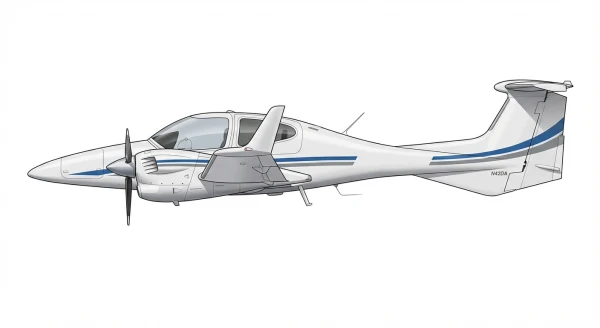
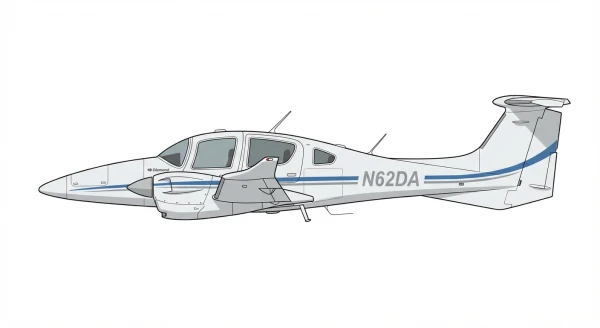
| DA42 Twin Star | Diamond DA62 | |
|---|---|---|
| Origin country | 🇦🇹 Austria | 🇦🇹 Austria |
| Category | Military Training Aircraft | Military Special Mission Aircraft |
| Manufacturer | Diamond | Diamond |
| First flight | 9 December 2002 | 1 April 2012 |
| Year introduced | 2004 | 2015 |
| Number produced | 600 units | 120 units |
| Average unit price | $1.3 million | $1.9 million |
| Wing area | 16.3 m² | 17.1 m² |
| Wingspan | 13.4 m | 14.6 m |
| Height | 2.5 m | 2.8 m |
| Length | 8.0 m | 9.2 m |
| Maximum speed | 354 km/h | 372 km/h |
| Operational range | 2,250 km | 2,380 km |
| Service ceiling | 9,000 m | 6,069 m |
| Max. takeoff weight | 2,000 kg | 2,300 kg |
| Empty weight | 1,200 kg | 1,590 kg |
| Total thrust | 2 x 100 kW | 2 x 132 kW |
Detailed Comparison
Diamond Aircraft’s transition from general aviation to military intelligence, surveillance, and reconnaissance (ISR) platforms relies on adapting composite, diesel-powered twin-engine airframes. The DA42 Twin Star established the viability of manned, low-cost commercial off-the-shelf (COTS) aircraft for military sensing, while the DA62 scales this concept up, providing increased payload capacity and internal volume at a higher acquisition cost.
Development and Design
The DA42 originated in the late 1990s as a composite touring aircraft. Diamond integrated Thielert diesel engines to burn Jet-A fuel, simplifying logistics for military operators accustomed to turbine fuels. Following Thielert’s insolvency in 2008, Diamond shifted to the proprietary 127 kW Austro AE 300. The DA62, developed a decade later, is derived from the single-engine DA50 fuselage. It integrates 132 kW Austro AE 330 engines and aerodynamic refinements to offset a heavier gross weight. The primary structural divergence is cabin volume; the DA62 expands to accommodate up to seven seats in civilian configurations, translating directly to increased internal space for ISR operator consoles and avionics racks in the Multi-Purpose Platform (MPP) variants.
Specifications and Performances
Both aircraft prioritize persistence and operating economy over speed. The DA62 provides a maximum takeoff weight of 2,300 kg compared to the DA42’s 2,000 kg. This 300 kg increase directly enables heavier sensor suites—such as synthetic aperture radars (SAR) or full-motion video (FMV) turrets—without sacrificing fuel load. The DA62 cruises 18 km/h faster at maximum speed (372 km/h) and extends the range by 130 km to 2,380 km. However, the DA42 maintains a higher service ceiling (9,000 m versus 6,069 m). This 3,000 m altitude delta is a distinct tactical advantage for visual and acoustic signature reduction during covert loitering missions. Endurance for both platforms routinely reaches 10 hours on less fuel than a turboprop burns during taxi operations.
Deployment and usage
The DA42 MPP established the COTS ISR concept in high-intensity environments. The platform operates in several military capacities:
- Manned ISR: Two Royal Air Force DA42 MPPs deployed to Iraq in 2008 and 2009, logging 2,000 flight hours carrying high-definition cameras and laser scanners to track insurgent movements.
- Unmanned platforms: The DA42 airframe serves as the basis for the Aeronautics Defense Dominator UAV and the armed Russian DA-42B.
The DA62 MPP targets state actors requiring border patrol and maritime surveillance on restricted budgets. The Nigerian Air Force acquired four DA62s in 2023 for counter-insurgency surveillance, while Greece contracted three in 2024 for SAR and civil protection tasks.
Conclusion
The DA42 holds the tactical edge for high-altitude, low-signature surveillance and unmanned conversion. Its 9,000-meter ceiling allows it to operate above man-portable air defense systems (MANPADS) and small arms fire, making it a survivable asset in contested airspace. The DA62 is the preferred platform for maritime patrol, border security, and domestic policing, where airspace is permissive but operator fatigue and heavy multi-sensor payloads are the primary constraints. For defense ministries seeking a manned, long-endurance ISR workhorse to replace aging turboprops, the DA62’s internal operator volume justifies its $1.9 million price tag over the DA42’s $1.3 million.