Austria Military Forces
Open-source order of battle for 2026: 22,050 active troops, 89 aircraft, 599 ground vehicles.
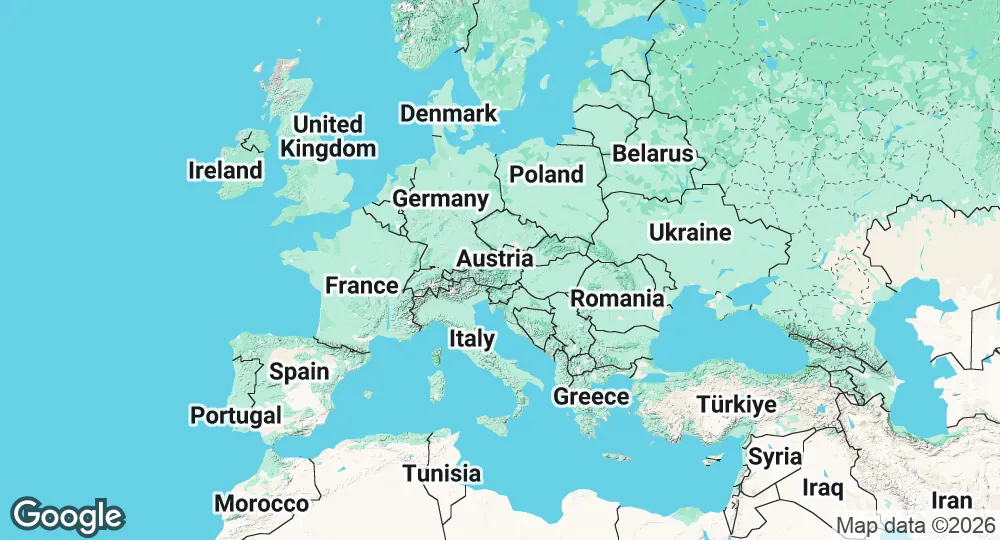
Armed Forces in 2026
| Domain | Strength | Composition |
|---|---|---|
| Air Force | 89 aircraft | 15 combat 41 helicopters +56 on order |
| Ground Forces | 599 vehicles | 56 main battle tanks |
| Personnel | 22,050 active | 125,600 reserve |
Global Military Index
Full ranking →| Pillar | Weight | Score | Basis |
|---|---|---|---|
| Manpower | 15% | 64.4 | Active, reserve & paramilitary personnel |
| Ground forces | 20% | 42.9 | Tanks, armor & artillery weighted by type |
| Naval power | 20% | 0.0 | Weighted by hull type: carrier tiers, nuclear vs conventional submarines |
| Air power | 25% | 35.4 | Weighted by aircraft type and fleet age |
| Nuclear deterrent | 10% | 0.0 | No declared nuclear capability |
| Defense budget | 10% | 47.2 | Annual spending, purchasing-power adjusted |
| Readiness | modifier | ×1.13 | Budget per soldier: proxy for training, maintenance & technology |
Country File
| Population | 9.2M (2024) |
| GDP | $534.8 billion (2024) |
| GDP per capita | $58,269 |
| Military budget | $5.3 billion (2024) |
| Share of GDP | 1.0% (2024) |
| Military spending per capita | $583 (2024) |
| Inflation rate | 2.94% (2024) |
| Capital | Vienna |
| Region | Europe |
| Land area | 82,445 km² |
| Land borders | 2,562 km |
| Bordering countries | 8 |
| Currency | EUR |
Strategic Overview in 2026
Strategic Position
Austria maintains a policy of permanent neutrality, a status established by the 1955 Federal Constitutional Law. While not a member of NATO, the state is a participant in the Partnership for Peace (PfP) program and a member of the European Union. Its defense posture is governed by the "Comprehensive National Defense" doctrine, which integrates military readiness with civil, economic, and psychological defense.
Austria’s primary security concerns focus on regional stability in the Western Balkans and the potential for hybrid warfare, cyber threats, and the destabilization of critical infrastructure. Under the European Union's Treaty of Lisbon (Article 42.7), Austria is committed to the mutual defense clause, though its neutral status limits participation to non-combat or humanitarian support in specific collective frameworks. The country maintains a strong presence in international peacekeeping, specifically through the United Nations and EU-led missions, with long-term deployments in Kosovo (KFOR), Bosnia and Herzegovina (EUFOR ALTHEA), and Lebanon (UNIFIL).
Military Forces
The Bundesheer (Austrian Armed Forces) is organized under the Ministry of Defense and comprises Land Forces, Air Forces, and specialized commands for cyber and special operations. The force structure relies on a mix of professional personnel and conscripts, who serve a mandatory six-month term.
-
Personnel: Active-duty personnel number approximately 23,000, supported by a militia (reserve) framework of approximately 125,000. In 2025 and 2026, the military is focusing on expanding its mobilization-ready cadre to 55,000.
-
Land Forces: The army operates Leopard 2A4 main battle tanks, which are currently undergoing modernization to an upgraded digital standard. Armored infantry units utilize Ulan infantry fighting vehicles and the Pandur EVO wheeled armored vehicle. The Gebirgsjäger (mountain infantry) are a specialized component trained for high-altitude combat.
-
Air Forces: Airspace sovereignty is maintained by a fleet of Eurofighter Typhoon interceptors. The transport fleet is transitioning from the C-130 Hercules to the Embraer C-390 Millennium. Rotary-wing assets include Leonardo AW169M and S-70 Black Hawk helicopters, which are used for transport, medical evacuation, and disaster relief.
-
Special Operations: The Jagdkommando is the primary special forces unit, capable of counter-terrorism, reconnaissance, and unconventional warfare.
-
Cyber and Electronic Warfare: The military maintains specialized cyber defense units to protect command-and-control networks and civilian critical infrastructure.
Defense Industry
Austria possesses a substantive domestic defense industry, characterized by high export rates and a focus on small arms and light armored vehicles.
-
Glock: Produces pistols utilized by military and law enforcement agencies globally.
-
Steyr Arms: Manufactures the StG 77 (AUG) assault rifle, the standard-issue weapon of the Bundesheer, along with precision sniper rifles.
-
General Dynamics European Land Systems-Steyr (GDELS-Steyr): The domestic manufacturer for the Pandur EVO armored vehicle and the Ulan IFV.
-
Hirtenberger Defense Systems: Specializes in mortar systems and associated ammunition.
-
Diamond Aircraft: Produces light aircraft utilized for intelligence, surveillance, and reconnaissance (ISR) missions.
While self-sufficient in small arms and wheeled armored vehicles, Austria relies on international procurement for high-performance combat aircraft, heavy armor, and advanced air defense systems.
Strategic Trends
The Austrian defense posture is undergoing a period of expansion under the "Aufbauplan 2032" (Build-up Plan 2032), a multi-year investment strategy initiated following the 2022 invasion of Ukraine. In 2025 and 2026, the defense budget is approximately €4.4 billion and €5.2 billion respectively, representing a trajectory toward a target of 1.5% of GDP by 2028.
Procurement priorities for 2026 include the arrival of modernized Leopard 2A4 tanks, the integration of additional AW169M helicopters, and the acquisition of more than 200 Pandur EVO vehicles. A major strategic shift is Austria’s participation in the European Sky Shield Initiative (ESSI), with billions allocated for ground-based air defense systems to address short-, medium-, and long-range threats. Doctrinally, the Bundesheer is transitioning from a focus on international crisis management back to conventional territorial defense and "Mission Vorwärts," which emphasizes the restoration of mechanized combat capabilities and logistical self-sufficiency.
Austrian Defense Manufacturing
Designed in AustriaFrequently Asked Questions
How large is Austria's military?
What is Austria's defense budget?
How does Austria rank militarily in the world?
Does Austria have nuclear weapons?
How many aircraft does Austria's air force have?
How many tanks does Austria have?
What percentage of GDP does Austria spend on defense?
What is Austria's military personnel per capita?
Military Expenditure: CIA World Factbook. Suggest a change