An-24 Coke vs Il-14 Crate
An-24 Coke vs Il-14 Crate at a glance — top speed 485 vs 430 km/h, range 2,400 vs 1,300 km, built 1,367 vs 1,348 units.
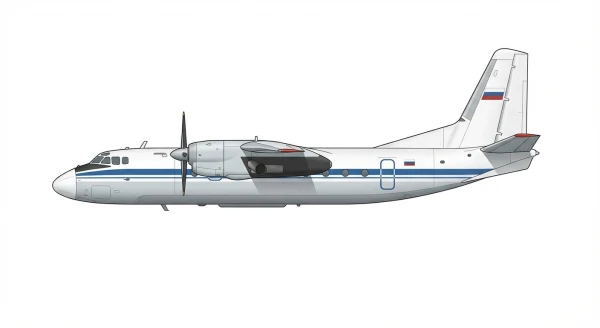
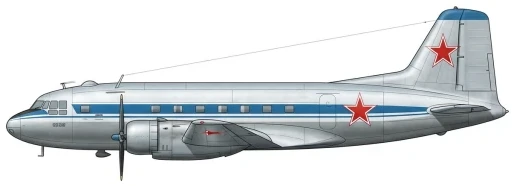
| An-24 Coke | Il-14 Crate | |
|---|---|---|
| Origin country | 🇺🇦 Ukraine | 🇷🇺 Ex-USSR |
| Category | Military Transport Aircraft | Military Transport Aircraft |
| Manufacturer | Antonov | Ilyushin |
| First flight | 20 October 1959 | 1 October 1950 |
| Year introduced | 1962 | 1954 |
| Number produced | 1367 units | 1348 units |
| Average unit price | $8 million | $1.5 million |
| Wing area | 75.0 m² | 100.0 m² |
| Wingspan | 29.2 m | 31.7 m |
| Height | 8.3 m | 7.9 m |
| Length | 23.5 m | 22.3 m |
| Maximum speed | 485 km/h | 430 km/h |
| Operational range | 2,400 km | 1,300 km |
| Service ceiling | 8,400 m | 7,400 m |
| Max. takeoff weight | -- kg | 18,000 kg |
| Empty weight | 13,300 kg | 12,600 kg |
| Total thrust | 2 x 1,876 kW | 2 x 1,397 kW |
Detailed Comparison
The Antonov An-24 and Ilyushin Il-14 represent a direct generational succession in Soviet military transport aviation, with the turboprop-powered An-24 specifically developed to replace the piston-engined Il-14. While both were designed for reliability and operation from austere airfields, the An-24 incorporated key design advancements, most notably its high-wing configuration, which offered superior protection for its engines and propellers on unprepared surfaces compared to the Il-14's conventional low-wing layout. This fundamental difference reflects a shift in operational focus towards more demanding tactical environments.
Development and Design
The Il-14 was an evolutionary design, refining the preceding Il-12 to correct critical deficiencies like poor engine-out performance. It represented the pinnacle of Soviet radial piston-engine transport technology with its two Shvetsov ASh-82T engines. In contrast, the An-24 was a clean-sheet design that embraced the next wave of propulsion technology. Its two Ivchenko-Progress AI-24A turboprops were more powerful, lighter, and more reliable. This technological leap, combined with a rugged airframe optimized for minimal ground support, defined the An-24 as a more capable and modern tactical airlifter from its inception.
Specifications and Performances
The performance disparity is a direct result of the powerplant differences. The An-24's engines produce 1876 kW each, compared to the Il-14's 1397 kW. This translates to a higher service ceiling for the An-24 (8400 m vs. 7400 m), providing greater operational flexibility in mountainous terrain or adverse weather. While the An-24's maximum speed is not specified in the provided data, it significantly surpassed the Il-14's 430 km/h, offering faster troop and cargo delivery. The Il-14's payload and range were adequate for its era, but the An-24 offered tangible improvements in efficiency and overall performance, rendering the Il-14 obsolete for frontline duties.
Deployment and usage
Both aircraft were prolific, with similar production numbers of over 1,300 units each, and formed the backbone of transport fleets across the Warsaw Pact and allied nations. The Il-14 served extensively through the 1950s and 1960s in roles from cargo hauling (Il-14G) to paratroop transport (Il-14T). The An-24 assumed these duties from the 1960s onward, proving to have far greater longevity. The development of the An-24T variant, featuring a ventral loading hatch and cargo winch, was a significant enhancement for military logistics, streamlining the loading of bulky cargo and airdrop operations in a way the side-door-only Il-14 could not match. Both platforms were adapted for specialized roles, including electronic warfare and reconnaissance.
Conclusion
The Il-14 was a robust and dependable aircraft that successfully concluded the era of piston-powered military transports for the Soviet Union. However, the An-24 was a clear and necessary successor. Its adoption of more efficient turboprop engines and a purpose-built, high-wing airframe provided a marked increase in performance and tactical suitability. For military operators, the An-24 delivered greater speed, altitude capability, and rough-field performance, making it a more versatile and enduring asset that defined Soviet-bloc tactical airlift for decades.