An-24 Coke
Soviet regional turboprop, noteworthy for widespread civilian and military usage during the Cold War era. Key figures: top speed 485 km/h, range 2,400 km, service ceiling 8,400 m, unit price $8M, built 1,367. In service with 6 air forces as of 2026 — Russia (24), Ukraine (22), Kazakhstan (6) and 3 others.
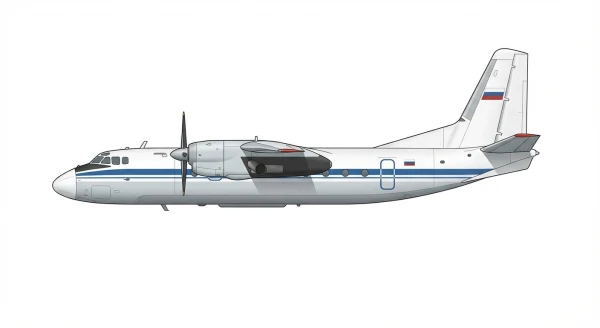
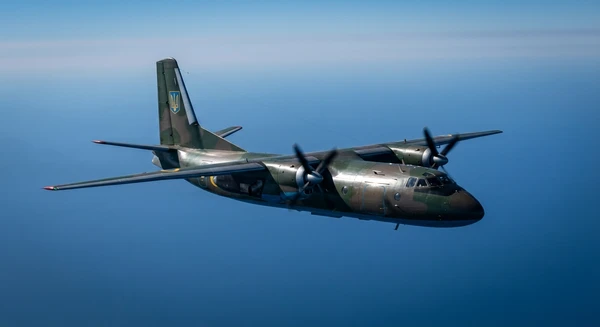
| Length | 23.5 m (77.2 ft) |
| Wingspan | 29.2 m (95.8 ft) |
| Height | 8.3 m (27.3 ft) |
| Wing area | 75.0 m² (807.0 sqft) |
| Empty weight | 13,300 kg (29,321 lbs) |
| Powerplant | 2 × turboprops Ivchenko-Progress AI-24A 1,876 kW each |
| Maximum speed | 485 km/h (301 mph) |
| Operational range | 2,400 km (1,491 mi) |
| Service ceiling | 8,400 m (27,559 ft) |


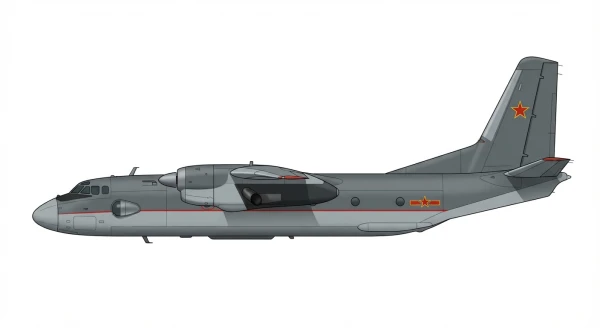
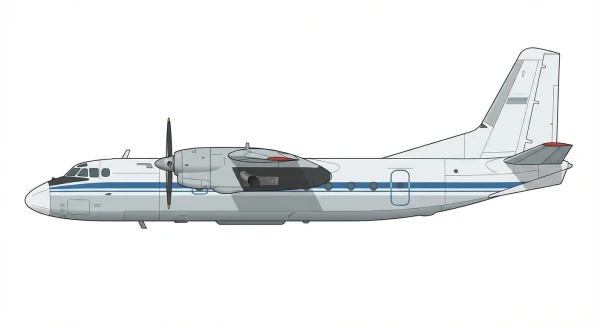
Description
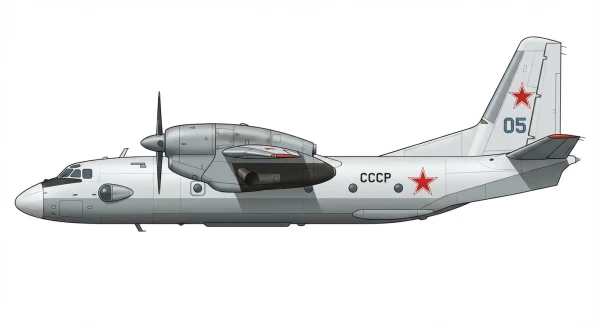
Designed in 1957 by the Antonov Design Bureau in the Soviet Union, the An-24 was a 44-seat twin turboprop transport/passenger aircraft intended to replace the Ilyushin Il-14 on short to medium haul routes. Optimized for operations from rough strips and unprepared airports in remote areas, the An-24's high-wing layout was chosen to protect the engines and blades from debris. Its rugged design required minimal ground support equipment, while the aircraft's high power-to-weight ratio offered enhanced performance. First flown in 1959, the An-24 was manufactured by the Kyiv, Irkutsk and Ulan-Ude Aviation Factories, with production ceasing in the USSR by 1978. The Kyiv-Svyatoshino plant (later renamed "Aviant") constructed 985 examples, Ulan Ude built 180, and Irkutsk produced 197 An-24T tactical transport/freighters. Total production amounted to approximately 1,000 units.
Design
The An-24 was conceived to replace the Ilyushin Il-14 on short to medium haul routes, specifically optimized for operation from rough airstrips and unprepared airports in remote locations; the high-wing layout protects the engines and blades from debris. Its rugged airframe allowed for adaptation to secondary roles such as ice reconnaissance and as an engine/propeller testbed, while further development led to the An-26 tactical transport, An-30 photo-mapping/survey aircraft and An-32 tactical transport featuring more powerful engines. Several variants of the An-24 exist, each with specific modifications for different roles, such as the An-24T tactical transport equipped with a ventral loading hatch, cargo winch, and escape hatch, or the An-24RT, similar to the An-24T but fitted with an auxiliary turbojet engine. Special mission aircraft included the An-24LR 'Toros' for ice reconnaissance, equipped with SLAR (sideways looking airborne radar) and the An-24RR for Nuclear, biological and chemical warfare reconnaissance versions, carrying air sampling pods and a sensor pod. Search and rescue (SAR) modifications (An-24PRT) included rescue equipment and exploration devices.
Armament
The An-24 was not designed as a combat aircraft and is not typically armed. Certain specialized military variants, such as the An-24T tactical transport, featured a ventral loading hatch and cargo winch for transporting troops and supplies, but were not equipped with offensive weaponry. Reconnaissance or surveillance roles (An-24RR) involved modifications with radar and sensor pods but did not include adding offensive weapons capabilities.
Operational History
The An-24 has seen widespread use across various theaters, primarily within the Soviet Union and among its satellite states, as well as in Africa. As a rugged and reliable aircraft, it was well-suited for operations from rough strips and unprepared airports in remote locations. The An-24 also served in military roles, including tactical transport, with specialized variants developed for search and rescue, ice reconnaissance, and airborne command post duties. Its operational strengths included a high power-to-weight ratio, a design that protected engines from debris, and minimal ground support requirements. The aircraft was eventually proposed for accelerated decommissioning following fatal incidents, leading to a ban on scheduled flights inside Russia, although it continues to see limited commercial service. Beyond its initial Soviet operators, the An-24 was adopted by numerous air forces globally, including those of Cambodia, North Korea, Syria, and Ukraine.
Variants
Main Variants:
-
An-24: The initial production model, separate from the prototypes, entering service in 1962 and later exported to Cuba for use as military transports.
-
An-24A: An improved version seating 44 passengers with a larger interior volume and the APU exhaust moved to the tip of the starboard nacelle, with 200 aircraft built.
-
An-24B: The second production version with seating for up to 52 passengers, an increased maximum takeoff weight, additional windows, and modifications to the flaps, with 400 aircraft built.
-
An-24T (Transportnyy – transport): A tactical transport aircraft equipped with a ventral loading hatch, cargo winch, and escape hatch for transporting airborne troops and infantry.
-
An-24V: An export version of the An-24B, equipped with an AI-24T turboprop engine, available in early and late models, with variations in wing design, flaps, and interior configuration for cargo or passenger transport.
Frequently Asked Questions
What type of aircraft is the An-24 Coke?
What is the maximum speed of the An-24 Coke?
What is the range of the An-24 Coke?
When did the An-24 Coke first fly?
How many An-24 Coke have been built?
Which countries operate the An-24 Coke?
How much does a An-24 Coke cost?
What is the service ceiling of the An-24 Coke?
- APR 72026 Updated Sources and cross-references refreshed
- FEB 72026 Updated Top speed added
- JAN 122026 Updated Range updated in a site-wide editorial pass