Il-14 Crate
Soviet twin-engine transport aircraft, used extensively by Eastern Bloc nations and China during the Cold War era. Key figures: top speed 430 km/h, range 1,300 km, service ceiling 7,400 m, max takeoff weight 18,000 kg, unit price $1.5M, built 1,348.
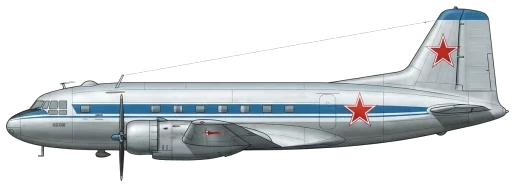
| Crew | 4 |
| Length | 22.3 m (73.2 ft) |
| Wingspan | 31.7 m (104.0 ft) |
| Height | 7.9 m (25.9 ft) |
| Wing area | 100 m² (1076.4 sqft) |
| Empty weight | 12,600 kg (27,778 lbs) |
| Max. takeoff weight | 18,000 kg (39,683 lbs) |
| Powerplant | 2 × radial engine Shvetsov ASh-82T 1,397 kW each |
| Maximum speed | 430 km/h (267 mph) |
| Operational range | 1,300 km (808 mi) |
| Service ceiling | 7,400 m (24,278 ft) |
| Climb rate | 5.0 m/s (16.4 ft/s) |
Description
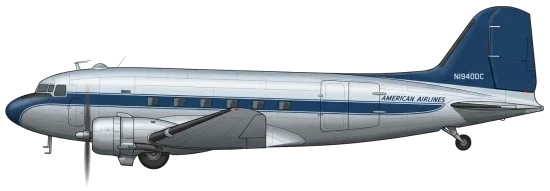
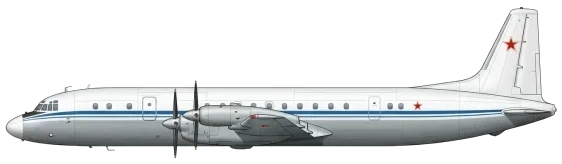
The Ilyushin Il-14 was developed as a successor to the Douglas DC-3 and its Soviet equivalent, the Lisunov Li-2. Evolving from the earlier Ilyushin Il-12, which first flew in 1945 and faced significant limitations including poor engine-out handling and a reduced payload capacity carrying only 18 passengers compared to the planned 32, the Il-14 was designed to overcome these deficiencies. Key design enhancements included a redesigned wing and a broader tailfin, powered by two 1,400 kW (1,900 hp) Shvetsov ASh-82T-7 radial piston engines. These modifications substantially improved aerodynamic performance, particularly in single-engine operation, contributing to its ruggedness and reliability and enabling operation from airfields with limited infrastructure. Production of the Il-14 totaled 1,345 aircraft, with 1065 built in Moscow and Tashkent between 1954 and 1958. Additionally, 80 were manufactured under license in East Germany by VEB Flugzeugwerke Dresden from 1956 to 1959, and 203 were produced in Czechoslovakia by Avia in Prague from 1956 to 1960. The East German aircraft industry utilized the Il-14 as a test platform for the horizontal stabilizer of the Baade 152.
Operational History
While primarily designed as a transport aircraft, certain variants were adapted for military roles. The Il-14T served as a military transport configured for cargo or paratroopers. The Il-14TB was employed as a glider tug. The Il-14TD variant specifically supported paratroop and assault transport duties. An electronic warfare version was developed, designated Crate-C by NATO. The Il-14TS was equipped for medevac missions.
The Il-14 saw extensive military service across numerous nations, primarily within the Soviet sphere of influence. The Soviet Air Force and Naval Aviation operated a substantial fleet, utilizing it for personnel and cargo transport. Its robust design led to widespread adoption by air forces in Afghanistan, Albania, Algeria, Bulgaria, Cambodia, China, Republic of the Congo, Cuba, Czechoslovakia, East Germany, Egypt, Ethiopia, Guinea-Bissau, Hungary, India, Indonesia, Iraq, Khmer Republic, Mali, Mongolia, North Korea, North Yemen, Poland, Romania, South Yemen, Syria, Vietnam, Yemen, and Yugoslavia. While many nations phased out the Il-14 by the late 20th century, some air forces continued to operate them into the 1990s. Some nations employed the Il-14 in VIP transport roles.
Variants
Main Variants:
-
Il-14: This was the basic twin-engine passenger and cargo transport aircraft.
-
Il-14FK/14FKM: Specialized as an aerial photography platform, these variants were equipped with necessary equipment for aerial survey missions.
-
Il-14G: This was the dedicated freight or cargo carrying version, optimized for transporting goods rather than passengers.
-
Il-14M: A stretched version of the Il-14P, it featured a longer fuselage to accommodate between 14 and 36 seats, increasing passenger capacity.
-
Il-14T: This was the military transport version, designed for troop transport and logistical support.
Frequently Asked Questions
What type of aircraft is the Il-14 Crate?
What is the maximum speed of the Il-14 Crate?
What is the range of the Il-14 Crate?
When did the Il-14 Crate first fly?
How many Il-14 Crate have been built?
Which countries operate the Il-14 Crate?
How much does a Il-14 Crate cost?
What is the service ceiling of the Il-14 Crate?
- AUG 52026 Updated Climb rate added
- APR 72026 Updated Sources and cross-references refreshed