SA330 Puma vs UH-1 Iroquois "Huey"
SA330 Puma vs UH-1 Iroquois "Huey" at a glance — top speed 257 vs 222 km/h, range 580 vs 510 km, max takeoff weight 7,000 vs 4,309 kg, built 697 vs 16,000 units.
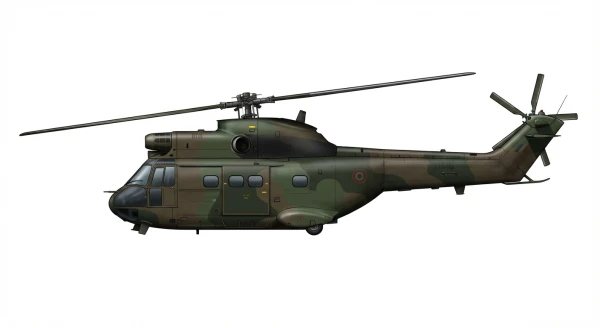
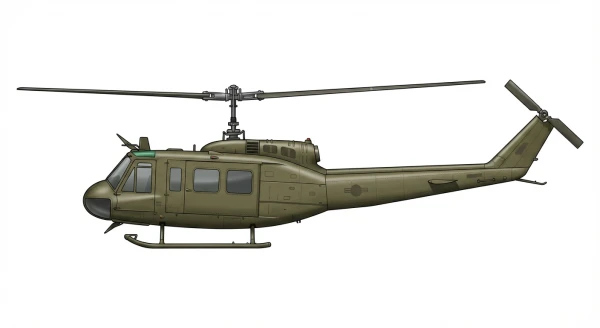
| SA330 Puma | UH-1 Iroquois "Huey" | |
|---|---|---|
| Origin country | 🇫🇷 France | 🇺🇸 United States |
| Category | Military Helicopters | Military Helicopters |
| Manufacturer | Aérospatiale | Bell |
| First flight | 15 April 1965 | 22 October 1956 |
| Year introduced | 1968 | 1959 |
| Number produced | 697 units | 16000 units |
| Average unit price | $2 million | $1.3 million |
| Wingspan | 15.0 m | 14.6 m |
| Height | 5.1 m | 4.5 m |
| Length | 18.2 m | 12.7 m |
| Maximum speed | 257 km/h | 222 km/h |
| Operational range | 580 km | 510 km |
| Service ceiling | 4,800 m | 5,910 m |
| Max. takeoff weight | 7,000 kg | 4,309 kg |
| Empty weight | 3,536 kg | 2,087 kg |
| Total thrust | 2 x 1,175 kW | 1 x 820 kW |
Detailed Comparison
The Aérospatiale SA330 Puma and Bell UH-1 Iroquois "Huey" emerged during the Cold War to address the rising demand for rotorcraft in modern maneuver warfare. While the American UH-1 defined the concept of air mobility through mass production and light utility, the French SA330 was designed as a larger, dedicated medium transport platform emphasizing all-weather capabilities and heavier lift capacities.
Development and Design
Developed in the late 1960s, the SA330 Puma prioritized twin-engine safety and all-weather operation to meet French Army requirements for a logistics vehicle capable of carrying up to 20 soldiers. Its design features redundant hydraulic systems and a transmission engineered for vibration reduction, reflecting a philosophy focused on survivability and technical sophistication.
Conversely, the UH-1, introduced in the late 1950s, pioneered the use of turbine engines in U.S. service. Its design philosophy centered on simplicity, modularity, and ease of maintenance, utilizing a single Lycoming T53 turboshaft (in most variants) and a semi-monocoque metal fuselage. While the Huey became the global standard for general utility helicopters, the Puma’s architecture laid the groundwork for the heavier, more complex Super Puma family.
Specifications and Performance
The performance metrics highlight the classification difference between the two platforms. The Puma is a significantly heavier aircraft, with a Maximum Takeoff Weight (MTOW) of 7,000 kg compared to the UH-1's 4,309 kg. Powered by two Turbomeca Turmo IVC engines generating a total of 2,350 kW, the Puma achieves a higher maximum speed of 257 km/h, surpassing the Huey's 222 km/h.
- Payload: The Puma offers superior lift capability, transporting up to 16 soldiers or 2,500 kg of external cargo. The standard UH-1D/H is limited to approximately 12 troops or lighter external loads.
- Altitude: Notably, the lighter UH-1 demonstrates a superior service ceiling of 5,910 m versus the Puma's 4,800 m, providing distinct advantages in high-altitude environments despite its lower power output.
Deployment and usage
The UH-1 defined U.S. air cavalry tactics during the Vietnam War, flying roughly 7 million sorties. Its roles ranged from troop transport and medevac to dedicated gunship configurations (UH-1B/C/M) armed with rockets and miniguns. It became the backbone of forward operating units due to its ability to land in restricted zones.
The Puma found its niche in medium tactical transport, combat search-and-rescue (CSAR), and special forces extraction. It was utilized extensively by France and the UK in theaters such as the Falklands, Iraq, and the Balkans. While the Huey often served as a frontline assault asset, the Puma frequently operated as a logistical enabler, capable of operating in adverse weather where the Huey might be grounded. Both platforms achieved massive export success, with the Huey seeing service in over 60 nations and the Puma establishing a lineage of licensed production in Romania and South Africa.
Conclusion
The UH-1 Iroquois represents the successful implementation of widespread vertical lift, favoring cost-effective mass production and versatility for light utility roles. The SA330 Puma serves as a more specialized, heavier asset, offering greater range, speed, and payload for complex logistical demands. While the Huey remains the archetype of the utility helicopter, the Puma's twin-engine configuration and robust airframe offered a necessary evolution for modern survivability standards and heavier lift requirements.