Victor vs Vulcan
Victor vs Vulcan at a glance — top speed 1,009 vs 1,039 km/h, range 9,662 vs 4,195 km, max takeoff weight 92,986 vs 77,111 kg, built 86 vs 134 units.
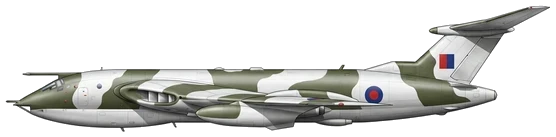
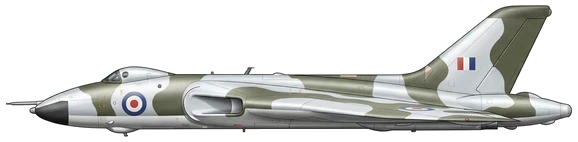
| Victor | Vulcan | |
|---|---|---|
| Origin country | 🇬🇧 United Kingdom | 🇬🇧 United Kingdom |
| Category | Bombers | Bombers |
| Manufacturer | Handley Page | Avro |
| First flight | 24 December 1952 | 30 August 1952 |
| Year introduced | 1958 | 1956 |
| Number produced | 86 units | 134 units |
| Average unit price | -- | -- |
| Wing area | 223.5 m² | 330.2 m² |
| Wingspan | 34.0 m | 30.3 m |
| Height | 8.6 m | 8.1 m |
| Length | 35.0 m | 29.6 m |
| Maximum speed | 1009 km/h | 1039 km/h |
| Operational range | 9,662 km | 4,195 km |
| Service ceiling | 17,000 m | 17,000 m |
| Max. takeoff weight | 92,986 kg | 77,111 kg |
| Empty weight | 40,383 kg | 37,908 kg |
| Total thrust | 4 x 49 kN | 4 x 49 kN |
Detailed Comparison
Procured simultaneously to satisfy Air Ministry Specification B.35/46, the Handley Page Victor and Avro Vulcan formed the core of the Royal Air Force’s V-bomber deterrent during the early Cold War. Both were designed to carry a 10,000 lb nuclear payload to targets 1,500 nautical miles away at Mach 0.8, but their engineering paths diverged sharply, dictating their ultimate utility when Soviet air defenses forced them to low altitudes.
Development and Design
Avro selected a tailless delta wing to maximize internal volume and minimize drag, iterating through scale models before finalizing the design. Handley Page opted for a crescent wing—swept sharply at the root and decreasing toward the tips—to maintain a constant critical Mach number across the span. Both utilized four buried turbojets. A highly criticized design flaw in both airframes was the crew escape system: only the pilot and co-pilot received Martin-Baker ejection seats. The rear crew members (navigator radar, navigator plotter, air electronics officer) had to bail out manually, causing disproportionate fatalities during emergencies.
Specifications and Performances
The Victor was a heavier lifting platform. With a maximum takeoff weight of 92,986 kg compared to the Vulcan’s 77,111 kg, it carried more conventional ordnance:
- The Victor carried up to forty-eight 1,000 lb bombs, or singular weapons like the 22,000 lb Grand Slam.
- The Vulcan was restricted to twenty-one 1,000 lb conventional bombs in its bay.
Early B.1 Victors powered by Armstrong Siddeley Sapphires achieved marginally higher high-altitude cruise speeds than Olympus-powered Vulcans. However, the Vulcan's 330.2 m² delta wing resulted in lower wing loading, providing a 17,000-meter service ceiling and tighter turn radii. The Victor possessed double the base range (9,662 km against the Vulcan's 4,195 km), a metric that drove its later conversion to aerial refueling.
Deployment and usage
Both entered service in the late 1950s for high-altitude nuclear strike on Quick Reaction Alert (QRA). After Soviet SA-2 missiles downed Gary Powers' U-2 in 1960, the RAF shifted V-bombers to low-level penetration. The Victor’s crescent wing could not withstand the aerodynamic stresses of low-level flight; fatigue cracks grounded the bomber fleet by 1968. Handley Page subsequently converted them into strategic tankers (K.2). The Vulcan’s delta wing absorbed low-altitude turbulence without severe airframe degradation, keeping it in the strike role until 1984. During the 1982 Falklands War, Victor K.2 tankers refueled Vulcan bombers flying 3,889-mile missions from Ascension Island to strike Port Stanley.
Conclusion
The Vulcan holds the edge as a strike platform. Its structural resilience allowed it to survive the doctrinal shift to low-level penetration, maintaining the UK's conventional and nuclear strike capability into the 1980s while integrating anti-radiation weapons like the AGM-45 Shrike in combat. Conversely, for sheer lift and strategic support, the Victor is the superior aircraft. Its heavy payload capacity and massive fuel fraction made it a highly effective tanker, sustaining RAF expeditionary operations through the 1991 Gulf War, seven years after the Vulcan's retirement.