AMX-10 RC vs KMW Fennek
AMX-10 RC vs KMW Fennek at a glance — weight 17,200 vs 10,400 kg, top speed 85 vs 115 km/h, range 800 vs 860 km, crew 4 vs 3.
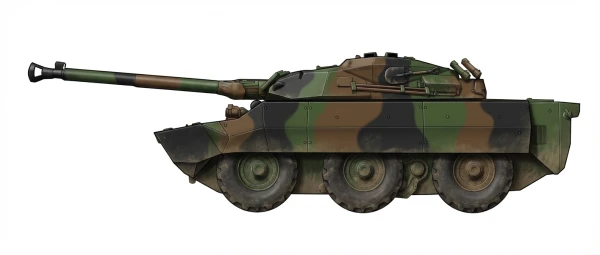
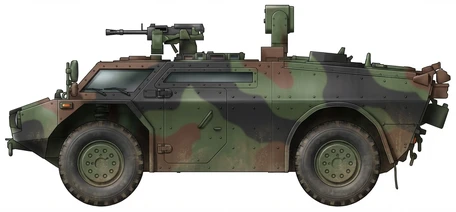
| AMX-10 RC | KMW Fennek | |
|---|---|---|
| Origin country | 🇫🇷 France | 🇩🇪 Germany |
| Category | Light Armoured Vehicle | Light Armoured Vehicle |
| Type | Reconnaissance Armored Vehicle | Scout car |
| Manufacturer | GIAT Industries | Krauss-Maffei Wegmann |
| Number produced | 464 units | 632 units |
| Estimated unit price | $-- million | $0.8 million |
| Combat weight | 17.2 tons | 10.4 tons |
| Maximum speed | 85 km/h | 115 km/h |
| Operational range | 800 km | 860 km |
| Length | 9.15 m | 5.58 m |
| Width | 2.78 m | 2.55 m |
| Height | 2.56 m | 2.29 m |
| Crew | 4 | 3 |
| AMX-10 RC | KMW Fennek | |
|---|---|---|
| Main armament | 105 mm F2 BK MECA L/47 medium-pressure gun | HK GMG 40 mm grenade autocannon |
| Secondary weapon | 1 × 7.62 mm NF1 coaxial machine gun | Rheinmetall MG3 |
| Engine | Baudouin Diesel Model 6F11 SRX (current) | Deutz diesel 179 kW (239 hp) |
Detailed Comparison
The French AMX-10 RC and the German-Dutch Fennek serve the reconnaissance spectrum but occupy opposite ends of the doctrinal scale. While the AMX-10 RC prioritizes aggressive armed reconnaissance and direct fire support through a heavy 105mm cannon, the Fennek focuses on stealth, advanced optics, and low observability to gather intelligence without engagement.
Development and Design
Developed by GIAT Industries in the 1970s, the AMX-10 RC is a six-wheeled vehicle utilizing skid steering and hydropneumatic suspension, allowing variable ground clearance and hull tilt. Its design shares automotive lineage with the AMX-10P IFV but emphasizes heavy armament within a three-man turret. Conversely, the Fennek, entering service in 2003, was designed by KNDS and Dutch Defence Vehicle Systems as a dedicated scout platform. Its defining feature is a retractable 1.5-meter sensor mast housing thermal and daylight cameras, enabling hull-down surveillance. Uniquely, the Fennek's sensor head can be detached for dismounted operations, a flexibility absent in the older French platform.
Protection and Firepower
The disparity in firepower is acute. The AMX-10 RC mounts a 105 mm F2 BK MECA medium-pressure gun, capable of defeating fortifications and older tanks. However, its gun is unstabilized, severely limiting accuracy while moving. The Fennek relies on self-defense weaponry, typically a 40mm HK GMG or machine gun, although specialized variants carry Spike missiles or Stinger systems. Regarding protection, the AMX-10 RC utilizes aluminum armor enhanced by steel add-ons in the RCR standard to resist light autocannon fire. The Fennek offers baseline protection against 7.62mm rounds and anti-personnel mines, relying primarily on low silhouette and speed for survivability rather than armor mass.
Mobility and Logistics
The lighter Fennek (10.4 tons) offers superior operational mobility, achieving 115 km/h with a range of 860 km. Its central tire pressure system allows the driver to adapt to terrain instantly. The 17.2-ton AMX-10 RC is slower (85 km/h) and mechanically more complex; its skid-steering mechanism places significant stress on the gearbox and tire wear during prolonged road movements. While the AMX-10 RC was originally amphibious, this capability has largely been removed, whereas the Fennek was never designed for amphibious operations.
Deployment and Combat Record
The AMX-10 RC has an extensive combat history, from the 1991 Gulf War to counter-insurgency in Mali and conventional warfare in Ukraine. In Ukraine (2023), its thin armor and unstabilized gun proved problematic in high-intensity frontal assaults, leaving it vulnerable to artillery. The Fennek saw service with ISAF in Afghanistan and recently in Ukraine. Combat reports highlight its vulnerability to IEDs and RPGs, though internal spall liners have successfully mitigated crew casualties during penetrations.
Conclusion
The AMX-10 RC remains a potent "shoot-and-scoot" fire support vehicle, valuable for flanking maneuvers and rapid response where heavy firepower is required. The Fennek represents the modern shift toward C4ISTAR assets, excelling in stealthy observation and data relay rather than direct engagement. The AMX-10 RC fights to gain information; the Fennek avoids the fight to secure it.