KMW Fennek vs JLTV
KMW Fennek vs JLTV at a glance — weight 10,400 vs 10,200 kg, top speed 115 vs 110 km/h, range 860 vs 480 km, crew 3 vs —.
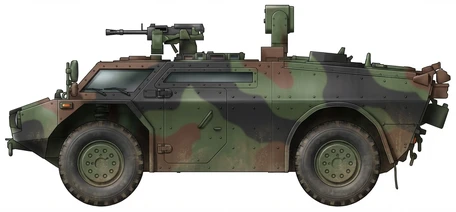
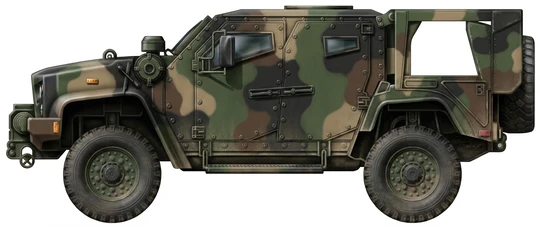
| KMW Fennek | JLTV | |
|---|---|---|
| Origin country | 🇩🇪 Germany | 🇺🇸 United States |
| Category | Light Armoured Vehicle | Protected Mobility Vehicle |
| Type | Scout car | Light utility/combat multi-role vehicle |
| Manufacturer | Krauss-Maffei Wegmann | AM General |
| Number produced | 632 units | 20,000 units |
| Estimated unit price | $0.8 million | $0.4 million |
| Combat weight | 10.4 tons | 10.2 tons |
| Maximum speed | 115 km/h | 110 km/h |
| Operational range | 860 km | 480 km |
| Length | 5.58 m | 6.20 m |
| Width | 2.55 m | 2.50 m |
| Height | 2.29 m | 2.60 m |
| Crew | 3 | 1 + 3 in individual seats + optional gunner |
| KMW Fennek | JLTV | |
|---|---|---|
| Main armament | HK GMG 40 mm grenade autocannon | M2 Browning .50 Caliber heavy machine gun |
| Secondary weapon | Rheinmetall MG3 | M153 CROWS II remote weapon system |
| Engine | Deutz diesel 179 kW (239 hp) | 6.6 L Gale Banks Engineering 866T V8 (based on General Motors Duramax L5P) |
Detailed Comparison
The Joint Light Tactical Vehicle (JLTV) constitutes a high-volume, multi-role utility platform designed to replace the HMMWV with Mine Resistant Ambush Protected (MRAP) survivability standards. In contrast, the Fennek is a specialized, low-volume reconnaissance vehicle engineered specifically for stealthy observation and intelligence gathering. While both vehicles operate in the 10-ton weight class, their distinct design objectives reflect the difference between a mass-produced general-purpose combat transport and a dedicated scout system.
Development and Design
Originating from a 2006 requirement to counter Improvised Explosive Devices (IEDs) in Iraq, the JLTV integrates a blast-resistant hull with the mobility of a light truck. It employs a modular armor configuration (A-kit/B-kit) and the CORE 1080 crew protection system, featuring energy-absorbing seating and flooring. The Fennek, designed in the late 1990s by KNDS and Dutch Defence Vehicle Systems, prioritizes a low visual and thermal signature. Its defining feature is a retractable mast extending 1.5 meters above the roof, housing a thermal imager, daylight camera, and laser rangefinder. This sensor head can be dismounted for concealed operation, a capability not inherent to the standard JLTV design.
Protection and Firepower
The JLTV prioritizes crew survival against underbody blasts. Its modular nature allows for scalable protection levels depending on the threat environment. Armament is versatile, supporting the M153 CROWS II, .50 caliber machine guns, or the M41A7 Saber TOW missile system. The Fennek provides all-round protection against 7.62mm rounds and anti-personnel mines, with NBC filtration standard for the crew of three. Although primarily an observation platform, it mounts defensive weaponry such as the HK GMG 40mm autocannon or Rheinmetall MG3. Specialized variants, such as the Dutch MRAT, carry Spike anti-tank missiles, while the German SWP variant mounts Stinger missiles for air defense.
Mobility and Logistics
Powered by a 6.6 L V8 diesel, the JLTV utilizes TAK-4i independent suspension with adjustable ride height, achieving 110 km/h. It is transportable as an underslung load by CH-47 and CH-53E helicopters. The vehicle has a comparatively short operational range of 480 km. The Fennek, powered by a Deutz diesel engine, matches the JLTV's speed at 115 km/h but offers a significantly superior operational range of 860 km, essential for deep reconnaissance patrols. The Fennek's selectable 4WD and driver-controlled tire pressure regulation are optimized for stealthy cross-country movement rather than the tactical agility required of the JLTV.
Deployment and Combat Record
With 20,000 units built, the JLTV is widely distributed across U.S. branches and export customers like Romania and Lithuania. It has seen active combat with the Israel Defense Forces during the Gaza war. The Fennek, limited to 632 units, has been deployed by Germany and the Netherlands in Afghanistan (ISAF) and by Ukraine against Russian forces. Combat engagements have highlighted the Fennek's vulnerability to heavy anti-armor weapons; however, internal spall liners have proven effective in reducing crew casualties during RPG strikes.
Conclusion
The JLTV is a cost-effective, mass-production solution ($0.399 million) that excels at providing protected mobility and fire support for infantry and logistics units in high-threat environments. The Fennek is a high-cost ($1.68 million), precision instrument designed for passive surveillance. The JLTV dominates in direct combat support and force protection, while the Fennek is superior in stand-off reconnaissance and target acquisition where low observability is paramount.