Burkina Faso Military Forces
Burkina Faso ranks #126 of 170 militaries worldwide in 2026, with 11,200 active troops. The Air Force flies 26 aircraft, including 3 combat aircraft. Landlocked, Burkina Faso has no navy and no nuclear weapons.
Armed Forces in 2026
| Domain | Strength | Composition |
|---|---|---|
| Burkina Faso Air Force | 26 aircraft | 3 combat 19 helicopters +2 on order |
| Personnel | 11,200 active | 5,000 paramilitary |
ATLAS Index (Aggregate Total of Land, Air and Sea strength)
Full ranking →| Pillar | Weight | Score | Basis |
|---|---|---|---|
| Manpower | 10% | 25.9 | Active, reserve & paramilitary personnel |
| Ground forces | 20% | 0.0 | ARMS inventory power: armour & artillery by type and era, attack helicopters, armament |
| Naval power | 20% | 0.0 | SEAS inventory power: hulls by type, size and era, air wing, sustainment, armament |
| Air power | 25% | 16.6 | AIRS inventory power: aircraft by type and generation, enablers, armament |
| Nuclear deterrent | 10% | 0.0 | No declared nuclear capability |
| Defense budget | 15% | 24.0 | Annual spending, purchasing-power adjusted |
| Availability | modifier | ground ×1.11 · naval ×1.00 · air ×1.20 | Budget per point of each force, from the branch indexes |
Country File
| Population | 23.5M (2024) |
| GDP | $23.1 billion (2024) |
| GDP per capita | $982 |
| Military budget | $1B (2024) |
| Share of GDP | 4.5% (2024) |
| Military spending per capita | $44 (2024) |
| Inflation rate | 4.19% (2024) |
| Capital | Ouagadougou |
| Region | Africa |
| Land area | 273,602 km² |
| Land borders | 3,193 km |
| Bordering countries | 6 |
| Currency | XOF |
Strategic Overview in 2026
Strategic Position
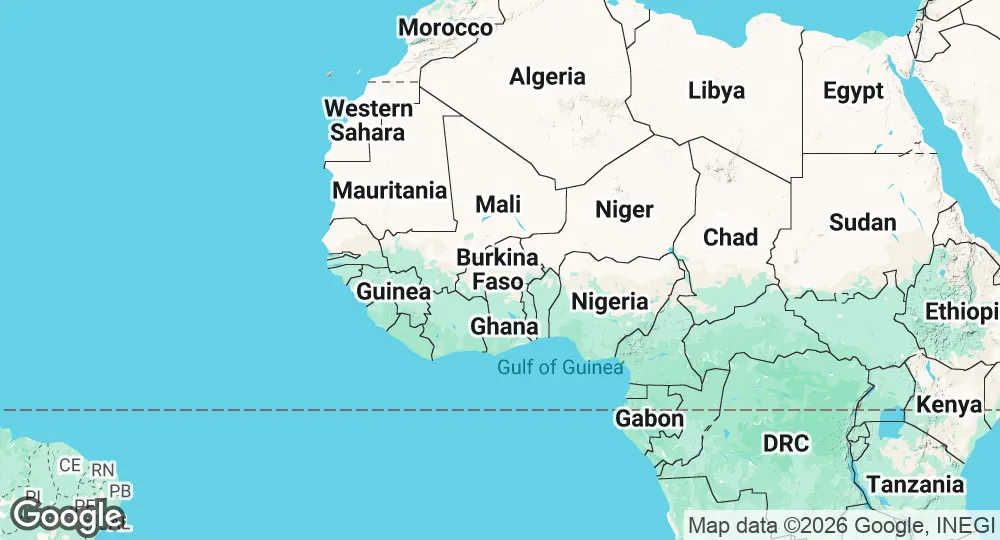
Burkina Faso occupies a landlocked position in the center of the Sahel, where its primary security concern is a sustained jihadist insurgency led by Jama'at Nasr al-Islam wal-Muslimin (JNIM) and Islamic State - Sahel Province (IS-Sahel). Territorial integrity is the central strategic priority, with significant portions of the country contested by non-state armed groups.
The country's geopolitical alignment underwent a fundamental shift in early 2025 following its formal withdrawal from the Economic Community of West African States (ECOWAS). Defense policy is now centered on the Alliance of Sahel States (AES), a mutual defense pact and confederation with Mali and Niger established to coordinate military operations and counter external influence. As part of this shift, Burkina Faso has ended long-standing defense cooperation with France and prioritized bilateral agreements with Russia, Turkey, and China. Under the Liptako-Gourma Charter, the AES members maintain a unified military force (FU-AES), inaugurated in late 2025, with a headquarters in Niamey and a mandate for cross-border counter-insurgency operations.
Military Forces
The Burkina Faso Armed Forces (Forces Armées Nationales - FAN) are organized into the Army (L’Armée de Terre), the Air Force (L’Armée de l'Air), and the National Gendarmerie. Other service components include the National Fire Brigade and the Central Army Group. The current leadership has implemented a decentralized command structure, expanding the number of military regions to enhance responsiveness in rural conflict zones.
Personnel Active military personnel are estimated at approximately 15,000, supported by roughly 5,000 Gendarmerie and 3,000 Air Force personnel. These conventional forces are augmented by a massive auxiliary component known as the Volunteers for the Defense of the Homeland (VDP). Recruitment drives in 2024 and 2025 have aimed to maintain a VDP force exceeding 90,000 individuals to provide localized security and intelligence support.
Army The Army is transitioning from a light infantry force to a more mechanized structure. Its inventory includes Panhard AML-60 and AML-90 armored cars, Eland-90 vehicles, and an increasing number of mine-resistant ambush-protected (MRAP) vehicles, such as the Bastion and the Turkish-made Nurol Makina Ejder Yalçın. Recent procurement from China has introduced the Norinco VN22B wheeled fire support vehicle, CS/VP14 MRAPs, and SR5 multiple rocket launch systems (MLRS) to the inventory. Specialized offensive capabilities are concentrated in the Rapid Intervention Battalions (BIR) and a recently formed Special Rapid Intervention Brigade.
Air Force The Air Force has been reorganized to prioritize unmanned aerial systems (UAS) and light attack capabilities. It operates Embraer EMB-314 Super Tucano aircraft for close air support and Mi-24/35 Hind and Mi-17 Hip helicopters for transport and strike missions. The UAV fleet is the core of current aerial operations, featuring Turkish-made Bayraktar TB2 and the more advanced, long-endurance Bayraktar Akıncı combat drones.
Defense Industry
Burkina Faso maintains a limited but expanding domestic defense sector focused on self-sufficiency in low-intensity conflict. The state-run Cartoucherie de Ouagadougou produces small arms ammunition to reduce reliance on imports. In 2025, the country unveiled its first indigenous light armored vehicle prototype, the LX70, designed for patrol and border security. National firms have also begun the local assembly of specialized logistical equipment, including tanker trucks and anti-mine armored vehicles, to support the war effort.
Strategic Trends
Defense spending is the primary driver of the national budget, with approximately 27% of total government resources allocated to security and defense for the 2025 fiscal year. This effort is supported by the Patriotic Support Fund (FSP), which leverages citizen and corporate contributions to finance the VDP and military procurement.
Modernization efforts are currently focused on three pillars: the massive expansion of the VDP to saturate contested rural areas, the acquisition of advanced UAVs for persistent surveillance and precision strikes, and the procurement of heavy fire support systems from China and Russia. A key constraint remains the logistical challenge of sustaining a rapidly expanded force across vast, insecure terrain while managing the high attrition rates associated with active counter-insurgency operations. Doctrinally, the military is shifting toward an "armed nation" model, where civilian auxiliaries are permanently integrated into the national security architecture.
Military Expenditure: CIA World Factbook. Last updated on 4 August 2026. Suggest a change
Frequently Asked Questions
How large is Burkina Faso's military?
What is Burkina Faso's defense budget?
How does Burkina Faso rank militarily in the world?
Does Burkina Faso have nuclear weapons?
How many aircraft does Burkina Faso's air force have?
What percentage of GDP does Burkina Faso spend on defense?
What is Burkina Faso's military personnel per capita?
Does Burkina Faso have paramilitary forces?
- AUG 42026 Updated Global Military Index updated in a site-wide editorial pass
- AUG 32026 Updated Global Military Index updated
- JUL 162026 Updated Global Military Index updated in a site-wide editorial pass
- JUN 162026 Updated Yearly statistics, military spending and 2 more fields updated
- APR 82026 Updated Paramilitary personnel updated
- MAR 172026 Updated Paramilitary personnel updated
- JAN 132026 Updated Description updated