Bulgaria Military Forces
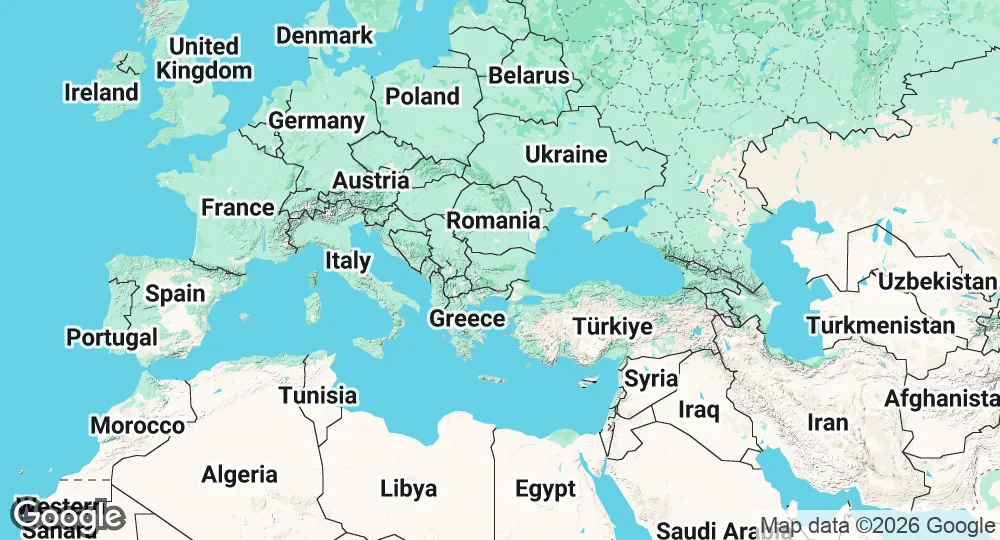
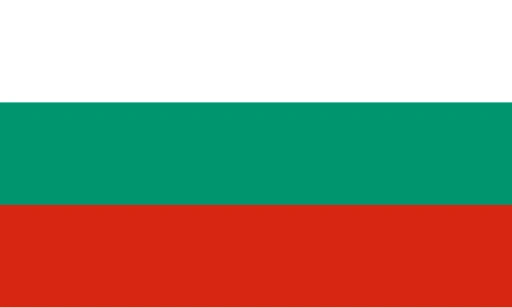
Bulgaria ranks #59 of 170 militaries worldwide in 2026, with 36,950 active troops. The Bulgarian Army fields 501 ground vehicles, including 90 main battle tanks; the Air Force flies 79 aircraft, including 27 combat aircraft; the Navy operates 36 warships. Bulgaria has no nuclear weapons.
Armed Forces in 2026
| Domain | Strength | Composition |
|---|---|---|
| Air Force | 79 aircraft | 27 combat 29 helicopters 8 air bases +8 on order |
| Bulgarian Navy | 36 warships | 5 major combatants |
| Ground Forces | 501 vehicles | 90 main battle tanks |
| Personnel | 36,950 active | 3,000 reserve |
ATLAS Index (Aggregate Total of Land, Air and Sea strength)
Full ranking →| Pillar | Weight | Score | Basis |
|---|---|---|---|
| Manpower | 10% | 33.7 | Active, reserve & paramilitary personnel |
| Ground forces | 20% | 30.0 | ARMS inventory power: armour & artillery by type and era, attack helicopters, armament |
| Naval power | 20% | 29.6 | SEAS inventory power: hulls by type, size and era, air wing, sustainment, armament |
| Air power | 25% | 25.3 | AIRS inventory power: aircraft by type and generation, enablers, armament |
| Nuclear deterrent | 10% | 0.0 | No declared nuclear capability |
| Defense budget | 15% | 27.5 | Annual spending, purchasing-power adjusted |
| Availability | modifier | ground ×1.05 · naval ×1.00 · air ×1.06 | Budget per point of each force, from the branch indexes |
Country File
| Population | 6.4M (2024) |
| GDP | $113.3 billion (2024) |
| GDP per capita | $17,596 |
| Military budget | $2.4B (2025) |
| Share of GDP | 2.1% (2025) |
| Military spending per capita | $370 (2025) |
| Inflation rate | 2.45% (2024) |
| Capital | Sofia |
| Region | Europe |
| Land area | 108,612 km² |
| Coastline | 354 km |
| Land borders | 1,808 km |
| Bordering countries | 5 |
| Currency | BGN |
Strategic Overview in 2026
Strategic Position
Bulgaria's defense posture is defined by its location on the Black Sea and its proximity to the conflict in Ukraine. As a member of NATO since 2004 and the European Union since 2007, the state functions as a component of the Alliance’s Eastern Flank. Primary security concerns center on maritime security in the Black Sea, the stability of the Western Balkans, and the transition away from legacy Soviet-era military hardware.
The national defense doctrine emphasizes collective defense within the NATO framework and participation in Common Security and Defence Policy (CSDP) missions of the EU. Bulgaria hosts a NATO Multinational Battle Group, with Italy serving as the framework nation, and participates in the Three Seas Initiative to improve regional infrastructure and security. Bilateral defense cooperation is most active with the United States, Greece, and Romania. Relations with Turkey are maintained through NATO maritime coordination, while the relationship with Russia has transitioned to a confrontational posture following the 2022 invasion of Ukraine.
Military Forces
The Bulgarian Armed Forces are organized into the Land Forces, Air Force, Navy, and the Joint Special Operations Command. Total active personnel numbers approximately 30,000, supported by a reserve component and the Bulgarian Border Police.
The Land Forces are the largest branch, structured around mechanized brigades. Primary equipment includes T-72 main battle tanks, many of which have undergone recent modernization to improve fire control and communications. Infantry mobility is provided by BMP-1 and MT-LB armored vehicles, alongside BTR-60 personnel carriers. The force is currently integrating Stryker armored fighting vehicles to replace older Soviet platforms.
The Air Force operates a mix of legacy and modern platforms. Current combat aviation consists of MiG-29 fighters and Su-25 close air support aircraft. Transition to Western platforms is underway with the procurement of F-16 Block 70 fighters. Transport capabilities are provided by C-27J Spartan aircraft, while the helicopter fleet includes Mi-17, Mi-24, and Eurocopter Cougar models. Air defense is maintained through S-300 and S-125 systems, though plans exist for their replacement with NATO-interoperable medium-range systems.
The Navy focuses on littoral defense and mine countermeasures in the Black Sea. The fleet includes Wielingen-class frigates acquired from Belgium, Pauk-class corvettes, and Tripartite-class minehunters. The force is currently expanding with the acquisition of new Multipurpose Modular Patrol Vessels (MMPVs) constructed domestically.
The Joint Special Operations Command maintains independent units trained for unconventional warfare, counter-terrorism, and long-range reconnaissance.
Defense Industry
Bulgaria maintains a domestic defense industrial base concentrated on small arms, light weapons, and ammunition. The sector is largely export-oriented, with products frequently supplied to markets in the Middle East, Africa, and more recently, Ukraine.
Major manufacturers include Arsenal AD, which produces assault rifles, machine guns, and mortars based on Kalashnikov and NATO designs. VMZ Sopot is the primary producer of anti-tank missiles, aviation rockets, and artillery ammunition. Terem-Holding, a state-owned entity, provides maintenance, repair, and overhaul (MRO) services for land systems, aircraft, and naval vessels. The domestic industry also produces optical equipment, communications systems, and unmanned aerial vehicles (UAVs). While self-sufficient in small arms and ammunition, Bulgaria remains dependent on imports for high-technology platforms such as multirole fighters and advanced air defense systems.
Strategic Trends
The primary trend in Bulgarian defense is the "re-armament" program aimed at achieving full NATO interoperability. This involves the systematic replacement of Soviet-designed platforms with Western technology. The defense budget for 2025 and 2026 is set to meet or exceed the NATO target of 2% of GDP, with a portion of the 2026 budget specifically allocated for the final installment of F-16 aircraft and the arrival of the first units.
Procurement priorities include the acquisition of 8x8 wheeled armored vehicles, new 155mm self-propelled howitzers, and 3D radar systems for the Air Force. The Navy is focused on the delivery of two new patrol vessels, with the first expected to reach operational status in 2025.
Constraints facing the military include a persistent personnel deficit, with recruitment and retention lagging behind authorized force levels. This is compounded by an aging demographic and competition from the private sector. Doctrinally, there is a shift toward "permanent presence" strategies, including the expansion of military infrastructure to support larger NATO deployments and the development of cyber defense capabilities to counter hybrid threats and disinformation.
Military Expenditure: CIA World Factbook. Last updated on 4 August 2026. Suggest a change
Bulgarian Defense Manufacturing
Designed in BulgariaFrequently Asked Questions
How large is Bulgaria's military?
What is Bulgaria's defense budget?
How does Bulgaria rank militarily in the world?
Does Bulgaria have nuclear weapons?
How many aircraft does Bulgaria's air force have?
How large is Bulgaria's navy?
How many tanks does Bulgaria have?
What percentage of GDP does Bulgaria spend on defense?
What is Bulgaria's military personnel per capita?
- AUG 42026 Updated Global Military Index updated in a site-wide editorial pass
- AUG 32026 Updated Global Military Index updated
- JUL 242026 Updated Global Military Index updated
- JUL 162026 Updated Global Military Index updated in a site-wide editorial pass
- JUN 162026 Updated Yearly statistics, military spending and 2 more fields updated
- JAN 212026 Updated Rank insignia updated (51 entries)
- JAN 172026 Updated Main battle tank count and Global Military Index updated