Ethiopia Military Forces
Ethiopia ranks #68 of 170 militaries worldwide in 2026, with 503,000 active troops. The Ethiopian Army fields 4,753 ground vehicles, including 338 main battle tanks; the Air Force flies 99 aircraft, including 34 combat aircraft. Landlocked, Ethiopia has no navy and no nuclear weapons.
Armed Forces in 2026
| Domain | Strength | Composition |
|---|---|---|
| Air Force | 99 aircraft | 34 combat 31 helicopters 1 air bases |
| Ground Forces | 4,753 vehicles | 338 main battle tanks |
| Personnel | 503,000 active |
ATLAS Index (Aggregate Total of Land, Air and Sea strength)
Full ranking →| Pillar | Weight | Score | Basis |
|---|---|---|---|
| Manpower | 10% | 60.5 | Active, reserve & paramilitary personnel |
| Ground forces | 20% | 39.0 | ARMS inventory power: armour & artillery by type and era, attack helicopters, armament |
| Naval power | 20% | 0.0 | SEAS inventory power: hulls by type, size and era, air wing, sustainment, armament |
| Air power | 25% | 24.0 | AIRS inventory power: aircraft by type and generation, enablers, armament |
| Nuclear deterrent | 10% | 0.0 | No declared nuclear capability |
| Defense budget | 15% | 23.8 | Annual spending, purchasing-power adjusted |
| Availability | modifier | ground ×0.84 · naval ×1.00 · air ×1.00 | Budget per point of each force, from the branch indexes |
Country File
| Population | 132.1M (2024) |
| GDP | $149.7 billion (2024) |
| GDP per capita | $1,134 |
| Military budget | $1B (2024) |
| Share of GDP | 0.7% (2024) |
| Military spending per capita | $8 (2024) |
| Inflation rate | 21.04% (2024) |
| Capital | Addis Ababa |
| Region | Africa |
| Land area | 1,096,630 km² |
| Land borders | 5,328 km |
| Bordering countries | 6 |
| Currency | ETB |
Strategic Overview in 2026
Strategic Position
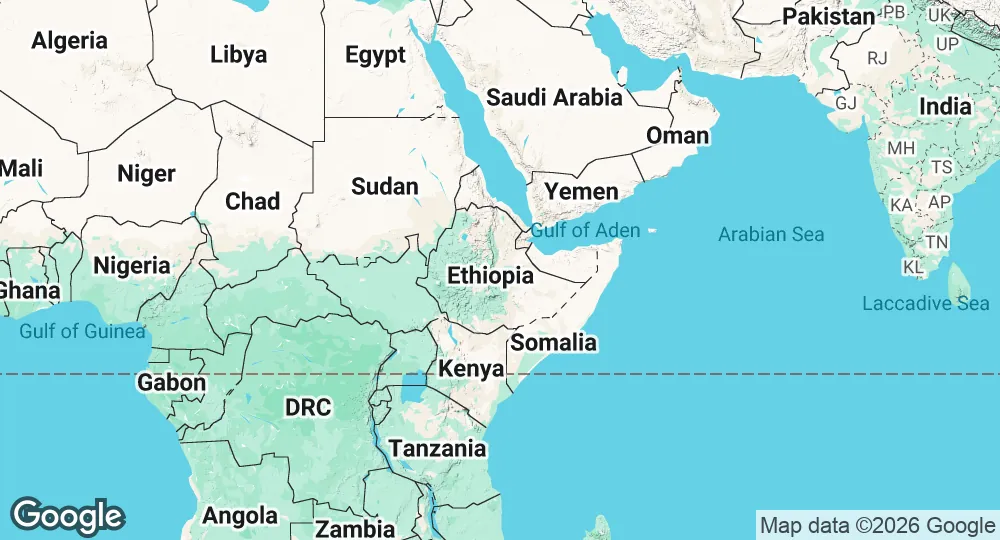
Ethiopia occupies a central position in the Horn of Africa, a region defined by internal insurgencies, border disputes, and competition for maritime access. The country’s primary security concerns include the management of the Grand Ethiopian Renaissance Dam (GERD) on the Blue Nile, which has led to protracted diplomatic friction with downstream states Egypt and Sudan. Internal security remains a priority, with the Ethiopian National Defense Force (ENDF) engaged in counter-insurgency operations against the Oromo Liberation Army (OLA) and Fano militias in the Amhara region.
In 2025, Ethiopia’s defense posture shifted toward securing sovereign access to the Red Sea. A Memorandum of Understanding (MOU) signed with Somaliland provides for a naval base and commercial port access in exchange for diplomatic recognition, a move that has strained relations with the federal government of Somalia.
Ethiopia is a member of the African Union (AU), hosting its headquarters in Addis Ababa, and is a major contributor to AU peacekeeping missions, specifically the African Union Transition Mission in Somalia (ATMIS). In 2024, Ethiopia formally joined the BRICS bloc, seeking to diversify its strategic partnerships beyond traditional Western and regional allies. Bilateral defense cooperation is strongest with Turkey, the United Arab Emirates, China, and Russia, which serve as primary suppliers of hardware and technical training.
Military Forces
The Ethiopian National Defense Force (ENDF) is organized into the Ground Forces, the Air Force, and a developing Navy. The Republican Guard is a specialized branch tasked with protecting high-ranking officials and sensitive installations in the capital. Total active personnel are estimated in the hundreds of thousands, a figure that expanded during the domestic conflicts of the early 2020s.
The Ground Forces represent the largest component of the ENDF. The inventory consists of Soviet-origin equipment supplemented by modern Chinese and Russian platforms. The army operates T-72 and T-62 main battle tanks, supported by WZ-551 and Type 89 armored personnel carriers. Artillery capabilities include BM-21 Grad multiple launch rocket systems and Chinese-made SH-15 155mm truck-mounted self-propelled howitzers.
The Ethiopian Air Force (ETAF) operates out of several primary bases, including Bishoftu and Bahir Dar. The combat fleet consists of Su-27 and Su-30 multirole fighters, alongside MiG-23 interceptors. Transport is provided by C-130 Hercules and An-12 aircraft. The ETAF has integrated a fleet of Unmanned Aerial Vehicles (UAVs) which now form a core part of its strike capability; these include the Turkish Bayraktar TB2, Chinese Wing Loong I and II, and Iranian Mohajer-6.
The Ethiopian Navy, reconstituted in recent years after being disbanded in the 1990s, focuses on coastal defense and securing shipping lanes. While currently lacking a home port within sovereign territory, the 2025 naval expansion strategy relies on the facilities planned under the agreement with Somaliland.
Defense Industry
Ethiopia maintains a domestic defense manufacturing capability primarily through the Ethiopian Defense Industrial Sector (EDIS), formerly part of the Metals and Engineering Corporation (METEC). Domestic production focuses on self-sufficiency in small arms, ammunition, and the maintenance of heavy equipment.
The Homicho Ammunition Engineering Complex produces a range of small arms ammunition and mortar rounds, while the Gafat Armament Engineering Complex is responsible for the assembly and maintenance of assault rifles and light weaponry. Ethiopia also performs local overhauls and upgrades for its T-72 tank fleet and Su-27 aircraft. While the country remains reliant on foreign imports for advanced electronics, aviation, and precision-guided munitions, it has moved toward local assembly of armored vehicles and tactical trucks in collaboration with foreign partners.
Strategic Trends
The ENDF is undergoing a transition from a mass-mobilized infantry force toward a more technologically integrated military. Procurement priorities emphasize precision-strike capabilities, specifically loitering munitions and advanced UAVs, which have been used extensively in internal security operations.
Defense spending remains high as a percentage of GDP, driven by the ongoing requirement to stabilize the Amhara and Oromia regions and the need to protect the GERD infrastructure. Future force structure changes include the formal establishment of a maritime command and the further professionalization of the Republican Guard.
A primary constraint facing the military is the recurring ethnic fragmentation within the officer corps and the rank-and-file, which has historically impacted command cohesion. Additionally, international pressure and potential sanctions regarding internal human rights issues limit the range of Western defense technology available for procurement, reinforcing Ethiopia's reliance on non-Western suppliers for its modernization programs.
Military Expenditure: CIA World Factbook. Last updated on 4 August 2026. Suggest a change
Frequently Asked Questions
How large is Ethiopia's military?
What is Ethiopia's defense budget?
How does Ethiopia rank militarily in the world?
Does Ethiopia have nuclear weapons?
How many aircraft does Ethiopia's air force have?
How many tanks does Ethiopia have?
What percentage of GDP does Ethiopia spend on defense?
What is Ethiopia's military personnel per capita?
- AUG 42026 Updated Global Military Index updated in a site-wide editorial pass
- JUL 162026 Updated Global Military Index updated in a site-wide editorial pass
- JUN 162026 Updated Yearly statistics, military spending and 2 more fields updated
- JAN 172026 Updated Main battle tank count and Global Military Index updated
- JAN 132026 Updated Description added