An-12 Cub
Soviet cargo aircraft, significantly deployed during the Cold War, primarily used for military transport. Key figures: top speed 770 km/h, range 5,700 km, service ceiling 10,200 m, max takeoff weight 61,000 kg, unit price $20M, built 1,248. In service with 7 air forces as of 2026 — Russia (64), Angola (8), Ethiopia (4) and 4 others.
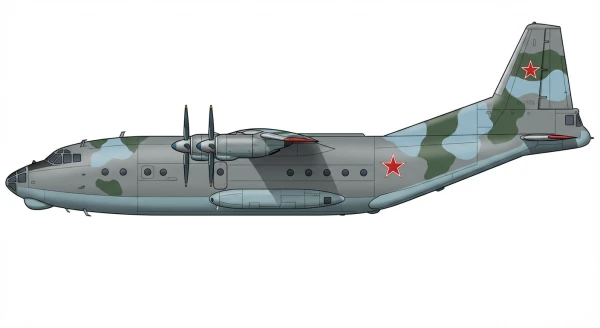
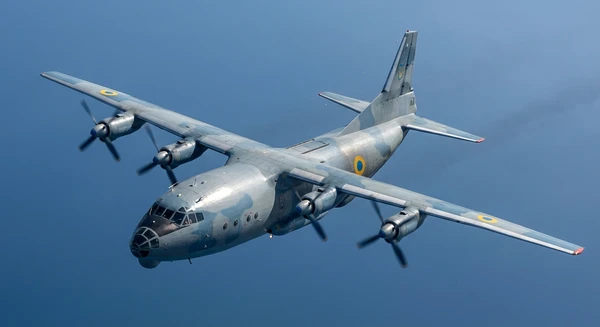
| Length | 33.1 m (108.6 ft) |
| Wingspan | 38 m (124.7 ft) |
| Height | 10.5 m (34.5 ft) |
| Wing area | 121.7 m² (1310.3 sqft) |
| Empty weight | 28,000 kg (61,729 lbs) |
| Max. takeoff weight | 61,000 kg (134,482 lbs) |
| Powerplant | 4 × turboprops Ivchenko-Progress AI-20M 3,126 kW each |
| Maximum speed | 770 km/h (478 mph) |
| Operational range | 5,700 km (3,542 mi) |
| Service ceiling | 10,200 m (33,465 ft) |
| Climb rate | 10.2 m/s (33.5 ft/s) |
| Takeoff distance | 900 m (2,953 ft) |
-
 Russia
64
Russia
64
-
 Angola
8
Angola
8
-
 Ethiopia
4
Ethiopia
4
-
 Sudan
4
Sudan
4
-
 Yemen
3
Yemen
3
-
 Uzbekistan
2
Uzbekistan
2
- 🇬🇶 Equatorial Guinea 1
Recent Events — An-12 Cub
3 events →
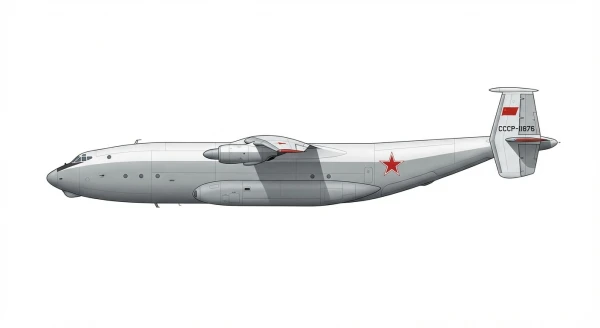
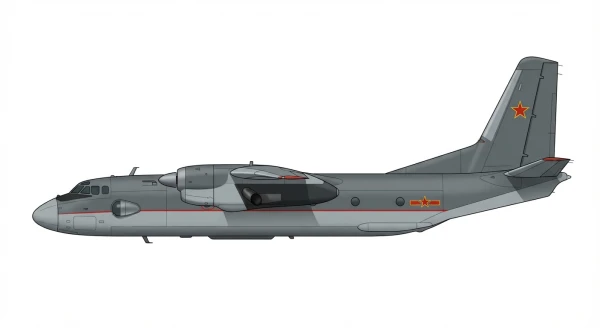
Description
The Antonov An-12 (NATO reporting name: Cub) is a four-engined turboprop transport aircraft designed in the Soviet Union. Developed as the military version of the An-10 passenger aircraft, it entered Soviet military service in 1959. For over three decades, the An-12 served as the standard medium-range cargo and paratroop transport for the Soviet Air Forces.
Development
The An-12 was developed from the Antonov An-8, with the first prototype flying in December 1957. Initial production took place at the State Aviation Factory in Irkutsk, Siberia, before transferring in 1962 to Tashkent, where 830 aircraft were constructed. Additional production occurred in Voronezh and Kazan until Soviet manufacturing ended in 1973 with 1,248 aircraft built. China purchased An-12 aircraft and an assembly license in the 1960s, but the withdrawal of Soviet technical assistance during the Sino-Soviet split required local reverse-engineering. The Xi'an Aircraft Company and Xi'an Aircraft Design Institute flew a reverse-engineered model in 1974, leading to serial production of the Chinese Y-8 variant in 1981.
Design
The An-12 is powered by four Ivchenko AI-20L or AI-20M turboprop engines rated at 3,000 kW (4,000 shp) each, driving four-bladed constant-speed reversible-pitch propellers. The airframe measures 33.1 m in length, with a wingspan of 38 m, a height of 10.53 m, and a wing area of 121.7 m². Flight operations require a five-person crew comprising two pilots, a flight engineer, a navigator, and a radio operator. Freight is loaded through a rear ramp and door assembly.
Armament
The An-12 has a maximum payload capacity of 20,000 kg (44,000 lb), accommodating up to 100 fully equipped paratroopers or two BMD-1 armored vehicles. Defensive armament on Soviet and former Soviet aircraft consists of two 23 mm Nudelman-Rikhter NR-23 cannons mounted in a tail turret.
Operational History
The Soviet Air Forces used the An-12 for equipment transport and search and rescue missions. During the Soviet–Afghan War, the aircraft was used to transport deceased soldiers from Afghanistan to Tashkent under the designation "Cargo 200," earning the nickname "Black Tulip." The Indian Air Force inducted the type in 1961, airlifting troops to Ladakh during the 1962 Sino-Indian War and employing the aircraft as heavy bombers during the Indo-Pakistani War of 1971. The aircraft was exported to civil and military operators in Africa, Asia, and Europe. In March 2010, the General Civil Aviation Authority of the United Arab Emirates permanently banned the type from UAE airspace after it failed airworthiness evaluations. Russia lost one An-12 on 1 June 2025 during Operation Spider's Web in the Russian invasion of Ukraine.
Variants
- An-12BP: Standard tactical transport variant produced with increased takeoff weights and additional fuel capacity.
- Shaanxi Y-8: Chinese reverse-engineered transport derivative featuring a navigator cockpit design adapted from the Tu-16/H-6 bomber.
- Y8-F600: Jointly developed Chinese variant featuring Pratt & Whitney Canada PW150B engines, Western avionics, a redesigned fuselage, and a two-crew glass cockpit.
Frequently Asked Questions
What type of aircraft is the An-12 Cub?
What is the maximum speed of the An-12 Cub?
What is the range of the An-12 Cub?
When did the An-12 Cub first fly?
How many An-12 Cub have been built?
Which countries operate the An-12 Cub?
How much does a An-12 Cub cost?
What is the service ceiling of the An-12 Cub?
- AUG 62026 Updated Description updated
- AUG 52026 Updated Climb rate added
- APR 72026 Updated Sources and cross-references refreshed
- JAN 242026 Updated Price updated
- JAN 122026 Updated Range updated in a site-wide editorial pass