Paraguay Military Forces 🇵🇾
Military Strength Overview
| 🛩️ Air Force | 53 active aircraft |
| 🪖 Active Troops | 13,950 personnels |
| ⛑️ Reserve Troops | 164,500 personnels |
| 👮♀️ Paramilitary | 14,800 personnels |
| 🗺️ Air bases | 2 active air bases |
Global Military Index
| 🪖 Manpower (15%) | 71.5 | Active, reserve & paramilitary: 100640 effective |
| 🛡️ Ground Firepower (20%) | 0.0 | Main battle tanks: 0 |
| ⚓ Naval Power (20%) | 0.0 | Weighted by ship type: carriers, submarines, destroyers... |
| ✈️ Air Power (25%) | 34.4 | Weighted by aircraft type: combat, bombers, helicopters... |
| ☢️ Nuclear Deterrent (10%) | 0.0 | No declared nuclear capability |
| 💰 Defense Budget (10%) | 40.3 | $0.4B annual military spending |
Methodology: Log-scaled composite index using SIPRI, IISS, and GMNET data. Each pillar is normalized to 0-100, then weighted by strategic importance.
Geography
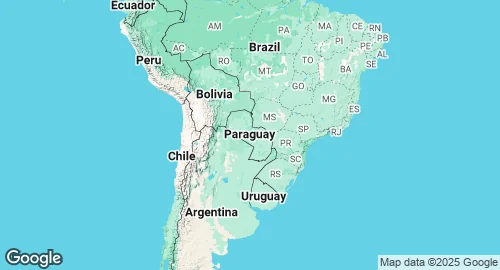
| Capital | Asunción |
| Land Area | 397,302 km² |
| Coastline Length | 0 km |
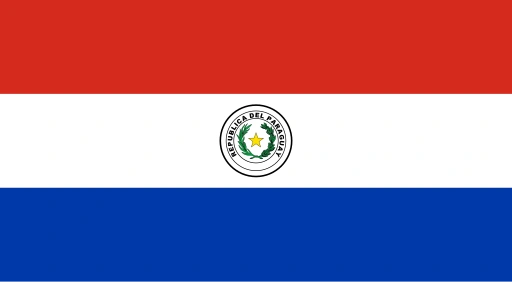
National Flag
Defense Statistics & Key Metrics
| Population | 6.8 million (2023) |
| GDP | $43.0 billion (2023) |
| GDP per capita | $6276 (2023) |
| Military Budget | $414.0 million (2024) |
| Share of GDP in Milex | 0.9% (2024) |
| Share of Govt Expenditures | 4.5% (2024) |
| Military spends per capita | $60 (2024) |
| Inflation Rate | 3.84% (2024) |
| Military Personnel | 29,000 (2020) |
Paraguayan Military Budget History
Population and Military Personnel Trends
GDP and Inflation Rate Trends
Strategic Overview in 2026
Strategic Position
Paraguay occupies a landlocked position in central South America, bordered by Brazil, Argentina, and Bolivia. Its defense doctrine is primarily characterized by a riverine and internal security focus, reflecting its geography and the role of the Paraguay and Paraná rivers as vital economic arteries. Primary security concerns center on transnational organized crime, particularly in the "Triple Frontier" region where Paraguay meets Argentina and Brazil. This area is a focal point for contraband, drug trafficking, and money laundering activities.
Strategic priorities emphasize border control and counter-insurgency. The military maintains a permanent presence in northern departments to address activities by the Ejército del Pueblo Paraguayo (EPP). Regionally, Paraguay maintains close bilateral defense ties with Brazil and the United States. It is a member of the Organization of American States (OAS), the Inter-American Treaty of Reciprocal Assistance (Rio Pact), and MERCOSUR. In 2025 and 2026, the government deepened alignment with the United States, facilitating joint training exercises and receiving hardware transfers to combat non-conventional threats.
Military Forces
The Armed Forces of Paraguay (Fuerzas Armadas de la Nación) are organized into the Army, Navy, and Air Force, with the President serving as Commander-in-Chief. Total active personnel number approximately 16,000, supported by a significant reserve force. Military service is compulsory for males at age 18.
Army The Army is the largest branch, structured into three corps and nine divisions. It primarily functions as a light infantry and mechanized force. Current land capabilities include: * Armored Vehicles: The force operates EE-9 Cascavel reconnaissance vehicles and EE-11 Urutu armored personnel carriers. In 2025, the Army began incorporating 20 additional Urutu units donated and modernized by Brazil. * Tactical Mobility: Under the U.S. Excess Defense Articles (EDA) program, the Army has begun the acquisition process for Oshkosh M-ATV 4x4 armored vehicles to improve mobility in rugged terrain and counter-narcotics operations. * Artillery: The branch is modernizing its fire support with the arrival of six M108 self-propelled howitzers donated from Brazilian stocks.
Navy Despite being landlocked, the Navy maintains a specialized riverine fleet. Its primary mission is the surveillance of the 3,500 kilometers of fluvial borders. * Vessels: The fleet consists of river monitors, patrol boats, and landing craft. Notable assets include the Parnaíba (historically linked to Brazilian cooperation) and various locally maintained patrol craft. * Marine Corps: The Infantería de Marina consists of approximately 800 personnel organized into battalions specialized in amphibious operations and riverine interdiction.
Air Force The Air Force (Fuerza Aérea Paraguaya) focuses on airspace sovereignty and logistical support. * Combat and Training: The force is undergoing a transition to the A-29 Super Tucano. By mid-2025, the first four of six ordered units were delivered by Embraer, with the remaining two scheduled for arrival by March 2026. These supplement and will eventually replace aging AT-27 Tucano and T-35 Pillán trainers. * Transport and Rotary Wing: The fleet includes C-212 Aviocar and Cessna utility aircraft, alongside a helicopter wing operating UH-1H Iroquois and Esquilo models.
Defense Industry
Domestic defense production is limited and centered on the Dirección de Material Bélico (DIMABEL). This state-owned entity manufactures small arms ammunition and pyrotechnics for the armed forces and national police. Paraguay remains heavily reliant on foreign imports and donations for major systems, primarily from Brazil, the United States, and Taiwan. Maintenance for riverine vessels and aircraft is conducted at the Arsenales de Marina and SEMAER (Air Maintenance Sector) facilities, which possess capabilities for airframe overhauls and minor naval repairs.
Strategic Trends
The current defense posture is defined by the 2023–2028 Strategic Security Plan, which represents the most comprehensive modernization effort in several decades. Procurement priorities focus on aerial surveillance and land mobility to address illegal flights and drug trafficking. In 2025, the government finalized contracts for a primary radar network to provide full coverage of the Chaco region, integrating these assets with the new Super Tucano fleet.
Defense spending is approximately 0.75% to 0.9% of GDP. A significant portion of the current budget is allocated to infrastructure, including the construction of a new Military Academy (Mariscal Francisco Solano López), with work beginning in 2026. Future force structure shifts favor the expansion of the Joint Task Force (FTC), a multi-branch unit dedicated to internal security and counter-insurgency operations in the northern provinces. Constraints remain, however, in the form of limited technical self-sufficiency and a reliance on international financing for large-scale equipment acquisitions.
Frequently Asked Questions
How large is Paraguay's military?
What is Paraguay's defense budget?
How does Paraguay rank militarily in the world?
Does Paraguay have nuclear weapons?
How many aircraft does Paraguay's air force have?
What percentage of GDP does Paraguay spend on defense?
What is Paraguay's military personnel per capita?
Does Paraguay have paramilitary forces?
Military Expenditure: SIPRI Milex. Suggest a change