Timor-Leste Military Forces
Timor-Leste ranks #164 of 170 militaries worldwide in 2026, with 2,280 active troops. Timor-Leste has no nuclear weapons.
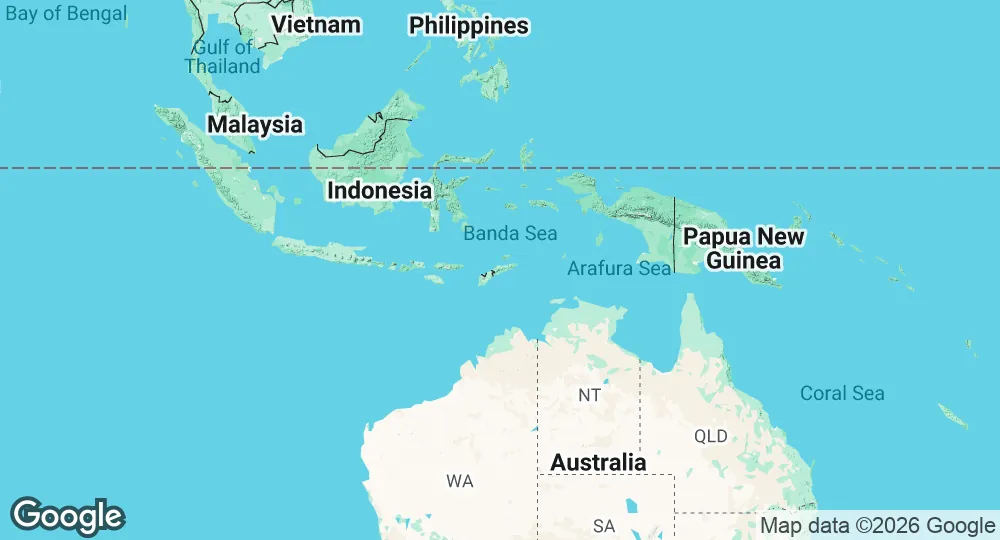

Armed Forces in 2026
| Domain | Strength | Composition |
|---|---|---|
| Personnel | 2,280 active |
ATLAS Index (Aggregate Total of Land, Air and Sea strength)
Full ranking →| Pillar | Weight | Score | Basis |
|---|---|---|---|
| Manpower | 10% | 15.5 | Active, reserve & paramilitary personnel |
| Ground forces | 20% | 0.0 | ARMS inventory power: armour & artillery by type and era, attack helicopters, armament |
| Naval power | 20% | 0.0 | SEAS inventory power: hulls by type, size and era, air wing, sustainment, armament |
| Air power | 25% | 0.0 | AIRS inventory power: aircraft by type and generation, enablers, armament |
| Nuclear deterrent | 10% | 0.0 | No declared nuclear capability |
| Defense budget | 15% | 8.4 | Annual spending, purchasing-power adjusted |
| Availability | modifier | ground ×0.80 · naval ×1.00 · air ×1.00 | Budget per point of each force, from the branch indexes |
Country File
| Population | 1.4M (2024) |
| GDP | $1.9 billion (2024) |
| GDP per capita | $1,332 |
| Military budget | $47M (2024) |
| Share of GDP | 2.5% (2024) |
| Military spending per capita | $33 (2024) |
| Inflation rate | 2.06% (2024) |
| Capital | Dili |
| Region | Asia |
| Land area | 14,919 km² |
| Coastline | 706 km |
| Land borders | 228 km |
| Bordering countries | 1 |
| Currency | USD |
Strategic Overview in 2026
Strategic Position
Timor-Leste maintains a defense posture centered on sovereignty protection, maritime surveillance, and regional integration. On October 26, 2025, the state officially became the 11th full member of the Association of Southeast Asian Nations (ASEAN), concluding a multi-decade accession process. As part of this integration, Timor-Leste deposited its instrument of accession to the Southeast Asia Nuclear Weapon-Free Zone (SEANWFZ) Treaty, aligning its strategic framework with ASEAN’s regional neutrality principles.
Primary security concerns involve the management of the land border with Indonesia (East Nusa Tenggara) and the monitoring of an extensive maritime exclusive economic zone (EEZ). The state relies on bilateral defense agreements to offset limited domestic capabilities. The Defense Cooperation Program (DCP) with Australia is the primary security pillar, providing training, infrastructure development, and maritime assets. Additional bilateral ties exist with Portugal, which provides advisory personnel and training, and the United States, primarily through the State Partnership Program with the Rhode Island National Guard. Relations with Indonesia have normalized into a cooperative border management framework, prioritizing the prevention of illegal cross-border movement and smuggling.
Military Forces
The national military, known as the FALINTIL-Forças de Defesa de Timor-Leste (F-FDTL), originated from the armed wing of the independence movement. It is an all-volunteer force with approximately 2,000 to 2,500 active personnel. The organization is divided into a Land Component, a Naval Component, and a developing Air Component.
The Land Component serves as the primary force for territorial defense and internal stability. It consists of two light infantry battalions and several specialized support units. The 1st Battalion is based at Baucau, while the 2nd Battalion is headquartered in Metinaro. Equipment is restricted to light infantry weaponry, including M16 and AK-type rifles, FN FAL battle rifles, and Heckler & Koch G3 rifles. The component maintains a limited fleet of light utility vehicles for transport and border patrol duties.
The Naval Component focuses on fisheries protection, search and rescue, and maritime border security. It operates from the Hera Naval Base near Dili. The fleet consists of several classes of patrol craft, including Alferes Cardoso-class vessels provided by Portugal and Jaco-class (Shanghai II-class) patrol boats donated by China. In 2025, the component integrated Guardian-class patrol boats provided by Australia under the Pacific Maritime Security Program.
The Air Component is currently the smallest branch and is undergoing expansion. Following the completion of a dedicated hangar and warehouse at Baucau Air Base in April 2025 with United States assistance, the branch has enhanced its capacity for aerial surveillance. Its inventory includes Cessna 206G aircraft configured for intelligence, surveillance, and reconnaissance (ISR) and humanitarian assistance missions.
Strategic Trends
Defense spending in Timor-Leste remains between 1% and 2% of GDP, with the 2025 defense budget estimated at approximately $47 million. Funding is primarily allocated to personnel costs and the maintenance of existing facilities, leaving procurement largely dependent on international donations and military assistance programs.
Modernization efforts are currently concentrated on maritime and aerial domain awareness. A priority is the operationalization of the Baucau Air Base as a hub for ISR activities in the Timor Sea. This development is supported by technical advisory teams from the United States and Australia, focusing on aircraft maintenance and airfield operations.
Future force structure shifts are driven by the requirement to meet ASEAN membership obligations, including participation in regional maritime exercises and disaster relief frameworks. This has led to increased interoperability training, exemplified by the annual Exercise Hari’i Hamutuk and the Cooperation Afloat Readiness and Training (CARAT) series. Constraints on military development include a limited pool of technical personnel and the lack of domestic maintenance facilities for advanced hardware, ensuring continued reliance on external partners for logistical sustainment and specialized training through 2026.
Military Expenditure: CIA World Factbook. Last updated on 4 August 2026. Suggest a change
Frequently Asked Questions
How large is Timor-Leste's military?
What is Timor-Leste's defense budget?
How does Timor-Leste rank militarily in the world?
Does Timor-Leste have nuclear weapons?
What percentage of GDP does Timor-Leste spend on defense?
What is Timor-Leste's military personnel per capita?
- AUG 42026 Updated Global Military Index updated in a site-wide editorial pass
- JUL 162026 Updated Global Military Index updated in a site-wide editorial pass
- JUN 162026 Updated Yearly statistics, military spending and 2 more fields updated
- JAN 132026 Updated Description added