South Africa Military Forces
South Africa ranks #52 of 170 militaries worldwide in 2026, with 65,350 active troops. The South African Army fields 1,637 ground vehicles, including 203 main battle tanks; the Air Force flies 194 aircraft, including 25 combat aircraft; the Navy operates 45 warships, including 3 submarines. South Africa has no nuclear weapons.
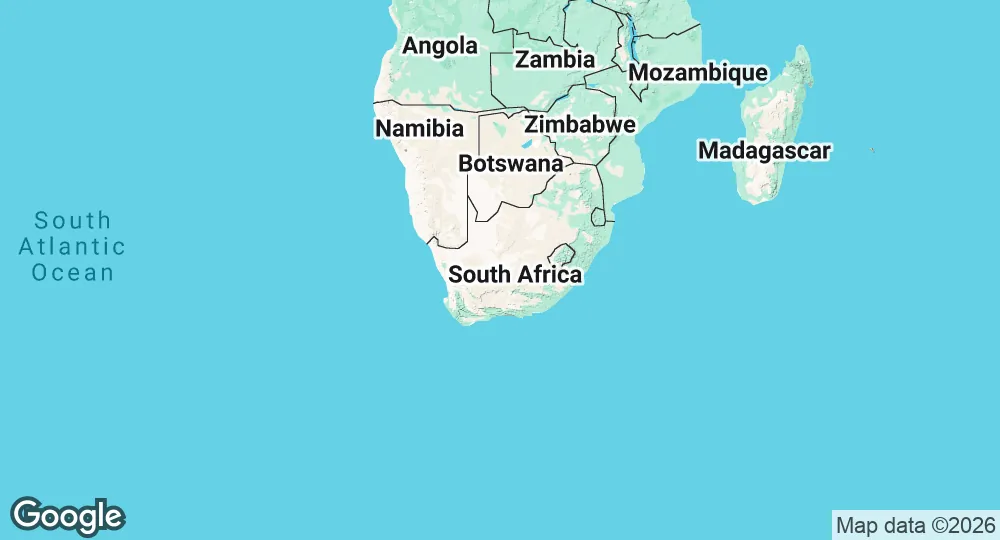
Armed Forces in 2026
| Domain | Strength | Composition |
|---|---|---|
| Air Force | 194 aircraft | 25 combat 84 helicopters 10 air bases |
| South African Navy | 45 warships | 7 major combatants 3 submarines |
| Ground Forces | 1,637 vehicles | 203 main battle tanks |
| Personnel | 65,350 active | 15,050 reserve |
ATLAS Index (Aggregate Total of Land, Air and Sea strength)
Full ranking →| Pillar | Weight | Score | Basis |
|---|---|---|---|
| Manpower | 10% | 38.2 | Active, reserve & paramilitary personnel |
| Ground forces | 20% | 36.5 | ARMS inventory power: armour & artillery by type and era, attack helicopters, armament |
| Naval power | 20% | 36.2 | SEAS inventory power: hulls by type, size and era, air wing, sustainment, armament |
| Air power | 25% | 27.6 | AIRS inventory power: aircraft by type and generation, enablers, armament |
| Nuclear deterrent | 10% | 0.0 | No declared nuclear capability |
| Defense budget | 15% | 23.5 | Annual spending, purchasing-power adjusted |
| Availability | modifier | ground ×0.91 · naval ×0.80 · air ×0.89 | Budget per point of each force, from the branch indexes |
Country File
| Population | 64.7M (2025) |
| GDP | $427.2 billion (2025) |
| GDP per capita | $6,598 |
| Military budget | $2.8B (2024) |
| Share of GDP | 0.7% (2024) |
| Military spending per capita | $43 (2024) |
| Inflation rate | 3.21% (2025) |
| Capital | Pretoria |
| Region | Africa |
| Land area | 1,214,470 km² |
| Coastline | 2,798 km |
| Land borders | 4,862 km |
| Bordering countries | 6 |
| Currency | ZAR |
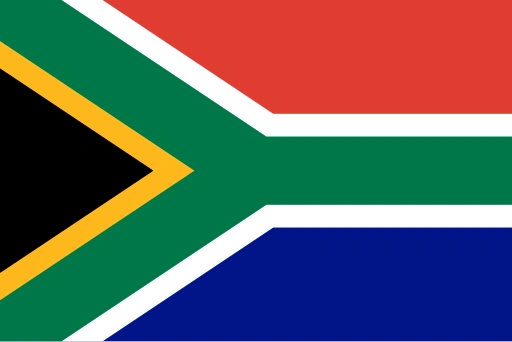
| Aspect ratio | 2:3 |
| Colors | Red, blue, green, yellow, white, black |
Strategic Overview in 2026
Strategic Position
South Africa’s defense posture is defined by its role as a regional power within the Southern African Development Community (SADC) and its participation in the BRICS+ bloc. The primary security concerns include maritime piracy in the Mozambique Channel, regional instability in the eastern Democratic Republic of the Congo (DRC), and internal infrastructure protection.
The South African National Defence Force (SANDF) currently prioritizes regional peacekeeping and stabilization operations. South Africa contributes personnel and assets to the Southern African Development Community Mission in the Democratic Republic of Congo (SAMIDRC), following the conclusion of the SADC Mission in Mozambique (SAMIM).
The country maintains a policy of non-alignment, characterized by military cooperation with a diverse range of international partners. This includes participation in the Exercise Mosi series with the Russian and Chinese navies, alongside maintaining bilateral defense agreements with various African and Western nations. South Africa is a signatory to the Pelindaba Treaty, which establishes Africa as a nuclear-weapon-free zone.
Military Forces
The SANDF is organized into four service branches: the South African Army, the South African Air Force (SAAF), the South African Navy (SAN), and the South African Military Health Service (SAMHS). Command is centralized under the Chief of the SANDF, who reports to the Minister of Defence and Military Veterans. Total active personnel number approximately 70,000, supported by a reserve force of roughly 12,000.
The South African Army is the largest branch and maintains a structure centered on motorized, paratroop, and mechanized infantry. Armored capabilities include Olifant Mk2 main battle tanks and Rooikat armored reconnaissance vehicles. The mechanized infantry operates Ratel infantry fighting vehicles and various mine-protected vehicles such as the Casspir and Mamba. Artillery units utilize G5 towed and G6 Rhino self-propelled howitzers.
The SAAF provides air defense, transport, and maritime patrol capabilities. Combat operations are centered on Gripen C/D multirole fighters and Hawk Mk 120 lead-in fighter trainers. The helicopter fleet includes Rooivalk combat support helicopters, Oryx medium transport helicopters, and AgustaWestland A109 light utility helicopters. Transport requirements are met by C-130BZ Hercules aircraft.
The SAN is responsible for protecting the country's 2,800-kilometer coastline. The primary surface combatants are Valour-class frigates, supported by Heroine-class Type 209 submarines. The fleet also includes Warrior-class multi-mission inshore patrol vessels (MMIPVs) delivered under Project Biro and a hydrographic survey vessel.
Specialized units include the South African Special Forces Brigade, which operates directly under the Chief of Joint Operations. These units are trained for unconventional warfare, long-range reconnaissance, and maritime operations.
Defense Industry
South Africa maintains a developed domestic defense industry capable of producing land systems, electronics, and precision-guided munitions. Denel, the state-owned defense conglomerate, produces the G6 self-propelled howitzer, the Rooivalk helicopter, and the Umkhonto surface-to-air missile. While Denel has undergone restructuring in 2025 to address liquidity and production challenges, it remains the primary domestic supplier.
The private sector is led by companies such as Paramount Group and Milkor. Paramount Group produces the Mbombe family of armored combat vehicles and the Mwari reconnaissance and light attack aircraft, which have secured export contracts across Africa and the Middle East. Reutech provides radar and communication systems, while Hensoldt South Africa specializes in optronics and electronic warfare. South Africa is largely self-sufficient in armored vehicle production and ammunition but relies on international partners for advanced avionics and high-performance aero-engines.
Strategic Trends
The South African defense budget has experienced a sustained decline in real terms, currently hovering around 0.7% of GDP. This fiscal environment has led to a high personnel-to-procurement spending ratio, where salaries account for over 60% of the total budget. Consequently, the SANDF faces challenges regarding the maintenance of primary mission equipment and the sustainment of long-term modernization programs.
Current procurement priorities are focused on maritime domain awareness and border security. The SAN is integrating new patrol vessels to counter illegal fishing and smuggling. The Army is seeking to replace the aging Ratel fleet through Project Hoefyster, although the program has faced significant delays.
Force structure shifts in 2025 and 2026 emphasize "border safeguarding" through Operation Corona, involving the deployment of infantry companies to the country's land borders. There is an increasing reliance on the SANDF for internal security tasks, including the protection of power plants and the prevention of illegal mining. The long-term strategic outlook involves balancing these domestic requirements with the high operational tempo of regional peacekeeping deployments.
Military Expenditure: CIA World Factbook. Last updated on 25 September 2026. Suggest a change
South African Defense Manufacturing
Designed in South AfricaFrequently Asked Questions
How large is South Africa's military?
What is South Africa's defense budget?
How does South Africa rank militarily in the world?
Does South Africa have nuclear weapons?
How many aircraft does South Africa's air force have?
How large is South Africa's navy?
How many tanks does South Africa have?
What percentage of GDP does South Africa spend on defense?
What is South Africa's military personnel per capita?
Does South Africa have submarines?
- SEP 252026 Updated Population, GDP and inflation added for 2025; GDP series revised
- AUG 42026 Updated Global Military Index updated in a site-wide editorial pass
- AUG 32026 Updated Global Military Index updated
- JUL 162026 Updated Global Military Index updated in a site-wide editorial pass
- JUL 22026 Updated Rank insignia and ranks overview added
- JUN 162026 Updated Yearly statistics, military spending and Global Military Index updated
- JAN 172026 Updated Main battle tank count and Global Military Index updated