Heroine-class (Type 209/1400 Mod)
South African submarine, 1,454 tons displacement, propelled by diesel-electric engines with one shaft. Key figures: displacement 1,454 tons, length 62 m, top speed 10 knots, crew 30, built 3. In service with 1 navy — South Africa (3).
| Subtype | Diesel-electric attack submarine |
| Displacement | 1454 tons |
| Displacement submerged | 1600 tons |
| Crew | 30 members |
| Width | 7.6 m (24.9 ft) |
| Length | 62.0 m (203.4 ft) |
| Max. depth | 500 m (1640.4 ft) |
| Propulsion | Diesel-electric, 4 MTU 12V 396 diesel engines delivering 2.8MW, 4 alternators, 1 Siemens 3.7MW motor, 1 shaft |
| Range | 11,000 nm at 10 knots |
| Maximum speed | 10 knots |
| Max. speed submerged | 22 knots |
- 8 x 21 in (533 mm) torpedo tubes
- 14 AEG SUT 264 torpedoes
- optional UGM-84 Harpoon integration
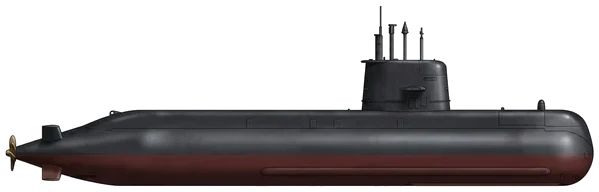
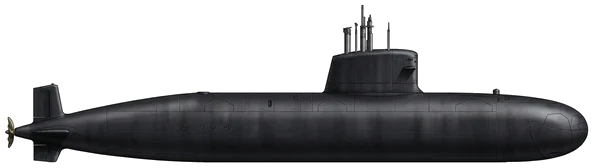
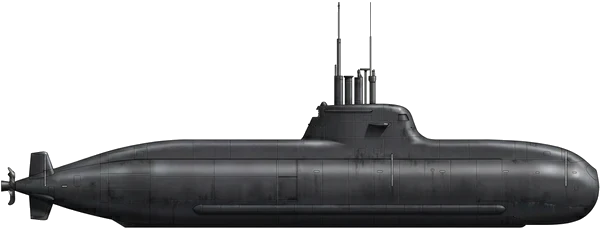
Description
The Heroine class is a South African Navy variant of the Type 209 diesel-electric attack submarine, built to the Type 209/1400-Mod standard. South Africa contracted for three boats in July 2000 with Howaldtswerke-Deutsche Werft (HDW) and Thyssen Nordseewerke, replacing the French-built Daphné-class submarines SAS Spear, SAS Assegaai and SAS Umkhonto, decommissioned in 2003. The lead boat, SAS Manthatisi, was built by HDW at Kiel, launched in June 2004 and commissioned in November 2005. Thyssen Nordseewerke at Emden built the remaining two: SAS Charlotte Maxeke, launched in May 2005 and commissioned in March 2007, and SAS Queen Modjadji, launched in 2006 and handed over in February 2008. The names commemorate South African women: Manthatisi, warrior chief of the Batlokwa; Charlotte Maxeke, an early 20th-century political activist; and the Rain Queen Modjadji. The procurement later became the subject of bribery allegations against Ferrostaal, with an internal audit by Debevoise and Plimpton reportedly citing payments of R300 million.
The boats have a maximum diving depth of approximately 500 metres. Propulsion is diesel-electric, with four MTU 12V 396 diesel engines producing 2.8 MW driving four alternators and a single Siemens 3.7 MW motor on one shaft. Combat direction is handled by the Atlas Elektronik ISUS 90-45 integrated combat information system, which provides navigation, sensor integration and fire control. Armament consists of eight 533 mm bow torpedo tubes with a capacity of 14 torpedoes; the South African Navy acquired Atlas Elektronik SUT torpedoes for the class. The submarines are believed to carry the CIRCE torpedo countermeasures ejector system.
Sensors comprise the Atlas Elektronik CSU 90 sonar suite, with hull-mounted passive and active search-and-attack arrays, a flank array, active intercept sonar and an own-noise monitoring system. South Africa declined the option of a clip-on towed array after existing operators advised that the system was clumsy and impractical for the envisaged operating context. Surface search radar operates in I-band. Optical equipment consists of two masts from Carl Zeiss Optronics: a hull-penetrating SERO 400 attack periscope and a non-penetrating OMS 100 optronic search mast carrying a high-definition colour television camera and a third-generation thermal imager, gyroscopically stabilised in elevation and azimuth and housed in a retractable unit outside the pressure hull. Electronic support is provided by the Saab Grintek Avionics S/UME-100 tactical ESM and ELINT system, comprising an ESM antenna, radar warning receiver antenna, signal distribution unit and electronic warfare controller, with antennae integrated into the mastheads of both periscopes.
The class is homeported at Simon's Town naval base near Cape Town and is used mainly for patrol work and the detection of illegal fishing in South African territorial waters. By 2019 two boats required complete refits, and Armscor reported to parliament that the submarine capability would lapse after FY2022/23 without them. Charlotte Maxeke entered refit at the Armscor Dockyard in 2021 with R189 million allocated. Manthatisi completed a Docking and Essential Defect period by April 2023, while Queen Modjadji remained in preservation pending refit funding. In August 2025 the Indian Navy conducted Rescue Seat Certification of Manthatisi under a rescue cooperation pact signed on 3 September 2024, permitting Indian Deep Submergence Rescue Vessel support.
Frequently Asked Questions
What type of ship is the Heroine-class?
What is the displacement of the Heroine-class?
What is the maximum speed of the Heroine-class?
What is the range of the Heroine-class?
How many crew members serve on the Heroine-class?
How many Heroine-class ships have been built?
Which countries operate the Heroine-class?
- AUG 302026 Updated Description updated
- JUL 292026 Updated Description updated
- JAN 182026 Created Page created: Heroine