AH-2 Rooivalk
South African attack helicopter, designed during the late 20th century, extensively deployed for peacekeeping missions in Africa. Key figures: top speed 309 km/h, range 740 km, service ceiling 6,096 m, max takeoff weight 8,750 kg, unit price $40M, built 12. In service with 1 air force as of 2026 — South Africa (11).
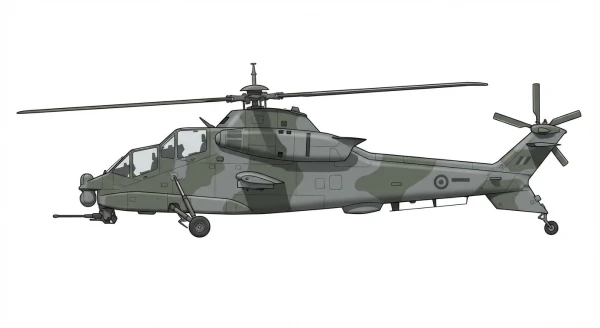
| Length | 18.7 m (61.5 ft) |
| Wingspan | 15.6 m (51.1 ft) |
| Height | 5.2 m (17.0 ft) |
| Empty weight | 5,730 kg (12,632 lbs) |
| Max. takeoff weight | 8,750 kg (19,290 lbs) |
| Powerplant | 2 × turboshafts Turbomeca Makila 1K2 1,420 kW each |
| Maximum speed | 309 km/h (192 mph) |
| Operational range | 740 km (460 mi) |
| Service ceiling | 6,096 m (20,000 ft) |
| Climb rate | 13.3 m/s (43.6 ft/s) |

Description
The Denel Rooivalk, originally designated CSH-2 and AH-2, is an attack helicopter manufactured by Denel Aviation of South Africa. Designed for reconnaissance, heliborne escort, close air support, deep penetration and anti-armour missions, it entered South African Air Force service as the Rooivalk Mk 1, with the first aircraft officially handed over in April 2011. The name is Afrikaans for "Red Falcon", a reference to the lesser kestrel. It is known for its protracted development, its derivation from the Aérospatiale SA 330 Puma line, and its combat use with United Nations forces in the Democratic Republic of the Congo.
Development
The programme began in early 1984 at the Atlas Aircraft Corporation, a Denel Aviation predecessor, in response to the conventional character of the later South African Border War and the arms embargo imposed by UN Security Council Resolution 418. Rather than a clean-sheet design, the engines and dynamic systems of the Atlas Oryx — itself a localised Puma development — were adopted for commonality and lower maintenance cost. The Atlas XH-1 Alpha, an Alouette III airframe with tandem stepped cockpit, nose-mounted 20 mm cannon and tail-dragger undercarriage, first flew on 3 February 1985 and validated the concept. The Rooivalk prototype flew on 11 February 1990. The end of the Border War in 1988 cut the planned procurement from 36 to 12 aircraft; the first production helicopter was delivered in 1998. Production ended in 2007 after 12 airframes. Export campaigns in Malaysia, the United Kingdom and Turkey produced no sales, and Denel ceased export development on 17 May 2007 after losing the Turkish tender to the Agusta A129 Mangusta. A Mk 1.1 upgrade and a proposed Mk 2 were studied from 2014 onward; Denel and Airbus Helicopters signed a memorandum of understanding on 15 September 2016, and Denel Aeronautics and Aselsan agreed in 2023 to collaborate on an avionics upgrade.
Design
The Rooivalk has a tandem cockpit, starboard tail rotor with port tailplane, fixed wheeled undercarriage, and wire cutters above and below the cockpit and on the undercarriage. It is powered by two Turbomeca Makila 1K2 turboshafts of 1,420 kW each, giving a maximum cruise of 278 km/h and a range of 740 km at sea level; maximum take-off weight is 8,750 kg. Equipment includes a fire control system, Doppler radar and GPS navigation, an electronic countermeasures suite with chaff and flare dispensers, a nose-mounted gyro-stabilised sensor turret with auto-tracking, and the Thales TopOwl helmet-mounted display. Field support requires only a medium transport helicopter with basic spares and four groundcrew. The aircraft can perform a loop.
Armament
The nose-mounted F2 20 mm cannon carries 700 rounds. Wing stations accommodate 8 or 16 Mokopa ZT-6 anti-tank guided missiles, four MBDA Mistral air-to-air missiles, and 38 or 76 70 mm folding-fin or wrap-around rockets, including the FZ90 and the FZ275 laser-guided rocket. The Mokopa was qualified during the Block 1F upgrade, which gave the type guided-missile capability for the first time.
Operational History
By April 2005 only six of the 12 aircraft were available for operational test and evaluation, and one airframe was destroyed in an uncontrolled landing on 3 August 2005. In November 2007 the Defence Ministry allocated R962 million over three years to reach full operational status. The first five Block 1F aircraft were delivered on 1 April 2011, the ninth and tenth in September 2012, and the eleventh and last on 13 March 2013. All serve with 16 Squadron at AFB Bloemspruit. Three aircraft deployed with the UN Force Intervention Brigade to MONUSCO in 2013; on 4 November 2013 two fired FZ90 70 mm rockets at M23 positions near Chanzu.
Variants
- Atlas XH-1 Alpha: Alouette III–based technology demonstrator with tandem cockpit and 20 mm nose cannon, first flown 3 February 1985.
- Rooivalk Mk 1 (Block 1F): Production SAAF standard with improved targeting systems and avionics, gearbox changes and cannon cooling fixes, enabling Mokopa missile employment.
- Rooivalk Mk 1.1: Proposed upgrade adding a missile approach warning system and further avionics improvements.
- Rooivalk Mk 2: Proposed new-build variant with a large proportion of new systems, marketed to Egypt, Brazil, Nigeria, Poland and India.
Frequently Asked Questions
What type of aircraft is the AH-2 Rooivalk?
What is the maximum speed of the AH-2 Rooivalk?
What is the range of the AH-2 Rooivalk?
When did the AH-2 Rooivalk first fly?
How many AH-2 Rooivalk have been built?
Which countries operate the AH-2 Rooivalk?
How much does a AH-2 Rooivalk cost?
What is the service ceiling of the AH-2 Rooivalk?
- AUG 302026 Updated Description updated
- AUG 52026 Updated Powerplant updated in a site-wide editorial pass
- APR 72026 Updated Picture credits updated in a site-wide editorial pass
- FEB 72026 Updated Wingspan added