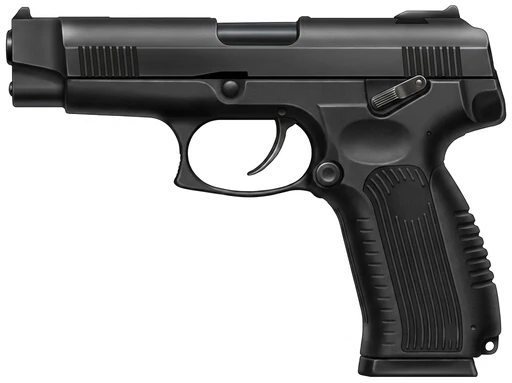
MP-443 Grach
| Fire rate | 40 - 45 rounds/min. |
| Caliber | 9 x 19 mm Parabellum |
| Magazine | 17 - 18 rounds |
| Length | 198 mm (7.8 in) |
| Weight | 0.95 kg (2.1 lb) |
| Range | 50 m (164 ft) |
Description
The MP-443 Grach, designated as the PYa (Pistolet Yarygina), was developed by designer Vladimir Alexandrovich Yarygin under the "Grach" designation. The design process occurred between 1993 and 2000 in response to Russian military trials initiated in 1993. Production was initially handled by the Izhevsk Mechanical Plant from 2003 until 2013, when manufacturing transitioned to the Kalashnikov Concern.
The pistol is a double-action, short-recoil operated semi-automatic firearm utilizing a locked-breech system based on a simplified Colt-Browning design. The rectangular breech end of the stainless steel barrel locks into matching grooves within the carbon steel slide, which is paired with a carbon steel frame and polymer grips. Ergonomic and safety features include an ambidextrous frame-mounted manual safety that does not decock the action, a slide stop lever installable on either side of the frame, and a partially concealed hammer designed to prevent snagging on clothing or gear. The magazine release is positioned at the base of the trigger guard. Aiming is conducted via a fixed front blade and a drift-adjustable dovetail rear sight, both equipped with white contrast inserts. The weapon feeds from a double-column, two-position feed box magazine and is built to withstand the high-pressure 7N21 cartridge, which features a semi-armor-piercing steel-core bullet. The frame can also accept a Weaver rail mount and tactical light or laser systems.
The weapon entered Russian military and law enforcement service in 2003. Mass production commenced in 2011, and the pistol has been issued to the Russian Airborne Troops, National Guard, SOBR, and OMON units, serving alongside older service pistols. It has seen operational deployment in the Second Chechen War, the Russo-Georgian War, the Syrian Civil War, and the Russo-Ukrainian War. Externally, the pistol is utilized by Armenian police and customs personnel, Kazakh private security firms, and captured units are in service with Ukrainian forces. Variants include the polyamide-framed MP-446 Viking civilian model, which is not rated for high-pressure military ammunition, the MP-446C Viking competition model, and the MP-353 and MP-472 non-lethal variants configured to fire rubber bullets.