Walther MPL / MPK
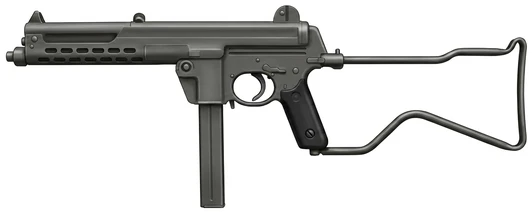
| Fire rate | 550 rounds/min. |
| Caliber | 9 x 19 mm Parabellum |
| Magazine | 32 rounds |
| Length | 659 mm (25.9 in) |
| Weight | 3.0 kg (6.6 lb) |
| Range | 200 m (656 ft) |
Description
The Walther MP series, consisting of the MPL and MPK, is a family of 9×19mm Parabellum submachine guns developed and produced in West Germany by Walther from 1963 to 1985. Development began in the late 1950s to align with West German military and police re-arming plans, with mass production starting in 1963. Upon release, it was adopted by West German intelligence agencies and US military special forces stationed in Germany, including the 39th Special Forces Detachment.
The design features a simple blowback mechanism with an unusual bolt configuration. Most of the bolt's mass is a hollow tubular weight positioned above and parallel to the barrel in a separate channel. Fixed underneath this tube is a small, light steel block that handles chambering, sealing, firing, and extraction. The tubular weight provides most of the inertia and extends ahead of the chamber when in battery, also containing the main spring. This design allows for a relatively long barrel compared to the overall length. The receiver is constructed from stamped steel with ventilation slots, and a prominent cocking handle is located on the left front. Ambidextrous selective fire switches are positioned on both sides of the receiver behind the trigger. Although designed for suppressor use, a loud mechanical operating noise limits its effectiveness. Both variants feature side-folding buttstocks made of thin steel tubes with a rubber coating.
The Walther MP series includes two versions:
MPK (Maschinenpistole Kurz, "short")
MPL (Maschinenpistole Lang, "long")
The only difference between the MPK and MPL variants is the barrel length. The MPL’s iron sights also incorporate settings for 100 and 200 meters.
The Walther MP was adopted by various users, including the West German Navy (MPL) and some police agencies, such as the West Berlin Police. It was utilized by local police during the 1972 Munich Olympics. Following this incident, the GSG-9 counter-terrorist unit adopted the H&K MP5. The MPK variant was exported to Brazil, Colombia, and Venezuela. In the United States, the MP was used by special forces, including US Navy SEALs during the Vietnam War and reportedly by US Army Special Forces in Operation Ivory Coast. The Delta Force also employed the Walther MP during a transitional period as the M3 submachine gun was phased out prior to adopting the MP5. Delta Force members were equipped with it during Operation Eagle Claw. Production ceased in 1983, with approximately 27,000 units produced in total.
Users of the Walther MP include Brazil (MPK variant), Colombia (MPK variant), Germany (various naval units in the 1960s, various police forces), Mexico (Mexican Navy), Portugal (MPL variant used by the Portuguese Navy and Portuguese Marine Corps), United States (1st SFOD-D during Operation Eagle Claw, Detachment A Special Forces Berlin), Venezuela (MPK variant), and Zimbabwe (MPK variant).
Frequently Asked Questions
What type of firearm is the Walther MPL / MPK?
What caliber is the Walther MPL / MPK?
What is the effective range of the Walther MPL / MPK?
What is the rate of fire of the Walther MPL / MPK?
What magazine does the Walther MPL / MPK use?
How heavy is the Walther MPL / MPK?
- JUL 232026 Updated Service entry year updated in a site-wide editorial pass
- APR 82026 Updated Sources and cross-references refreshed