Belgorod-class
The world's largest operational submarine, a Russian special-purpose boat carrying Poseidon nuclear drones. Key figures: displacement 17,000 tons, length 184 m, top speed 15 knots, crew 110, built 1. In service with 1 navy — Russia (1).

| Subtype | Special-purpose nuclear submarine |
| Displacement | 17000 tons |
| Displacement submerged | 30000 tons |
| Crew | 110 members |
| Width | 15.0 m (49.2 ft) |
| Length | 184.0 m (603.7 ft) |
| Propulsion | 2 × OK-650M.02 nuclear reactors, 2 steam turbines, 2 shafts |
| Endurance | 120 days |
| Maximum speed | 15 knots |
| Max. speed submerged | 32 knots |
- Up to 6 × Poseidon nuclear-powered unmanned underwater vehicles
- Carriage of deep-diving special-purpose submarines (Losharik, Paltus)
- 533 mm torpedo tubes

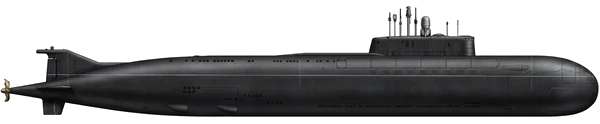
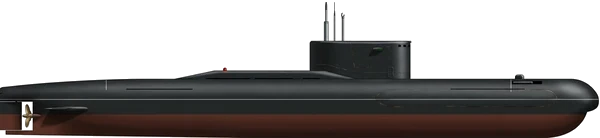


Description
K-329 Belgorod is a nuclear-powered special-purpose submarine (Project 09852) built by Sevmash at Severodvinsk for the Russian Navy. The boat was laid down on 24 July 1992 as hull number 664, a Project 949A (NATO: Oscar II) cruise missile submarine, and was named after the city of Belgorod in April 1993. Construction stopped in 1997 with the hull about three-quarters complete, and the crew was disbanded in January 1998. After the loss of the sister ship Kursk in 2000, work resumed to the upgraded Project 949AM standard. Funding fell short, and Sevmash continued construction slowly with its own money. In July 2006, with the boat about 80% complete, the Ministry of Defence decided not to commission it. The ministry considered selling it to the Indian Navy and, in 2009, rearming it with cruise missiles developed for the Project 885 Yasen class. In early 2012 the commander-in-chief of the Russian Navy announced that Belgorod would be completed as a "special projects" vessel. The redesign was designated Project 09852 in December 2012, when the hull was relaid.
The Belgorod conversion removed the cruise missile launch tube section and inserted a bay about 18 m long. This bay can carry deep-diving special-operations submarines such as Losharik or the Project 18510/18511 Paltus type. The bow section was lengthened to 38 m to house the Poseidon (2M39, NATO: Kanyon) nuclear-powered unmanned underwater vehicle, formerly known as Status-6. According to TASS, the submarine can carry up to six Poseidons, possibly on a revolving launcher. The Poseidon was developed by the Rubin design bureau. It has a reported range of 10,000 km and a diving depth of 1,000 m, and it is intended to deliver nuclear warheads against coastal infrastructure as a second-strike weapon. The hull was lengthened from 154 m to 184 m, almost 11 m more than the Project 941 Typhoon-class ballistic missile submarines. Following the decommissioning of the last Typhoon in 2023, Belgorod has been described as the world's largest operational submarine. Propulsion is by two OK-650M.02 pressurised water reactors driving two steam turbines on two shafts.
Some sources state that the Belgorod can also act as mother ship for a Project 18511 Paltus nuclear-powered mini-submarine. The Paltus would emplace ATGU Shelf nuclear turbo-generator units on the seabed to power underwater sensor arrays, with one ATGU unit carried on the submarine's centre deck section. The boat is also planned to operate Klavesin-2R-RM ("Harpsichord") unmanned underwater sensor vehicles. The redesign is linked to Russian activity on the Arctic shelf, including the Harmony network of seabed sonar listening stations. The 2019 fire aboard Losharik was a setback for the programme.
President Vladimir Putin presented Belgorod and the Poseidon in his March 2018 address. A new crew was formed in November 2018. The submarine was floated out of the covered dry dock at Sevmash on 23 April 2019. Planned commissioning dates in 2018 and 2020 were missed. In April 2021 TASS reported a Defence Ministry plan to assign the boat to the Pacific, and in the same month a naval analyst reported that it had been returned to the construction hall. Belgorod first sailed from Severodvinsk for builder's trials on 25 June 2021 and was delivered to the Russian Navy on 8 July 2022.
The submarine joined the 29th Submarine Division, the operational arm of the Main Directorate of Deep-Sea Research (GUGI), which reports directly to the Russian Defence Ministry and is based at Olenya Guba. At commissioning, Belgorod was to serve in an experimental role with the Northern Fleet before transferring to the Pacific. Poseidon vehicles were reportedly test-launched in 2023, although some sources suggest full operational integration may not occur until around 2027. As of mid-2025 the submarine remained in the Northern Fleet operating area.
Frequently Asked Questions
What type of ship is the Belgorod-class?
What is the displacement of the Belgorod-class?
What is the maximum speed of the Belgorod-class?
How many crew members serve on the Belgorod-class?
How many Belgorod-class ships have been built?
Which countries operate the Belgorod-class?
- SEP 262026 Updated Overview rewritten: design, service history, variants and operators
- JUL 272026 Updated Endurance updated
- JUL 242026 Created Page created: Belgorod