Poseidon (Status-6)
Unveiled by Russia in 2015, the Poseidon is a nuclear-armed unmanned underwater vehicle designed for strategic strike, distinguished by its nuclear-powered propulsion system. Key figures: displacement 100 tons, length 24 m, top speed 100 knots. No longer in service; operated by 1 navy over its career.
| Subtype | Unmanned underwater vehicle |
| Displacement | 100 tons |
| Displacement submerged | 100 tons |
| Width | 2.0 m (6.6 ft) |
| Length | 24.0 m (78.7 ft) |
| Max. depth | 1000 m (3280.8 ft) |
| Propulsion | Liquid metal reactor (at least 15 MW) with electric transmission |
| Range | 5,400 nm |
| Maximum speed | 100 knots |
| Max. speed submerged | 100 knots |
- Conventional or nuclear warhead (speculated yield of 2 Mt or more)
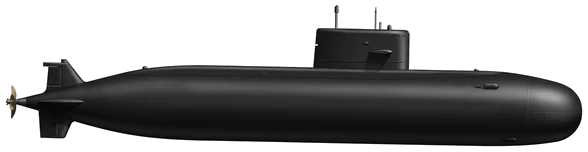
Description
The Poseidon (GRAU index 2M39, NATO reporting name Kanyon), originally known by the Russian codename Status-6, is an autonomous, nuclear-powered unmanned underwater vehicle developed by the Rubin Design Bureau. The project was first revealed in November 2015 through a television broadcast of a document during a speech by Russian President Vladimir Putin. The CIA categorized this leak as intentional. The first test-launch occurred on 27 November 2016 from the B-90 Sarov special purpose submarine in the Arctic Ocean. The United States Pentagon formally acknowledged the development of the system in early 2018. Following a public vote in March 2018, the system received the official name Poseidon. Russia completed a stage of trials in early 2019, and the first batch of weapons was reportedly manufactured in early 2023. A successful test of the system was announced in October 2025.
The Poseidon is designed as a torpedo-shaped robotic mini-submarine constructed with a titanium alloy body. It is propelled by a compact, low-power nuclear reactor designed to reduce acoustic noise. The vehicle is designed to bypass missile defense systems and is capable of carrying both conventional and nuclear warheads. It can function as a radiological second-strike weapon; speculation suggests it can carry a cobalt bomb to contaminate marine environments and coastal areas. To elude acoustic tracking, the vehicle utilizes a silent running strategy. It operates in a low-speed stealth mode during transit to minimize its detection radius, transitioning to a high-speed mode in the final phase of its approach. The propulsion system features a specialized pump-jet design intended to mimic the acoustic signature of civilian commercial vessels. The Poseidon family includes variants optimized for stealthy attacks on coastal cities and others designed to target aircraft carrier battle groups. While Russian sources have claimed some variants may utilize supercavitation to achieve high speeds, such features have not been verified in released footage.
The Russian Navy plans to deploy the Poseidon on four submarines, with the procurement divided between the Northern Fleet and the Pacific Fleet. Speculated deployment platforms include the Project 09852 modified Oscar-class submarine Belgorod and the Project 09851 Khabarovsk submarines. Additionally, the system can be deployed in a seafloor-staged container configuration known as Skif. The Russian auxiliary vessels Zvezdochka (Project 20180) and Akademik Aleksandrov (Project 20183) support testing operations, indicating their potential role in deploying and retrieving the seabed-launched version.
Frequently Asked Questions
What type of ship is the Poseidon?
What is the displacement of the Poseidon?
What is the maximum speed of the Poseidon?
What is the range of the Poseidon?
Which countries operate the Poseidon?
- JUL 252026 Created Page created: Poseidon