Blekinge-class (A26)
The Swedish Blekinge-class is a diesel-electric attack submarine scheduled for commissioning in 2027, featuring a Stirling air-independent propulsion system for extended underwater endurance. Key figures: displacement 1,925 tons, length 66 m, crew 26, unit cost $1.3B. In service with 2 navies — Poland, Sweden.
| Subtype | Attack submarine |
| Displacement | 1925 tons |
| Crew | 26 members |
| Width | 6.75 m (22.1 ft) |
| Length | 66.1 m (216.9 ft) |
| Propulsion | 1 shaft with 1 propeller, driven by: 4 × Kockums MkV V4-275R Stirling engines (AIP) and 2 ×... |
| Endurance | 45 days |
- 4 x 533 mm torpedo tubes (Torped 62 steg 2 or Torped 63)
- 2 x 400 mm torpedo tubes (Torped 47 / Saab SLWT)
- Naval mines
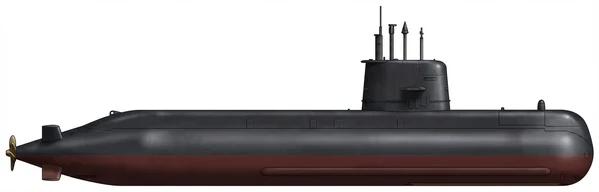
Description
The Blekinge-class submarine, also designated the A26 type, is a class of diesel-electric attack submarines developed by Saab Kockums for the Swedish Navy and ordered by the Polish Navy. The project originated in the early 1990s under the designation "U-båt 2000." Following the end of the Cold War, the program was suspended until the mid-2000s, when Sweden identified a requirement to replace its Södermanland-class submarines. An initial joint Scandinavian effort, the Viking class, dissolved when Denmark withdrew from submarine operations, prompting Kockums to proceed independently.
Design development began formally in 2010 when Kockums signed a design contract with the Swedish Defence Materiel Administration (FMV). In 2014, disputes between the Swedish government and Kockums' then-owner, ThyssenKrupp, led to the temporary cancellation of the project and a government repossession of FMV-owned materials and secret blueprints under armed escort. Saab subsequently purchased Kockums, and the Swedish government ordered two submarines in 2015. Contract renegotiations in 2021 and 2025 adjusted the delivery schedule for the Swedish vessels to 2031 and 2033.
The Blekinge class is designed as an upgrade of the Gotland-class submarine, introducing blue-water operational capability. For propulsion, the class utilizes a diesel-electric system integrated with a fifth-generation Stirling air-independent propulsion (AIP) system to reduce acoustic signatures. The hull features Genuine Holistic Stealth (GHOST) technology to minimize detection and is built to withstand shock loads from underwater explosions. The sail is constructed from composite materials similar to those used on Visby-class corvettes. Onboard systems include the Safran Series 30 Search Optronic Mast, FAMOR S.A. control consoles, and the "Autonomous Ocean Core," an artificial intelligence system that assists with navigation, sensor fusion, electronic warfare, and uncrewed system coordination. For weapon and deployable systems, the submarines feature torpedo tubes capable of launching and recovering uncrewed vehicles, heavy and lightweight torpedoes, and a Multi-mission Portal designed for special forces and larger uncrewed underwater vehicles.
No vessels of the class are currently in service. Two submarines, HSwMS Blekinge and HSwMS Skåne, are under construction for the Swedish Navy. Poland selected the A26 for its Orka program, ordering three submarines in June 2026 with deliveries planned to begin in 2031. Saab Kockums also markets three export variants—Pelagic, Oceanic, and Oceanic (Extended Range)—which can be configured with an optional vertical launch system module for cruise missiles. The design has been offered to Chile and Greece, while prior bids to Australia, Canada, the Netherlands, and Norway were unsuccessful.
Frequently Asked Questions
What type of ship is the Blekinge-class?
What is the displacement of the Blekinge-class?
How many crew members serve on the Blekinge-class?
Which countries operate the Blekinge-class?
How much does a Blekinge-class cost?
- JUL 272026 Updated Endurance updated
- JUL 252026 Created Page created: Blekinge; then built and max speed removed