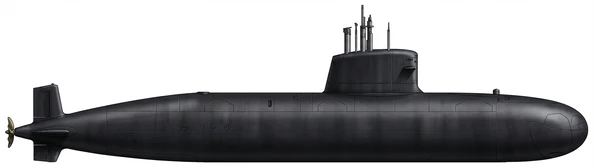
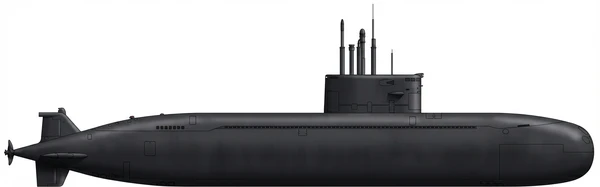
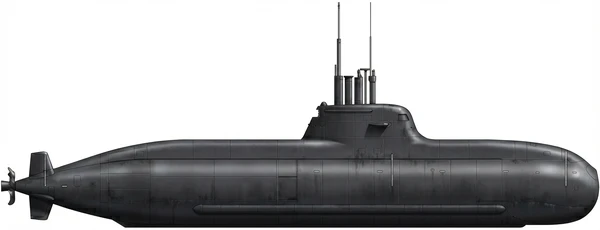
The Scorpène class is a series of diesel-electric attack submarines jointly developed by the French company Naval Group and the Spanish company Navantia. Designed to succeed the Agosta class, the design is currently marketed by Naval Group following the conclusion of the joint partnership. The class is intended for export and involves technology transfer agreements for domestic construction in several purchasing nations.
The design includes three primary variants: the CM-2000 conventional version, the AM-2000 featuring air-independent propulsion (AIP), and the CA-2000 coastal model. National variants include the Indian Kalvari class and the Brazilian Riachuelo class. Propulsion is diesel-electric, with the option to integrate the Module d'Energie Sous-Marine Autonome (MESMA) AIP system. This system utilizes ethanol and oxygen combustion to generate steam for a turbine, extending underwater endurance. A further iteration, the Scorpène Evolved, incorporates lithium-ion battery technology. Sensor systems include the TSM 2233 Mk 2 sonar or the Thales S-Cube suite.
The Chilean Navy was the initial operator, commissioning two units in 2005 and 2006. The Royal Malaysian Navy commissioned two submarines in 2009. India's Kalvari class (six boats built by Mazagon Dock Limited under Project 75, in service since 2017) and Brazil's Riachuelo class (an enlarged hull built at Itaguaí, in service since 2022) are national derivatives built under technology-transfer agreements and are described as separate classes.
Indonesia signed a contract for two Scorpène Evolved units to be built by PAL Indonesia, with the contract entering into force in July 2025. Other nations, including Argentina, Romania, and the Philippines, have evaluated the design for potential procurement. In 2016, technical documents regarding the Indian variant were leaked to the media, leading to legal action in Australia. The design has also been proposed for requirements in Poland, Norway, and Spain, though those countries selected alternative submarine classes.