Golf I & II-class (Project 629)
Ex-USSR diesel-electric submarine, introduced in 1958, carried three R-13 ballistic missiles in a vertical launch configuration. Key figures: displacement 2,794 tons, length 98 m, top speed 17 knots, crew 80, built 23. No longer in service; operated by 2 navies over its career.
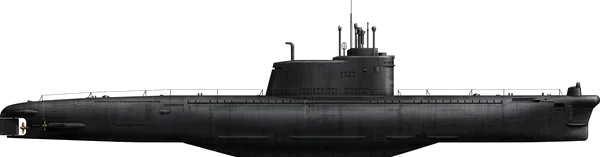
| Subtype | Diesel-electric ballistic missile submarine |
| Displacement | 2794 tons |
| Displacement submerged | 3553 tons |
| Crew | 80 members |
| Width | 8.2 m (26.9 ft) |
| Length | 98.4 m (322.8 ft) |
| Max. depth | 300 m (984.3 ft) |
| Propulsion | 3 × diesel engines, each 2,000 bhp (1,500 kW); 3 × electric motors, 5,200 shp (3,880 kW); 3 shafts |
| Units | K-129, K-229, K-118, K-102, K-153, K-61, B-42, K-107, Great Wall 200 |
| Range | 9,500 nm at 5 knots |
| Endurance | 70 days |
| Maximum speed | 17 knots |
| Max. speed submerged | 12 knots |
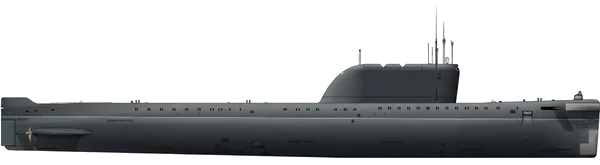

Description
Project 629, designated Golf by NATO, was developed in the mid-1950s by OKB-16. The design was based on the Foxtrot-class submarine and integrated the D-2 missile launch system. Construction took place at shipyards in Severodvinsk and Komsomolsk-na-Amure. The first vessels entered service in 1958, with the production run concluding in 1962.
The class features a sail-mounted vertical launch configuration. In the original Project 629 (Golf I) configuration, ballistic missiles were housed in silos located behind the bridge and required surfacing for launch. Between 1966 and 1972, several units were modified to the Project 629A (Golf II) standard. This refit incorporated the D-4 launch system, which enabled the deployment of R-21 missiles from a submerged position. Specialized variants included Project 601 for expanded missile capacity, Project 605 and 619 for testing new missile types, and Project 629R, which served as command posts with missile and torpedo tubes removed. The Chinese Type 6631 variant, later designated Type 031, was modified to accommodate solid-fueled missiles.
The Soviet Navy operated the majority of the class, while the People's Liberation Army Navy utilized a Chinese-built unit and a second hull for reverse engineering. In March 1968, the Soviet vessel K-129 sank in the Pacific Ocean. The United States recovered portions of the hull in 1974 during Project Azorian. Soviet units were removed from service by 1990. In 1993, North Korea acquired decommissioned hulls for scrap. Reports indicate potential attempts to return these vessels to service or use them as a basis for new construction. The Chinese unit, renamed Great Wall 200, remains in service as a platform for training and missile testing.
Frequently Asked Questions
What type of ship is the Golf I & II-class?
What is the displacement of the Golf I & II-class?
What is the maximum speed of the Golf I & II-class?
What is the range of the Golf I & II-class?
How many crew members serve on the Golf I & II-class?
How many Golf I & II-class ships have been built?
Which countries operate the Golf I & II-class?
- APR 72026 Updated Description updated in a site-wide editorial pass
- JAN 182026 Updated Units added; type, manufacturer and 7 more fields updated