Type 205-class
German diesel-electric submarine, introduced in 1962, displaced 419 tons. Key figures: displacement 419 tons, length 44 m, top speed 10 knots, crew 22, built 13. No longer in service; operated by 2 navies over its career.
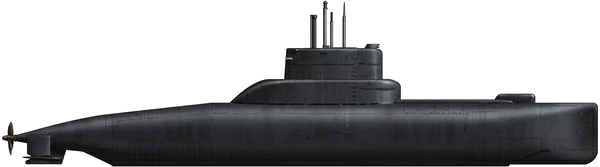
| Subtype | Diesel-electric submarine |
| Displacement | 419 tons |
| Displacement submerged | 455 tons |
| Crew | 22 members |
| Width | 4.59 m (15.1 ft) |
| Length | 44.3 m (145.3 ft) |
| Max. depth | 100 m (328.1 ft) |
| Propulsion | 2 × 440 kW (590 hp) Mercedes-Benz 4-stroke V12 diesel engines each coupled to a BBC generator; 1 × 1,100 kW (1,500 hp) SSW electric motor |
| Units | U-1, U-2, U-4, U-5, U-6, U-7, U-8, U-9, U-10, U-11, U-12, Narhvalen, Nordkaperen |
| Range | 3,950 nm at 4 knots |
| Maximum speed | 10 knots |
| Max. speed submerged | 17 knots |
- 8 × 533 mm (21 in) torpedo tubes
- Torpedoes and naval mines
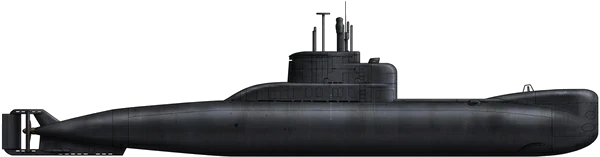
Description
The Type 205 is a class of German diesel-electric submarines developed as an evolution of the Type 201. Designed by Ingenieurkontor Lübeck (IKL) under the direction of Ulrich Gabler, the class was optimized for operations in the shallow waters of the Baltic Sea. The primary design change from the preceding Type 201 was the use of ST-52 steel for the pressure hull, as the non-magnetic steel used in the earlier class had proven problematic. The Type 205 also featured a lengthened hull and updated machinery and sensors.
The class consists of 13 completed vessels, with construction divided between Howaldtswerke in Kiel and the Copenhagen Naval Dockyard. The German Navy commissioned 11 boats between 1962 and 1969. The Royal Danish Navy operated two vessels, known as the Narhvalen class, which were modified to meet specific Danish requirements.
Several units were utilized for experimental or specialized roles. U-1 was used to test an experimental closed-cycle diesel air-independent propulsion system. U-11 was converted to a Type 205A double-hulled configuration, with the outer hull filled with polystyrene foam for use as a torpedo target. U-12 was designated Type 205B and served as a platform for sonar trials.
The Type 205 entered service in 1962 and the final units were decommissioned in 2005. Early German units, specifically U-4 through U-8, were retired in 1974. The Danish vessels were decommissioned in 2003 and 2004. Three vessels were preserved as museum ships: U-9 in Speyer, U-10 in Wilhelmshaven, and U-11 in Burgstaaken. The class was succeeded by the Type 206 submarine, which successfully reintroduced non-magnetic steel hulls.
Frequently Asked Questions
What type of ship is the Type 205-class?
What is the displacement of the Type 205-class?
What is the maximum speed of the Type 205-class?
What is the range of the Type 205-class?
How many crew members serve on the Type 205-class?
How many Type 205-class ships have been built?
Which countries operate the Type 205-class?
- JUL 242026 Updated Type updated
- APR 72026 Updated Description updated in a site-wide editorial pass
- JAN 182026 Updated Range at cruise speed added; type, manufacturer and 7 more fields updated