M10 Wolverine
Summary
| Origin country | 🇺🇸 United States |
| Category | Tank Destroyer |
| Sub-type | Tank Destroyer |
| Manufacturer | U.S Army Ordnance |
| Number built | 5000 units |
Technical specifications
| Crew | 5 personnels |
| Range | 322 km |
| Mass | 29.0 tons |
| Height | 2.5 m (8.2 ft) |
| Width | 3.05 m (10.0 ft) |
| Length | 6.0 m (19.7 ft) |
| Max. speed | 48 km/h (30 mph) |
| Engine | General Motors S6-71 Diesel Engines (x2) with 375 hp each |
| Weapon 1 | 1 M7 76.2mm gun |
| Weapon 2 | 1 M2 12.7mm machine gun |
Historical operators
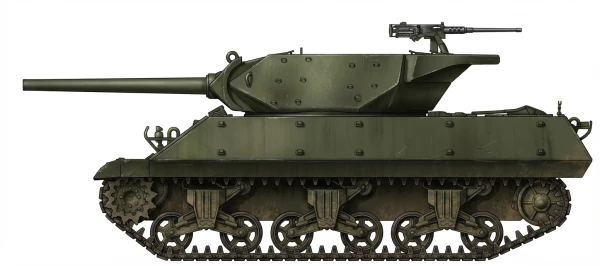
Profile of M10 Wolverine
Description
The 3-inch Gun Motor Carriage M10 was developed by the U.S. Army Ordnance Department in 1942. Its creation was driven by the requirements of the Tank Destroyer Force for a vehicle equipped with a gun in a fully rotating turret, as earlier interim models were criticized for design deficiencies. The prototype, designated T35, utilized an early-production M4A2 medium tank hull and a 3-inch gun. Following testing at Aberdeen Proving Ground, the design was modified with sloped hull armor and a welded pentagonal turret, leading to its standardization as the M10 in June 1942. Production was carried out by the Fisher Body division of General Motors and the Ford Motor Company. To ensure sufficient supply, the M10A1 variant was also authorized, utilizing the M4A3 medium tank chassis.
The M10 is built on a modified M4 medium tank chassis and features an open-topped turret. This design was intended to provide the crew with increased visibility and facilitate communication with accompanying infantry, though it left the crew vulnerable to artillery, grenades, and sniper fire. The primary armament is the 3-inch gun M7, which fires armor-piercing, high-explosive, and smoke ammunition. Secondary armament consists of a .50 caliber Browning M2HB machine gun mounted on the rear of the turret. The hull and turret utilize sloped armor plates to improve protection against anti-tank fire. The M10 variant is powered by a twin diesel engine, while the M10A1 is equipped with a gasoline V8 engine. The vehicle uses a vertical volute spring suspension system and a synchromesh transmission.
The M10 served as the primary American tank destroyer during World War II, seeing action in North Africa, Italy, Northwest Europe, and the Pacific. It made its combat debut in March 1943 at the Battle of El Guettar during the Tunisian campaign. During the Normandy campaign, the 3-inch gun was found to be ineffective against the frontal armor of German Panther tanks, which resulted in the prioritization of the 90mm-armed M36 for tank destroyer battalions. In the Pacific theater, M10s were employed as mobile artillery and infantry support due to limited Japanese armor opposition. Under the Lend-Lease program, the M10 was supplied to the United Kingdom, Canada, Free French forces, and the Soviet Union. British versions were frequently up-gunned with the 17-pounder gun and designated as the Achilles.
Post-war, the M10 was operated by several countries, including Belgium, Denmark, the Netherlands, and the Republic of China. Israel acquired surplus M10s after 1948 and later modified them with 17-pounder or French 75mm guns, keeping them in service until 1966. During the Battle of the Bulge, German forces utilized Panther tanks modified to resemble the M10, known as the Ersatz M10. While the name "Wolverine" appeared in wartime advertising, it was an unofficial nickname not used by American troops, who referred to the vehicle by its formal designation or as a "TD."