M1117 ASV
Summary
| Origin country | 🇺🇸 United States |
| Category | Light Armoured Vehicle |
| Sub-type | Armored Security Vehicle |
| Manufacturer | Textron |
| Number built | 2058 units |
| Est. avg unit price | $0.8 million |
Technical specifications
| Crew | 3 personnels |
| Range | 700 km |
| Mass | 13.4 tons |
| Height | 2.64 m (8.7 ft) |
| Width | 2.38 m (7.8 ft) |
| Length | 6.1 m (20.0 ft) |
| Max. speed | 100 km/h (62 mph) |
| Engine | Cummins 6CTA8.3 260 hp diesel |
| Weapon 1 | Mk 19 40mm grenade launcher |
| Weapon 2 | M2HB .50 cal machine gun |
| Weapon 3 | M240H 7.62mm machine gun |
Historical operators
Profile of M1117 ASV
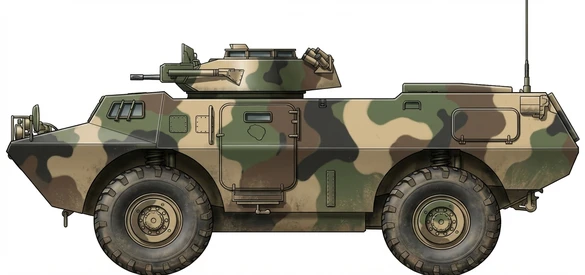
Description
The M1117 armored security vehicle (ASV), designated Guardian, was developed in the late 1990s for the United States Army Military Police Corps. It is a derivative of the V-100 and V-150 Commando series of armored cars used during the Vietnam War. Prototypes appeared in February 1997, and serial production commenced between 1999 and 2000. Although the program was nearly canceled in 2002, the start of the Iraq War in 2003 led to increased production as a response to the threat of improvised explosive devices (IEDs). The vehicle was adopted to replace unarmored light utility vehicles in roles requiring higher levels of protection for convoy security and rear-area patrols.
The M1117 is constructed with a specialized mine-resistant hull utilizing a V-shape to deflect explosive forces. Its armor system consists of a modular expandable package featuring ceramic composite appliqué on the exterior and an interior spall liner. The design uses angled surfaces to deflect rocket-propelled grenade hits and small arms fire. Primary armament is housed in a turret similar to that of the Amphibious Assault Vehicle, typically mounting a Mk 19 grenade launcher and an M2HB machine gun. An M240H machine gun is positioned at the gunner’s hatch. The vehicle utilizes an independent suspension system and an automatic transmission. Internal features include air conditioning and a gas particulate air filtration system. Several variants exist, including command and control, recovery, reconnaissance, ambulance, and infantry carrier configurations. A fire support variant was also developed, equipped with a 90mm low-pressure cannon.
United States military police units first field-tested the vehicle in Kosovo and subsequently deployed it for convoy security and patrol duties in Iraq and Afghanistan. The M1117 is widely exported and serves with numerous international operators. Canada operates a modified version known as the Tactical Armoured Patrol Vehicle (TAPV). Other nations utilizing the vehicle include Colombia, Greece, Iraq, Bulgaria, Kenya, and Ukraine. In Afghanistan, it was designated as the Mobile Strike Force Vehicle (MSFV) for the national army. Following the withdrawal of U.S. forces and various regional conflicts, quantities of the vehicle were captured and operated by non-state actors, including the Taliban and the Islamic State. The United States Army added the M1117 to its divestiture list in 2019, with the Oshkosh M-ATV intended as its replacement.