M18 Hellcat
Summary
| Origin country | 🇺🇸 United States |
| Category | Tank Destroyer |
| Sub-type | Tank Destroyer |
| Manufacturer | U.S Army Ordnance |
| Number built | 2500 units |
Technical specifications
| Crew | 5 personnels |
| Range | 240 km |
| Mass | 18.1 tons |
| Height | 2.6 m (8.5 ft) |
| Width | 3.0 m (9.8 ft) |
| Length | 6.7 m (22.0 ft) |
| Max. speed | 80 km/h (50 mph) |
| Engine | Continental R-975 Diesel Engine with 400 hp |
| Weapon 1 | 1 M7 76.2mm gun |
| Weapon 2 | 1 M2 12.7mm machine gun |
Historical operators
Profile of M18 Hellcat
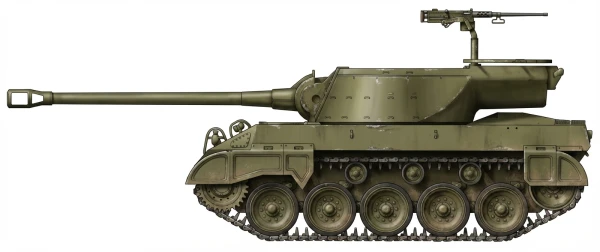
Description
The 76 mm Gun Motor Carriage M18 originated from a 1941 United States Tank Destroyer Force requirement for a vehicle with higher speeds and greater firepower than existing tanks, but with reduced armor to facilitate mobility. Development was led by the Buick Motor Division of General Motors and progressed through several prototypes, including the T42, T49, and T67, which tested different gun calibers and suspension systems. The final design, the T70, was standardized as the M18 in 1944. Production took place between July 1943 and October 1944.
The M18 features a torsion bar suspension and a Wright-Continental R-975 radial aircraft engine. The powerplant is paired with a Torqmatic automatic transmission providing three forward gears and one reverse. Innovative maintenance features include a rail system that allows the engine and transmission to be slid out of the hull for access. The vehicle is operated by a five-man crew, with the driver and assistant driver provided with identical controls.
Primary armament consists of a 76 mm gun (M1A1, M1A1C, or M1A2) with a 360-degree electro-hydraulic traverse and a maximum firing rate of 20 rounds per minute. Secondary armament is a .50 caliber Browning M2HB machine gun on a flexible ring mount. The hull and turret utilize light armor designed primarily to provide protection against small arms fire and shell fragments. The turret is open-topped, providing the crew with high visibility for identifying targets but exposing them to snipers and grenades. The 76 mm gun’s performance against heavy German armor was improved in late 1944 with the introduction of High Velocity Armor Piercing (HVAP) ammunition.
The M18 entered combat in early 1944 during the breakout from the Anzio beachhead in Italy. It was subsequently deployed throughout Western Europe, specifically with the Third U.S. Army. During the Battle of Arracourt, the 704th Tank Destroyer Battalion used the vehicle to flank and destroy German Panzer formations. The M18 also participated in the defense of Noville during the Battle of the Bulge. In the Pacific Theater, the vehicle was utilized for infantry support during the Battle of Manila and on Okinawa.
Following World War II, the United States retired the M18 from active service, though the M39 armored utility vehicle variant served in the Korean War as a personnel and munitions carrier. The M18 was widely exported under the Mutual Defense Assistance Act. It has been operated by several countries, including Greece, Iran, and Venezuela. Yugoslavia utilized the M18 through the 1990s, including during the Yugoslav Wars. Taiwan also operated the vehicle, eventually mounting M18 turrets onto surplus M42 Duster hulls to create the Type 64 light tank.