M50 Ontos
American tank destroyer, 297 units built, armed with six 106mm recoilless rifles. Key figures: weight 8.3 t, top speed 48 km/h, range 240 km, built 297. In service with 1 army — United States.
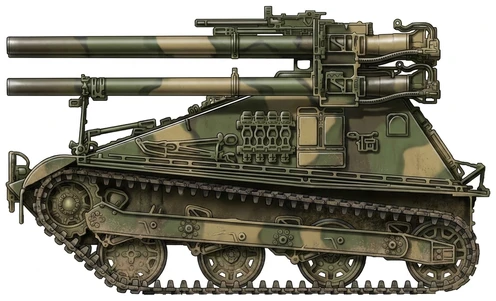
| Sub-type | Tank Destroyer |
| Crew | 3 personnels |
| Range | 240 km |
| Mass | 8.3 tons |
| Height | 2.13 m (7.0 ft) |
| Width | 2.6 m (8.5 ft) |
| Length | 3.82 m (12.5 ft) |
| Max. speed | 48 km/h (30 mph) |
| Engine | General Motors Model 302 Diesel Engine with 145 hp |
| Weapon 1 | 6s 106mm gun |
| Weapon 2 | 4 12.7mm machine guns |
| Weapon 3 | 1 7.62mm M1919A4 machine gun |
Description
The Rifle, Multiple 106 mm, Self-propelled, M50 Ontos was developed as an air-transportable tank destroyer for the United States military. Designed by Allis-Chalmers starting in 1952, the vehicle was intended for transport by cargo aircraft, which necessitated a restricted weight profile and the use of a standard six-cylinder gasoline engine. Allis-Chalmers produced pilot vehicles based on the running gear of the M56 Scorpion. Although the United States Army canceled its order in 1955 following testing at Aberdeen Proving Ground, the United States Marine Corps adopted the vehicle, with production occurring between 1955 and 1957.
The M50 features a cast steel turret with two external arms each holding three M40A1C recoilless rifles. These six main guns are manually loaded and can be fired in rapid succession. Targeting is facilitated by four .50 caliber spotting rifles mounted to the main guns, which fire tracer rounds that follow the same trajectory as the 106 mm ammunition. The vehicle is operated by a crew of three: a driver, gunner, and loader. Internal space limits the ammunition load, and the loader must exit the vehicle to reload the external rifles. Secondary armament consists of a single .30 caliber M1919A4 machine gun. The armor provides protection against small arms fire but is vulnerable to mines and rocket-propelled grenades.
The United States Marine Corps operated the M50 from 1956 until 1969. It saw combat during the 1958 Lebanon Crisis, the Dominican Civil War, and the Vietnam War. In the Dominican conflict, M50 units engaged and destroyed L/60L light tanks and an AMX-13. During the Vietnam War, the vehicle was primarily employed in a direct fire support role against infantry and fortified positions. It was utilized in the Battle of Huế to breach walls and was frequently deployed in static defense positions. The vehicle's weight permitted movement across pontoon bridges and transport via heavy-lift helicopter slings. Following its withdrawal from frontline service in 1969, some units were transferred to a United States Army light infantry brigade for use until spare parts were exhausted. The remaining vehicles were removed from service in 1970.
Frequently Asked Questions
What type of vehicle is the M50 Ontos?
What is the weight of the M50 Ontos?
What is the maximum speed of the M50 Ontos?
What is the operational range of the M50 Ontos?
How many crew members does the M50 Ontos require?
How many M50 Ontos have been built?
What weapons does the M50 Ontos carry?
- JUL 272026 Updated M50 Ontos: service entry year added; M50 Ontos: service status added
- APR 72026 Updated Description added
- JAN 172026 Updated Description added