M551 Sheridan
American light tank, 123 units built, saw limited action in Vietnam due to its light armor. Key figures: weight 15.203 t, top speed 70 km/h, range 600 km, built 123. In service with 1 army — United States.
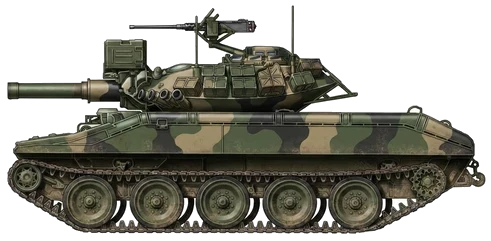
| Sub-type | Light Reconnaissance Tank |
| Crew | 4 personnels |
| Range | 600 km |
| Mass | 15.2 tons |
| Height | 3.81 m (12.5 ft) |
| Width | 2.79 m (9.2 ft) |
| Length | 6.31 m (20.7 ft) |
| Max. speed | 70 km/h (43 mph) |
| Engine | General Motors 6V53T V-6 Diesel Engine with 300 hp |
| Weapon 1 | 1 152mm gun |
| Weapon 2 | 2 M-240 7.62mm machine guns |
Description
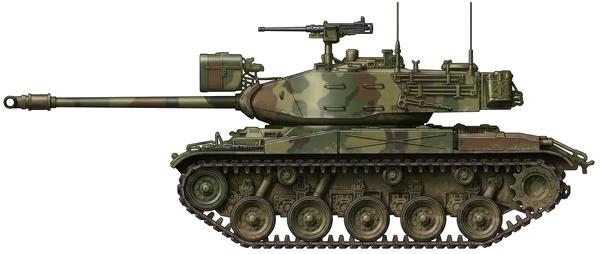
The M551 Sheridan Armored Reconnaissance/Airborne Assault Vehicle (AR/AAV) was developed by the United States to replace the M41 Walker Bulldog and M56 Scorpion. Concept studies initiated in January 1959 led to the selection of a Cadillac Motor Car Division design from General Motors. The vehicle was officially named after General Philip Sheridan in 1961. Designed for strategic mobility, the platform was intended to be parachute-deployable and capable of amphibious operations. Production occurred between 1966 and 1970 at the Cleveland Army Tank Automotive Plant.
The Sheridan features an aluminum alloy hull and a rolled homogeneous steel turret. Its primary armament consists of the 152mm M81E1 gun/launcher, which fires conventional rounds and the MGM-51 Shillelagh guided anti-tank missile. This gun system utilizes combustible nitrocellulose-cased ammunition, which eliminated the requirement for metal shell casings but presented operational challenges regarding moisture absorption and breech residues. To address these issues, a scavenging system using compressed air was implemented to clear the breech after firing. Secondary armament includes a pintle-mounted .50 caliber M2 Browning machine gun and a coaxial 7.62mm machine gun. The vehicle is powered by a turbocharged diesel engine with a torsion bar suspension system. For amphibious use, the Sheridan employs a flotation screen and a folding surfboard for buoyancy. It was designed for deployment via transport aircraft using low-velocity airdrops or the Low Altitude Parachute Extraction System (LAPES).
The M551 entered service in 1967 and was deployed to South Vietnam in 1969. During the Vietnam War, the Sheridan served in reconnaissance, patrol, and road clearing roles. Combat performance highlighted vulnerabilities to mines and rocket-propelled grenades, which could ignite the combustible-case ammunition. Following the war, the U.S. Army began phasing out the vehicle from most units, though it was retained by the 82nd Airborne Division and the National Guard.
In 1989, during Operation Just Cause in Panama, the 82nd Airborne Division conducted a combat airdrop of the M551. The vehicle later saw service in the Gulf War during Operations Desert Shield and Desert Storm, primarily in reconnaissance roles where it conducted tank-on-tank engagements. The Sheridan was also utilized as a simulated Soviet opposition force (OPFOR) at the National Training Center until 2003, using visual modification kits to resemble Warsaw Pact armor. Australia trialed the vehicle in the late 1960s but did not adopt it due to safety concerns regarding the ammunition cases. The U.S. Army retired the M551 in 1996 without a designated replacement.
Frequently Asked Questions
What type of vehicle is the M551 Sheridan?
What is the weight of the M551 Sheridan?
What is the maximum speed of the M551 Sheridan?
What is the operational range of the M551 Sheridan?
How many crew members does the M551 Sheridan require?
How many M551 Sheridan have been built?
What weapons does the M551 Sheridan carry?
- JUL 272026 Updated M551 Sheridan: manufacturer added; M551 Sheridan: service entry year added; M551 Sheridan: service status added
- APR 72026 Updated Description added
- JAN 172026 Updated Description added