M777 Howitzer
Summary
| Origin country | 🇺🇸 United States |
| Category | Towed Artillery |
| Sub-type | Towed 155 mm artillery piece |
| Manufacturer | BAE Systems |
| Est. avg unit price | $3.7 million |
Technical specifications
| Crew | 8 (normal), 5 (minimum), 3 (minimal emergency) personnels |
| Range | 70 km |
| Mass | 4.2 tons |
| Length | 9.1 m (29.9 ft) |
| Weapon 1 | 155 mm 55-caliber barrel |
| Weapon 2 | M982 Excalibur GPS-guided munition |
| Weapon 3 | M1128 projectile |
| Weapon 4 | XM1113 rocket-assisted projectile |
Historical operators
Profile of M777 Howitzer
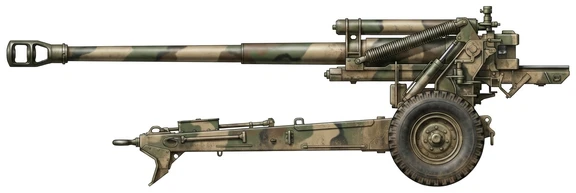
Description
The M777 is a towed artillery piece developed by BAE Systems. Development began in 1987 as the Ultralight Field Howitzer project by Vickers' Armaments Division in the United Kingdom. Following BAE Systems' assumption of the project, the design was modified to utilize United States-produced parts. Major structural components and recoil systems are manufactured in England, while final integration and testing are conducted in the United States. The weapon entered service in 2005 as a replacement for the M198 howitzer.
The design incorporates titanium to reduce mass compared to previous systems. The gun barrel, designated M776, serves as the towing bar through a forged projection on the muzzle brake. The howitzer is transportable by helicopter sling-load, transport aircraft such as the C-130 or C-5, or by towing with medium tactical vehicles. A standard gun crew consists of eight personnel, though the weapon can be operated by a crew of three in emergencies.
The M777A1 and M777A2 variants use digital fire-control systems for navigation, pointing, and self-location, allowing for rapid transition into action. The M777A2 is compatible with precision-guided munitions such as the M982 Excalibur and the Bofors/Nexter Bonus sensor-fused round. Canadian variants, designated M777C1, utilize a Digital Gun Management System that integrates specialized fire control software.
The artillery piece is operated by the ground forces of Australia, Canada, Colombia, India, Saudi Arabia, Ukraine, and the United States. In India, most units were assembled locally through a partnership with Mahindra Defence Systems. Production of the system was resumed in 2024 to address international orders and supply requirements.
Combat deployment began in 2006 with Canadian forces in Afghanistan, specifically during the Battle of Panjwaii. United States units first utilized the weapon in combat in 2008 during operations in Iraq and Afghanistan. The system provided fire support during the military intervention against ISIL, including engagements at Firebase Bell in Iraq and Firebase Saham in Syria. During the 2022 Russian invasion of Ukraine, the howitzer was utilized for its accuracy relative to older systems. Combat use in Ukraine indicated the weapon is susceptible to shrapnel damage and requires regular barrel changes during high-volume firing. The Indian Army has deployed the howitzer in mountainous regions during border standoffs with China and in the Himvijay exercise.