A900
Spanish fuel-powered unmanned tactical helicopter, developed in the mid-2010s, used for maritime ISR, surveillance and reconnaissance missions. Key figures: top speed 100 km/h, range 200 km, service ceiling 3,000 m, max takeoff weight 25 kg, unit price $0.3M. In service with 1 air force as of 2026 — Greece (10).
| Length | 1.8 m (5.8 ft) |
| Wingspan | 2.1 m (6.8 ft) |
| Max. takeoff weight | 25 kg (55 lbs) |
| Powerplant | 1 × 100cc two-stroke boxer engine |
| Maximum speed | 100 km/h (62 mph) |
| Operational range | 200 km (124 mi) |
| Endurance | 4 hours |
| Service ceiling | 3,000 m (9,843 ft) |
Description
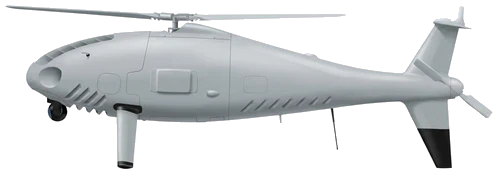
The A900 (Alpha 900) is a fuel-powered unmanned tactical helicopter developed by Alpha Unmanned Systems of Spain. Built for maritime ISR, border control and persistent surveillance, it operates autonomously from vessels of all sizes as well as from land, and entered Hellenic Navy service from late 2021. It is unarmed, and is known for automatic vertical take-off and landing from moving ships in sea states up to 5.
Development
Alpha Unmanned Systems, S.L. is a privately owned company headquartered in Madrid, founded in 2014 by Juan Luque, Alvaro Escarpenter and Eric Freeman. The A900 builds on the company's earlier Alpha 800 unmanned helicopter and was designed and built to STANAG 4738, with the airframe and systems qualified against MIL-STD-461F EMC and MIL-STD-810F environmental requirements. In April 2023 the U.S. Department of Defense awarded a prime contract to Rapid Expeditionary Concepts LLC covering integration, test, evaluation and deployment of A900 systems, with an operational evaluation conducted in southern Spain in May 2024. In June 2025, Alpha and Airbus Helicopters España announced a partnership on crewed-uncrewed teaming concepts pairing the A900 with Airbus helicopters.
Design
Maximum take-off weight is under 25 kg, with a payload capacity of up to 4 kg in the standard maritime ISR configuration and 6 kg in a heavy-payload configuration at the cost of endurance. Length is 1.76 m and main rotor diameter 2.07 m. Power comes from a single 100cc two-stroke boxer engine running on Jet A1, JP5, JP8 or gasoline, with an onboard generator supplying up to 150 W to payloads. Maximum speed is 100 km/h, cruise speed about 60 km/h, and service ceiling 3,000 m. Endurance is up to 4 hours, falling to 2.5 hours in stationary hover; mission range extends to 200 km with an encrypted datalink effective to about 100 km. The aircraft, ground control station and tracking antenna can be made operational in under 20 minutes. Shipboard landings use a double heading source with vessel-referenced flight and landing plans. Flight-critical systems are redundant, and the aircraft carries autonomous autorotation for engine failure, a radar altimeter and navigation lights for GPS-denied operation, and emergency flotation devices. Four payload bays accommodate electro-optical/infrared turrets with roughly 30x optical and 4x infrared zoom, LiDAR, AIS transponders and small cargo-release mechanisms.
Operational History
Early adopters were the Spanish Ministry of Defense and Spain's National Institute for Aerospace Technology (INTA). In November 2021 the Hellenic Navy signed an agreement with Greek partner Altus LSA and Alpha Unmanned Systems for five A900s for shipboard use, the type's first NATO sale; Greek aircraft conduct ISTAR duties including monitoring of migration flows in the Mediterranean and surveillance of straits, ports and other sites, and have appeared at the Thessaloniki Oxi Day parade. The Indonesian Maritime Security Agency (BAKAMLA) fields a maritime variant for coastal surveillance, and in March 2024 Indonesian military personnel evaluated the type at Husein Sastranegara International Airport, West Java, as a forward-observer platform for field-artillery spotting and coastal-defense target detection. Alpha partnered with PT Global Defense and PT MS.Tech for local assembly in Indonesia. The type was displayed at FEINDEF 2025.
Variants
- A900: Baseline maritime ISR configuration with up to 4 kg payload and 4 hours endurance.
- A900 heavy-payload configuration: Carries up to 6 kg of payload with reduced endurance.
- A900 T: Configured as an unmanned aerial target.
Frequently Asked Questions
What type of aircraft is the A900?
What is the maximum speed of the A900?
What is the range of the A900?
Which countries operate the A900?
How much does a A900 cost?
What is the service ceiling of the A900?
- AUG 202026 Updated Unit price filled (0.3 $M, estimate) for the UAV inventory weighting.
- AUG 202026 Created A900 page created: Spanish shipboard tactical helicopter UAV, Hellenic Navy operator