Antonov An-2 Colt
Summary
| Category | Military Transport Aircraft |
| Origin country | 🇨🇳 Ex-USSR |
| Manufacturer | Antonov |
| First flight | 31 August 1947 |
| Year introduced | 1947 |
| Number produced | 18000 units |
| Average unit price | $0.1 million |
Technical specifications
| Version: An-2 | |
|---|---|
| Crew | 2 |
| Operational range | 845 km (525 mi) |
| Maximum speed | 258 km/h (160 mph) |
| Wing area | 71.5 m² (769.8 sqft) |
| Wingspan | 18.2 m (59.7 ft) |
| Height | 4.1 m (13.5 ft) |
| Length | 12.4 m (40.7 ft) |
| Service ceiling | 4,500 m (14,764 ft) |
| Empty weight | 3,300 kg (7,275 lbs) |
| Max. takeoff weight | 5,440 kg (11,993 lbs) |
| Climb rate | 3.5 m/s (11.5 ft/s) |
| Powerplant | 1 x Shvetsov ASh-62IR radial engine delivering 750 kW each |
Current operating countries
| Country | Units | ||
|---|---|---|---|

|
North Korea | 270 | |

|
Vietnam | 6 | |

|
Latvia | 4 | |

|
Moldova | 2 | |

|
Bulgaria | 1 | |
All operators
Description
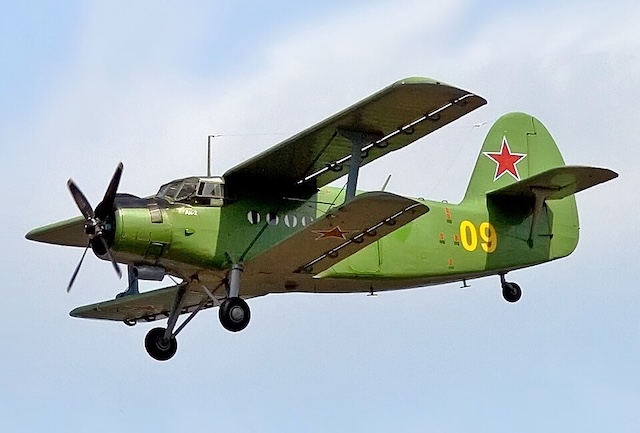
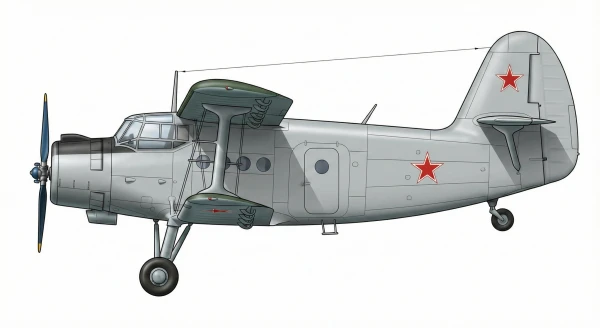
The Antonov An-2 was conceived in the 1940s to fulfill a Soviet Ministry of Forestry requirement for a replacement for the ubiquitous Polikarpov Po-2. Designed by the Antonov Design Bureau, the first prototype, designated SKh-1, achieved its maiden flight on 31 August 1947. Initial production was centered at State Factory 473 in Kiev, producing up to 5,000 units by 1960. Subsequently, the majority of the over 18,000 aircraft built were manufactured at Poland's WSK factory in Mielec, with production continuing until 1991. Limited assembly using remaining parts continued until 2001, and China also produced the aircraft under license as the Shijiazhuang Y-5. This exceptionally long production run, once a record, indicates the design's enduring utility.
The An-2 is a large, single-engine biplane of all-metal construction, renowned for its robustness and simplicity. Its most notable aerodynamic feature is a set of automatic leading-edge slats on the upper wing; held closed by airflow, these slats deploy via elastic springs when airspeed drops below 64 km/h, giving the aircraft an exceptionally low stall speed and remarkable short-field performance. The aircraft is equipped for rough-field operations with a pneumatic brake system and an onboard airline that allows for adjustment of tire and shock absorber pressure. Most versions are powered by the 750 kW (1,010 hp) Shvetsov ASh-62 nine-cylinder radial engine. The airframe's adaptability allowed for numerous specialized configurations, including versions equipped with floats, skis, and crop-dusting apparatus.
While primarily a utility transport, the An-2 has been adapted for combat roles. Its most significant armament modifications were often improvised in the field. During the Croatian War of Independence, aircraft were converted to drop makeshift barrel bombs. In the Vietnam War, the Vietnam People's Air Force used An-2s as attack platforms, employing machine guns and rockets. A specialized prototype, the An-2F artillery spotter, featured a dorsal defensive machine-gun position, while the An-2A balloon-interceptor concept was designed to carry a turreted 23 mm cannon or 12.7 mm heavy machine gun. The aircraft's general payload capacity is 2,140 kg.
The An-2 saw its first military service during the Korean War and was widely operated by the Soviet Union and Eastern Bloc nations. It was used in an offensive capacity by North Vietnamese forces in Vietnam and Laos, including a notable 1968 raid on a US TACAN site. In the 1991 Croatian War of Independence, its ability to operate from small, improvised airstrips made it invaluable for conducting supply missions to besieged garrisons, though its slow speed made it vulnerable to surface-to-air missiles. More recently, Azerbaijan employed unmanned An-2s for surveillance and bombing during the 2020 Nagorno-Karabakh war. The aircraft remains in widespread military and civilian service globally, valued for its low cost and operational flexibility.
Main Variants
- An-2T: The baseline first production model designed for transporting cargo and mail.
- An-2P: A standard passenger variant produced in both the Soviet Union and Poland, typically seating 10 to 14 passengers.
- An-2SKh: The agricultural version optimized for crop-spraying and dusting, featuring a chemical hopper in the cabin.
- An-2V: A seaplane version of the baseline An-2 fitted with large twin floats.
- Nanchang Y-5: The Chinese license-built version of the An-2, initially produced from Soviet blueprints.