Antonov An-22 Cock
Summary
| Category | Military Transport Aircraft |
| Origin country | 🇺🇦 Ukraine |
| Manufacturer | Antonov |
| First flight | 27 February 1965 |
| Year introduced | 1967 |
| Number produced | 68 units |
Technical specifications
| Version: An-22 Cock | |
|---|---|
| Operational range | 10,950 km (6,804 mi) |
| Maximum speed | 740 km/h (460 mph) |
| Wing area | 345 m² (3713.5 sqft) |
| Wingspan | 64.4 m (211.3 ft) |
| Height | 12.5 m (41.1 ft) |
| Length | 57.9 m (190.0 ft) |
| Service ceiling | 8,000 m (26,247 ft) |
| Empty weight | 114,000 kg (251,327 lbs) |
| Max. takeoff weight | 250,000 kg (551,155 lbs) |
| Takeoff distance | 1,460 m (4,790 ft) |
| Powerplant | 4 x turboprops Kuznetsov NK-12MA delivering 11186 kW each |
Current operating countries
| Country | Units | ||
|---|---|---|---|

|
Russia | 4 | |
1 recent event involving the An-22 Cock
| Date | Air Force | Aircraft | Active Δ | Ordered Δ |
|---|---|---|---|---|
| 9 Dec 2025 | 🇷🇺 Russian Air Force | An-22 | -1 | — |
| Strategic heavy transport crashed during test flight in Ivanovo region; 7 crew killed. Details → | ||||
Description
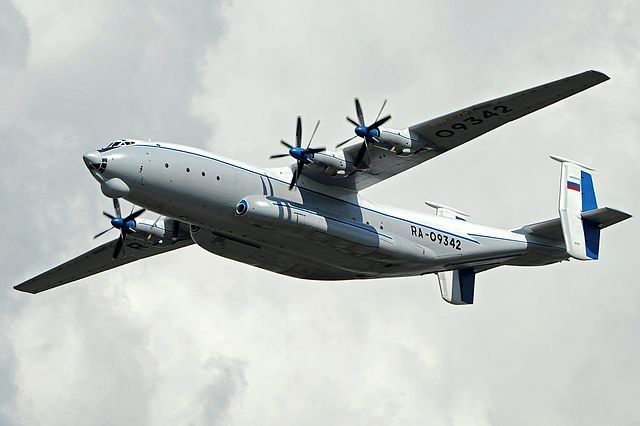
In the late 1950s, the Soviet Union identified a need for a large military transport aircraft to augment the Antonov An-8 and An-12 aircraft then entering service. The Antonov bureau responded with a conventional multi-engined, high-wing design, initially known as the An-20. In the early 1960s, a wooden mock-up designated the Model 100 was produced at the Kyiv, Ukraine, workshops. The prototype, redesignated An-22, was rolled out on 18 August 1964, and conducted its first flight on 27 February 1965. Named Antaeus, the prototype was displayed at the 1965 Paris Air Show after four months of test-flying. All An-22 aircraft were manufactured at the Tashkent State Aircraft Factory, with the first military delivery to the Air Transport Wing at Ivanovo Airbase in 1969.
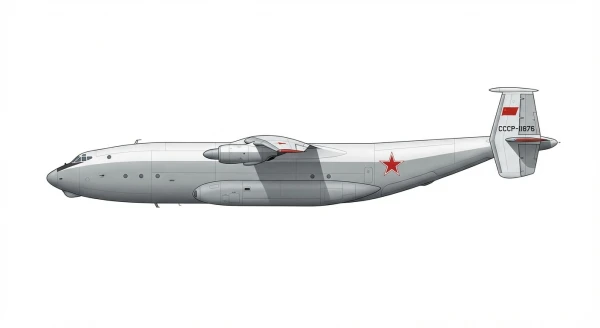
The An-22 is a high-wing design, enabling a spacious cargo compartment measuring 33 meters in length with a usable volume of 639 cubic meters. This substantial capacity enabled the aircraft to accommodate up to four BMD-1 armored vehicles, significantly enhancing operational capabilities. The aircraft was capable of carrying a maximum payload of 80,000 kg (176,370 lb) and has set a number of payload and payload-to-height world records. The forward fuselage is pressurized to accommodate 5 to 8 crew members and up to 28 passengers, while the cargo space maintains a lighter pressure of 3.55 PSI to reduce airframe weight. A pressure bulkhead-equipped door is located at frame 14, separating the cargo attendant's compartment from the main cargo compartment, allowing the rear cargo doors to be opened in flight for paratroop and equipment drops. The aircraft's capacity to operate from unpaved, short airstrips is facilitated by four pairs of contra-rotating propellers, which generate a slipstream over the wings and large double-slotted flaps. Its ruggedized landing gear, with in-flight adjustable tire pressures in early models, further contributes to its austere field capabilities. The An-22 also features a twin tail, enhancing engine-out performance and reducing height restrictions in hangars, with notable anti-flutter masses atop each tail.
The An-22 was initially produced for the Soviet Air Force and Aeroflot, with the Air Force beginning its transition from the An-12 in July 1974. Several Military Transport Aviation units were equipped with the An-22, including the 12th Mginsk Red Banner Military Transport Aviation Division and the 566th Solnechnogorsk Military Transport Aviation Regiment. The aircraft saw early operational use in delivering Soviet humanitarian aid to Peru in July 1970, following the Ancash earthquake, and in delivering military aid to Egypt and Syria during the Yom Kippur War in 1973, as well as to Angola in 1975 and Ethiopia in 1977. An-22s from Migalovo were instrumental in the initial deployment of Soviet Airborne Troops during the 1979 Soviet invasion of Afghanistan. In 1984, military An-22s delivered Mi-8 helicopters to Ethiopia during drought relief efforts, and in 1986, aircraft from the 8th Military Air Transport Aviation Regiment were used in the Chernobyl disaster relief operation. During 1987, the An-22s delivered military equipment to Angola, and a year later, they delivered 15,000 tons of supplies and 1,000 personnel for the 1988 Armenian earthquake relief operation.
Main Variants:
-
An-22: This was the initial production variant, featuring an external start system, with 37 units built at Tashkent.
-
An-22A: This improved variant introduced air-start capability, a modified electrical system, and updated radio and navigation equipment; 28 were built in Tashkent.
-
An-22PZ: This was a conversion of two An-22s designed to carry wing center sections or outer wings of the Antonov An-124 or An-225 externally above the fuselage and was fitted with a third centerline fin.