An-22 Cock vs C-17 Globemaster III
An-22 Cock vs C-17 Globemaster III at a glance — top speed 740 vs 930 km/h, range 10,950 vs 4,480 km, max takeoff weight 250,000 vs 259,460 kg, built 68 vs 279 units.
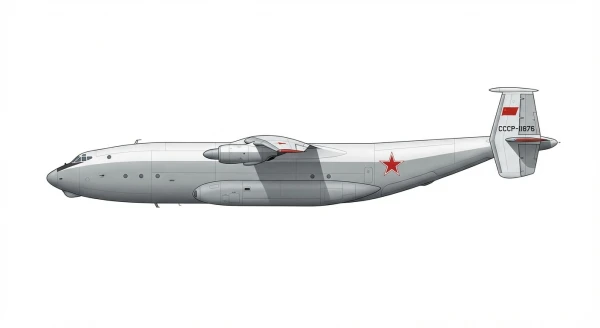
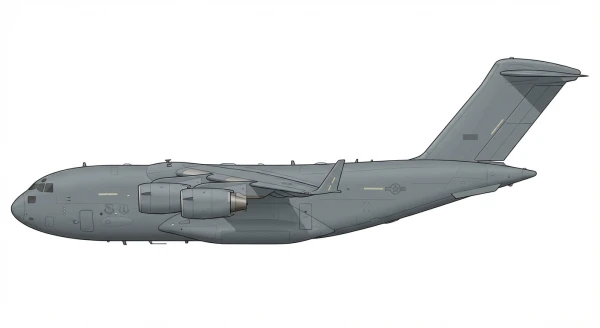
| An-22 Cock | C-17 Globemaster III | |
|---|---|---|
| Origin country | 🇺🇦 Ukraine | 🇺🇸 United States |
| Category | Military Transport Aircraft | Military Transport Aircraft |
| Manufacturer | Antonov | McDonnell Douglas |
| First flight | 27 February 1965 | 15 September 1991 |
| Year introduced | 1967 | 1993 |
| Number produced | 68 units | 279 units |
| Average unit price | -- | $340 million |
| Wing area | 345.0 m² | 353.0 m² |
| Wingspan | 64.4 m | 51.8 m |
| Height | 12.5 m | 16.8 m |
| Length | 57.9 m | 53.0 m |
| Maximum speed | 740 km/h | 930 km/h |
| Operational range | 10,950 km | 4,480 km |
| Service ceiling | 8,000 m | 13,715 m |
| Max. takeoff weight | 250,000 kg | 259,460 kg |
| Empty weight | 114,000 kg | 122,000 kg |
| Total thrust | 4 x 11,186 kW | 4 x 18,909 kgf |
Detailed Comparison
Separated by nearly three decades of aerospace development, the Antonov An-22 Cock and the Boeing C-17 Globemaster III illustrate the divergence between Soviet heavy-lift doctrine and American direct-delivery requirements. While the An-22 relies on the sheer torque of contra-rotating turboprops to lift oversized armor from austere Soviet airstrips, the C-17 utilizes advanced high-bypass turbofans and blown-flap systems to combine strategic range with tactical agility.
Development and Design
The An-22, born in the 1960s, was an upscaled evolution of the An-12, designed specifically to transport ICBMs and combat vehicles like the BMD-1 across the USSR's vast, infrastructure-poor interior. Its defining feature is the cavernous 639-cubic-meter cargo hold, maximized by a semi-pressurized fuselage design—only the crew and passenger compartments are fully pressurized, saving significant structural weight. The aircraft utilizes four massive Kuznetsov NK-12MA engines driving contra-rotating propellers, a setup chosen to generate maximum lift at low speeds for short-field performance.
Conversely, the C-17 was engineered in the 1980s to address the "airlift gap" between the C-130 and C-141. The design philosophy centers on direct delivery: flying equipment from the Continental U.S. directly to forward operating bases. The C-17 features a "powered lift" system where engine exhaust interacts with large flaps to allow steep, slow approaches. Unlike the An-22, the C-17 features a glass cockpit and a stick-controlled fly-by-wire system, reducing the crew to two pilots and a loadmaster, compared to the An-22’s five-to-eight-man flight deck.
Specifications and Performances
In raw payload, the aircraft are comparable, with the An-22 rated at 80,000 kg and the C-17 at roughly 77,000 kg. However, the operational tempo differs drastically due to propulsion. The C-17 cruises at 930 km/h (Mach 0.74+), significantly outpacing the An-22’s 740 km/h. This speed advantage allows the C-17 to complete more sorties within a given operational window, a critical factor in rapid deployment.
The An-22 holds a distinct advantage in unrefueled range (10,950 km) compared to the C-17’s 4,480 km at load. However, the C-17’s universal aerial refueling capability mitigates this limitation in Western doctrine. While the provided data lists the C-17 takeoff distance at 2,500 m (likely at MTOW), its tactical assault landing capabilities allow operation on runways as short as 1,064 m (3,500 ft), rivaling the An-22’s low-speed handling generated by its propeller slipstream.
Deployment and usage
The An-22 served as the backbone of Soviet strategic mobility during the Cold War. Its ability to operate from unpaved strips was utilized during the 1979 invasion of Afghanistan and airlift operations to Angola and Ethiopia. It proved vital for moving heavy infrastructure, such as during the Chernobyl relief effort. However, its lack of defensive systems and large radar cross-section relegated it to rear-echelon logistics in later years.
The C-17 transformed US logistics by eliminating the need for transloading cargo to smaller tactical aircraft. In Operation Iraqi Freedom (2003), C-17s executed the combat airdrop of the 173rd Airborne Brigade, a mission profile the An-22 could theoretically perform but without the survivability provided by the C-17’s modern electronic warfare suites and thrust reversers for tactical descents.
Conclusion
The C-17 Globemaster III is the superior combat platform. While the An-22 remains an engineering feat for its ability to lift outsized cargo from dirt strips, its utility is limited by slow cruise speeds, maintenance-heavy propulsion, and obsolescent avionics. The C-17’s ability to project power globally at jet speeds, then land on the same austere fields as the An-22, makes it the more versatile and survivable asset for modern warfare. The An-22 is a specialized hauler; the C-17 is a tactical weapon system.