An-22 Cock
Soviet strategic cargo aircraft, notably used during rescues, military airlifts, and humanitarian aid in the Cold War era. Key figures: top speed 740 km/h, range 10,950 km, service ceiling 8,000 m, max takeoff weight 250,000 kg, built 68. In service with 1 air force as of 2026 — Russia (4).
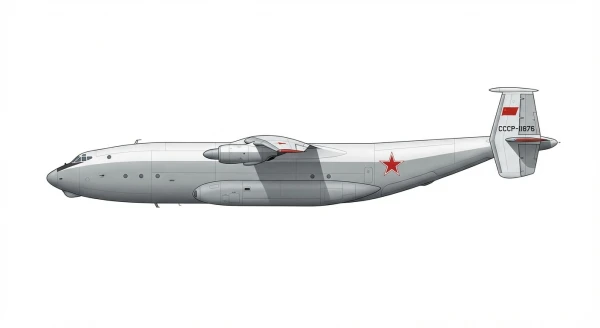
| Length | 57.9 m (190.0 ft) |
| Wingspan | 64.4 m (211.3 ft) |
| Height | 12.5 m (41.1 ft) |
| Wing area | 345 m² (3713.5 sqft) |
| Empty weight | 114,000 kg (251,327 lbs) |
| Max. takeoff weight | 250,000 kg (551,155 lbs) |
| Powerplant | 4 × turboprops Kuznetsov NK-12MA 11,186 kW each |
| Maximum speed | 740 km/h (460 mph) |
| Operational range | 10,950 km (6,804 mi) |
| Service ceiling | 8,000 m (26,247 ft) |
| Takeoff distance | 1,460 m (4,790 ft) |

Recent Events — An-22 Cock
1 event →
Description
The Antonov An-22 "Antei" (NATO reporting name "Cock") is a heavy military transport aircraft designed by the Antonov Design Bureau in the Soviet Union. Powered by four turboprop engines driving contra-rotating propellers, it was the first wide-body transport aircraft and remains the largest turboprop aircraft built. The type entered Soviet military service in 1969 as a strategic airlifter. It was operated primarily by the Soviet and Russian air forces until the final active aircraft crashed in December 2025.
Development
In the late 1950s, the Soviet Union initiated the design originally designated An-20 to supplement its An-8 and An-12 fleet. Antonov constructed a wooden mockup designated Model 100 in Kyiv before rolling out the An-22 prototype on 18 August 1964. The prototype completed its first flight on 27 February 1965 and was publicly displayed at the 1965 Paris Air Show. Serial production took place at the Tashkent State Aircraft Factory, delivering the first military aircraft to Ivanovo Airbase in 1969. Production comprised 37 standard An-22 aircraft and 28 updated An-22A models.
Design
The An-22 features a high-mounted wing, circular fuselage, and twin tail fin fitted with top-mounted anti-flutter masses. Power is supplied by four Kuznetsov NK-12MA turboprops rated at 11,000 kW each, driving eight-bladed contra-rotating propellers. Engine slipstream directed over double-slotted flaps and ruggedized landing gear allow operations from unpaved airstrips. The pressurized forward fuselage accommodates 5 to 8 crew members and up to 28 passengers, while the cargo hold is 33 meters long with a usable volume of 639 m³. Production aircraft incorporate nose-mounted radar, and the cargo bay is designed to carry up to 80,000 kg, including four BMD-1 armored vehicles.
Operational History
The Soviet Air Force began unit conversions to the An-22 in July 1974, equipping formations such as the 12th Mginsk Division and 566th Solnechnogorsk Regiment. The aircraft flew airlifts to Peru in 1970, Egypt and Syria in 1973, Angola in 1975 and 1987, and Ethiopia in 1977 and 1984. It deployed airborne troops during the 1979 invasion of Afghanistan, where one was shot down near Kabul on 28 October 1984. An-22s were also utilized during relief operations for the 1986 Chernobyl disaster and the 1988 Armenian earthquake, as well as peacekeeping deployments to Bosnia in 1995. Russia ceased operating the aircraft in August 2024, and the last operational An-22 crashed during a test flight in the Ivanovo region on 9 December 2025.
Variants
-
An-22 (prototypes): Three initial prototypes built at Kyiv featuring fully glazed noses and radar mounted under the right wheel well fairing.
-
An-22: Initial production transport variant built with an external engine start system, totaling 37 units manufactured in Tashkent.
-
An-22A: Upgraded production variant featuring air-start capability, a modified electrical system, an augmented flight control system, and updated avionics.
-
An-22PZ: Specialized conversion of two aircraft fitted with a third fin to transport An-124 and An-225 wing components externally above the fuselage.
-
Amphibious An-22: Projected water-landing variant that did not progress beyond the scale model stage.
Frequently Asked Questions
What type of aircraft is the An-22 Cock?
What is the maximum speed of the An-22 Cock?
What is the range of the An-22 Cock?
When did the An-22 Cock first fly?
How many An-22 Cock have been built?
Which countries operate the An-22 Cock?
What is the service ceiling of the An-22 Cock?
- AUG 62026 Updated Description updated
- APR 72026 Updated Picture credits updated in a site-wide editorial pass
- JAN 202026 Updated Range added