An-22 Cock vs Il-76 Candid
An-22 Cock vs Il-76 Candid at a glance — top speed 740 vs 850 km/h, range 10,950 vs 5,000 km, max takeoff weight 250,000 vs 195,000 kg, built 68 vs 960 units.
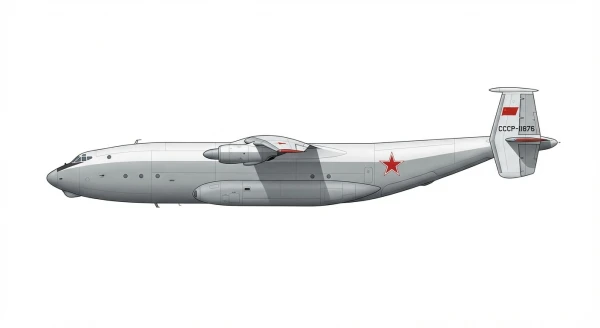
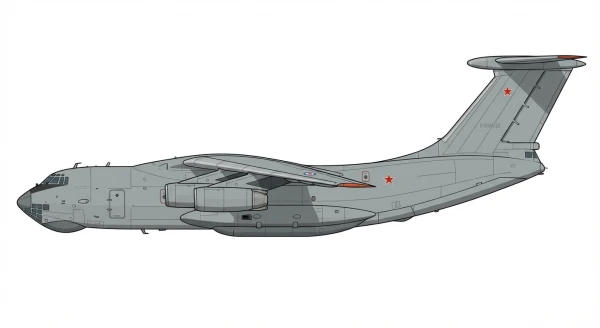
| An-22 Cock | Il-76 Candid | |
|---|---|---|
| Origin country | 🇺🇦 Ukraine | 🇷🇺 Ex-USSR |
| Category | Military Transport Aircraft | Military Transport Aircraft |
| Manufacturer | Antonov | Ilyushin |
| First flight | 27 February 1965 | 25 March 1971 |
| Year introduced | 1967 | 1974 |
| Number produced | 68 units | 960 units |
| Average unit price | -- | -- |
| Wing area | 345.0 m² | 300.0 m² |
| Wingspan | 64.4 m | 50.5 m |
| Height | 12.5 m | 14.8 m |
| Length | 57.9 m | 46.6 m |
| Maximum speed | 740 km/h | 850 km/h |
| Operational range | 10,950 km | 5,000 km |
| Service ceiling | 8,000 m | 13,000 m |
| Max. takeoff weight | 250,000 kg | 195,000 kg |
| Empty weight | 114,000 kg | 92,500 kg |
| Total thrust | 4 x 11,186 kW | 4 x 14,500 kgf |
Detailed Comparison
The Antonov An-22 Antaeus served as the Soviet Union's first true strategic heavy lifter, bridging the capability gap between tactical turboprops and the jet age, while the Ilyushin Il-76 Candid effectively democratized strategic mobility for the Eastern Bloc. While the An-22 maximized payload through sheer scale and turboprop torque, the Il-76 prioritized cycle times, versatility, and jet-powered rapid reaction, eventually displacing the An-22 in all but the most specialized heavy-lift roles.
Development and Design
Antonov's design philosophy for the An-22 was evolutionary scaling. By enlarging the An-12 concept and utilizing four Kuznetsov NK-12MA contra-rotating turboprops—derived from the Tu-95 bomber—Antonov created a wide-body airframe capable of austere field operations without waiting for high-bypass turbofan technology. Its 639 cubic meter pressurized cargo hold was specifically dimensioned to accommodate surface-to-air missile systems and armor that smaller transports could not fit.
Conversely, the Il-76 represented a shift toward high-speed operational mobility. Ilyushin adopted a configuration similar to the US C-141 Starlifter—swept wings and T-tail—but retained the Soviet requirement for unpaved strip capability. The inclusion of a glass nose for navigation and rear turret (on military variants) highlighted its dual nature as a frontline tactical transport and a strategic lifter. The shift to Soloviev D-30KP turbofans sacrificed some fuel efficiency compared to props but integrated the Soviet Airborne Forces (VDV) into the jet age.
Specifications and Performances
The An-22 dominates in raw lifting capacity, with a maximum payload of 80,000 kg, significantly outclassing the standard Il-76’s approximate 40,000–50,000 kg limit (depending on the variant). This allows the An-22 to transport up to four BMD-1s or heavy construction equipment that simply physically fits better in its wider fuselage.
However, the Il-76 holds the operational advantage in speed and ceiling. With a cruise speed of 850 km/h versus the An-22's 740 km/h, the Il-76 generates faster sortie rates during intensive airlifts. While the An-22 boasts a range of 10,950 km, the complex maintenance required for the NK-12 gearboxes and contra-rotating propellers reduces its availability compared to the more robust turbofans of the Il-76. Both aircraft feature rugged landing gear with low ground pressure, but the An-22’s ability to adjust tire pressure in flight gave it an edge on the softest surfaces during the 1970s.
Deployment and Usage
The An-22 was critical during the 1973 Yom Kippur War, airlifting heavy air defense systems to Egypt and Syria that smaller aircraft could not carry. It was also instrumental in the initial 1979 invasion of Afghanistan, delivering the heavy armor required to secure airfields. However, its acoustic signature and vulnerability to MANPADS limited its frontline utility in later years.
The Il-76 became the logistical workhorse of the Soviet-Afghan War, performing the bulk of resupply and troop rotation missions. Its combat resilience and faster climb rates made it preferable for operations in contested airspace. Unlike the An-22, the Il-76 airframe proved adaptable enough for conversion into the A-50 Mainstay (AEW&C) and Il-78 Midas (tanker), cementing its place in modern Russian doctrine.
Conclusion
The Ilyushin Il-76 is the superior asset for 90% of military logistics requirements. Its higher speed, lower maintenance burden, and adaptability allow it to sustain high-tempo operations that the An-22 cannot match. The An-22 remains a niche capability; it excels only when the payload exceeds 50 tons or involves outsized dimensions that preclude the Candid. While the An-22 proved the concept of Soviet strategic airlift, the Il-76 perfected its execution.