AQ-400 Scythe
Ukrainian one-way attack drone, developed in the early 2020s during the Russian invasion of Ukraine, used for long-range strike missions against Russian targets. Key figures: top speed 200 km/h, range 750 km, service ceiling 3,000 m, max takeoff weight 100 kg, unit price $0.015M.
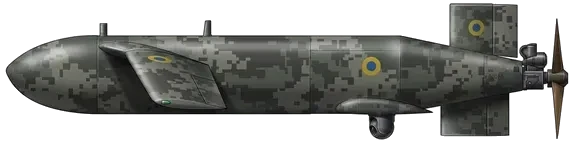
| Wingspan | 2.3 m (7.5 ft) |
| Max. takeoff weight | 100 kg (220 lbs) |
| Powerplant | 1 × piston engine |
| Maximum speed | 200 km/h (124 mph) |
| Operational range | 750 km (466 mi) |
| Endurance | 6 hours |
| Service ceiling | 3,000 m (9,843 ft) |
- Unguided Bomb Thermobaric warhead
- Unguided Bomb 122 mm artillery shells (x2)


Description
The AQ-400 Scythe is a one-way attack drone developed and built by the Ukrainian company Terminal Autonomy. Designed during the Russian invasion of Ukraine as a low-cost, mass-producible strike munition, it entered Armed Forces of Ukraine service in December 2023. It is known for its plywood airframe, a unit cost below that of the Russian Shahed-136, and a strike range of 750 km.
Development
Terminal Autonomy, originally named One Way Aerospace, was founded in mid-2022 by two veterans of the British and Australian militaries together with a Ukrainian engineer, with the aim of producing low-cost domestically built kamikaze drones. The AQ-400 was first demonstrated in spring 2023, and the first batch was delivered to the Armed Forces of Ukraine in December 2023. Initial output was planned at 100 units per month, rising to 500 per month in the second quarter of 2024, with a stated target of 1,000 units monthly. The basic airframe costs USD 15,000, rising to USD 30,000 with a guidance system and additional features, against roughly USD 20,000 for a Shahed-136.
Design
The fuselage is built from milled plywood sheets sourced from civilian furniture factories, chosen over 3-D printing or fiberglass for scalability and because assembly requires no technical training or skilled labour. Some components are imported, but production is concentrated inside Ukraine. The aircraft uses a tandem wing layout with forward and rear wing sets and a span of 2.3 m; 30 assembled airframes fit in a single shipping container. Launch is from short airstrips using tricycle landing gear or from a catapult with rocket boosters. With the standard gasoline engine and pusher propeller, cruise speed is 144 km/h, top speed 200 km/h, endurance 6.5 hours and strike range 750 km; alternative engine options extend range to 900 km or increase payload to 70 kg at reduced range. Low-altitude guidance uses a laser altimeter to hold 30 m, limiting the effect of GPS jamming until close to the target, while at 3,000 m the drone navigates by a visual positioning system referencing roads and other landmarks. An optional video datalink allows an operator to guide the drone onto moving targets, at higher cost and shorter range.
Armament
Total weight is 100 kg with a 43 kg payload, of which 32 kg is the warhead. The warhead may be thermobaric or consist of two 122 mm artillery shells. Payload can be raised to 70 kg with a corresponding reduction in range.
Operational History
Ukraine is the sole operator. Swarm employment uses a leader-follower method in which one lead drone carrying a navigation system is followed by nine basic airframes, saturating the target area and drawing defensive fire away from the armed aircraft; the tactic is intended to exhaust interceptor stocks by forcing expensive missiles to be expended against cheap targets. In July 2026 a Kyiv factory producing the AQ-400 and the AQ-100 Bayonet was destroyed by a Russian ballistic missile.
Frequently Asked Questions
What type of aircraft is the AQ-400 Scythe?
What is the maximum speed of the AQ-400 Scythe?
What is the range of the AQ-400 Scythe?
When did the AQ-400 Scythe first fly?
Which countries operate the AQ-400 Scythe?
How much does a AQ-400 Scythe cost?
What is the service ceiling of the AQ-400 Scythe?
- AUG 302026 Updated Description updated
- AUG 152026 Created AQ-400 Scythe UAV page created (specs, description, 1 operators)