Bell 430
American commercial helicopter, actively utilized globally for medical services and executive transportation since the late 20th century. Key figures: top speed 278 km/h, range 600 km, service ceiling 6,096 m, max takeoff weight 4,218 kg, unit price $10M, built 136. In service with 3 air forces as of 2026 — Ecuador (3), Dominican Republic (1), Paraguay (1).
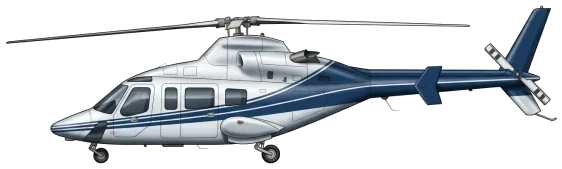
| Crew | 1 |
| Length | 15.3 m (50.2 ft) |
| Wingspan | 12.8 m (42.0 ft) |
| Height | 3.8 m (12.3 ft) |
| Empty weight | 2,406 kg (5,304 lbs) |
| Max. takeoff weight | 4,218 kg (9,299 lbs) |
| Powerplant | 2 × turboshafts Allison 250-C40B 585 kW each |
| Maximum speed | 278 km/h (173 mph) |
| Operational range | 600 km (373 mi) |
| Service ceiling | 6,096 m (20,000 ft) |
| Climb rate | 6.858 m/s (22.5 ft/s) |


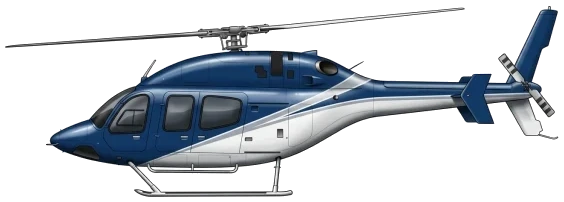
Description
The Bell 430 is an American-Canadian light-medium twin-engine helicopter built by Bell Helicopter. A stretched and re-engined derivative of the Bell 230, itself developed from the Bell 222, it entered service in 1996 in passenger transport, executive transport and medical evacuation roles. It is distinguished by its hingeless, bearingless four-blade main rotor and by the round-the-world helicopter record set in 1996.
Development
While developing the re-engined Model 222 into the 230, Bell began preliminary studies in 1991 of a stretched version fitted with a four-blade main rotor. The Bell 430 was officially launched in February 1992, with two prototypes converted from Bell 230 airframes. The first flew in its new configuration on 25 October 1994, the second, fitted with the full 430 avionics suite, on 19 December 1994. Bell 230 production ended in August 1995 and 430 production began; the first production aircraft was completed the same year. Canadian certification was obtained on 23 February 1996 and deliveries began in the middle of that year. On 24 January 2008, Bell announced the end of production once the outstanding orders were fulfilled. Production ended after 136 aircraft, the last being delivered in May 2008.
Design
The main change from the 230 is the composite hingeless, bearingless four-blade main rotor. Both the 230 and the 430 use Rolls-Royce (Allison) 250 turboshaft engines, those of the 430 delivering 10% more power. The fuselage is lengthened by 46 cm, allowing two seats to be added. An EFIS cockpit is offered as an option, as is the choice between skids and retractable wheeled landing gear. The standard configuration seats ten occupants: a pilot, a co-pilot and eight passengers in three rows in the main cabin. Six- and eight-seat executive interiors are also offered. In the medical configuration, the aircraft carries one or two stretchers accompanied by four or three medical attendants respectively. The maximum external load is 1,600 kg (3,500 lb).
Operational History
The Bell 430 entered service in 1996, with thirteen aircraft delivered that year. By 1998, some fifty examples were in service, totalling 9,000 flight hours. On 3 September 1996, Americans Ron Bower and John Williams broke the round-the-world helicopter record aboard the second Bell 430, departing the United Kingdom westbound, in 17 days, 6 hours and 14 minutes. Military users include the Bulgarian Air Force, the Dominican Air Force and the Ecuadorian Navy. Civil operators include Pelita Air in Indonesia, as well as AirMed, the New York State Police, Lee County EMS, GrandView Aviation, the Louisiana State Police and Uber Elevate in the United States. On 2 September 2009, a Bell 430 of the Andhra Pradesh government carrying Chief Minister Y. S. Rajasekhara Reddy crashed on a hill in the Nallamala Hills, killing all five occupants.
Frequently Asked Questions
What type of aircraft is the Bell 430?
What is the maximum speed of the Bell 430?
What is the range of the Bell 430?
When did the Bell 430 first fly?
How many Bell 430 have been built?
Which countries operate the Bell 430?
How much does a Bell 430 cost?
What is the service ceiling of the Bell 430?
- AUG 302026 Updated Description updated
- AUG 52026 Updated Powerplant updated in a site-wide editorial pass
- APR 72026 Updated Picture credits updated in a site-wide editorial pass
- FEB 72026 Updated Wingspan added
- JAN 122026 Updated Range updated in a site-wide editorial pass