Nanchang CJ-6
Chinese basic trainer aircraft, designed in the late 1950s, extensively utilized for military pilot training and civil aviation. Key figures: top speed 300 km/h, range 700 km, service ceiling 6,250 m, max takeoff weight 1,400 kg, unit price $0.075M, built 3,000. In service with 1 air force as of 2026 — China (438).
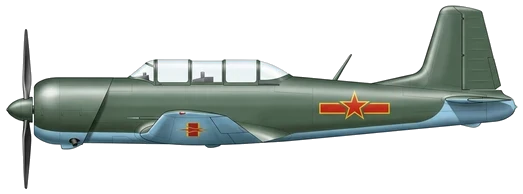
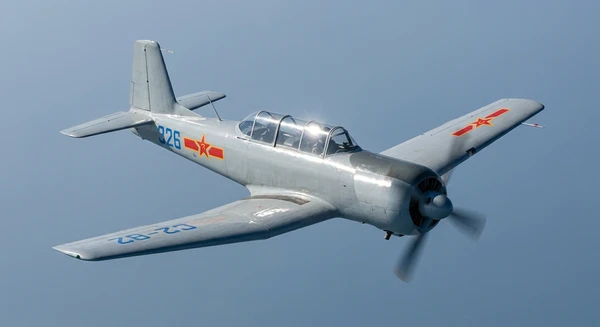
| Crew | 2 |
| Length | 8.5 m (27.8 ft) |
| Wingspan | 10.2 m (33.5 ft) |
| Height | 3.3 m (10.8 ft) |
| Empty weight | 1,095 kg (2,414 lbs) |
| Max. takeoff weight | 1,400 kg (3,086 lbs) |
| Powerplant | 1 × Zhouzhou HS-6A radial engine 213 kW each |
| Maximum speed | 300 km/h (186 mph) |
| Operational range | 700 km (435 mi) |
| Service ceiling | 6,250 m (20,505 ft) |

- Rocket Pod Rocket launchers
- Unguided Bomb Bombs
Description
The Nanchang CJ-6 is a Chinese basic trainer aircraft designed and manufactured by the Nanchang Aircraft Factory (now Hongdu Aviation) for the People's Liberation Army Air Force (PLAAF). Initiated in late 1957 by designers Cheng Bushi and Lin Jiahua to replace the CJ-5, the aircraft was developed as an original design after Chinese engineers determined the Soviet Yak-18A did not meet PLAAF requirements. The design program transferred to Nanchang in May 1958, and the first flight occurred on August 27, 1958. While the prototype used a Czech-built horizontally opposed engine, production aircraft received the 260 hp Huosai HS-6 radial engine. Total production is estimated at more than 3,000 aircraft. The aircraft received its civil type certificate on February 28, 2019.
Design
The CJ-6 features an aluminum semi-monocoque, flush-riveted fuselage with a modified Clark airfoil wing design that has a pronounced dihedral in the outer sections and an angular vertical tail. It utilizes a pneumatic system to control landing gear and flap operation, activate brakes, and start the engine. This system is recharged by an engine-driven pump, but can also be charged externally, or the engine can be started by hand swinging the propeller. The CJ-6A variant has a length of 8.46 meters, a wingspan of 10.22 meters, and a maximum takeoff weight of 1,400 kg. Powered by a 285 hp Zhouzhou HS-6A radial engine, it has a maximum speed of 300 km/h and a range of 700 km.
Armament
Armament options include two 7.62 mm machine guns and underwing hardpoints configured to carry rocket launchers and bombs.
Operational History
The aircraft is operated by the PLAAF and the People's Liberation Army Navy Air Force (PLANAF). Exported under the designation PT-6, operators have included Albania, Bangladesh, Cambodia, Ecuador, North Korea, Laos, Sri Lanka, Tanzania, and Zambia. The aircraft is also used in civil aviation in countries such as the United States, Australia, New Zealand, the United Kingdom, and South Africa. Following a fatal training accident on August 7, 2023, the Sri Lanka Air Force grounded its PT-6 fleet.
Variants
- Hongzhuan-502: The initial designation for the production CJ-6 aircraft.
- CJ-6: The standard two-seat primary trainer variant powered by a 260-hp Zhuzhou Huosai HS-6 radial piston engine.
- CJ-6A: An improved trainer variant equipped with a 285-hp Zhuzhou Huosai HS-6A radial piston engine.
- CJ-6B: A two-seat armed border patrol variant equipped with a 300-hp Zhuzhou Huosai HS-6D radial piston engine.
- PT-6: The export designation for the CJ-6 and CJ-6A trainer variants.
Frequently Asked Questions
What type of aircraft is the Nanchang CJ-6?
What is the maximum speed of the Nanchang CJ-6?
What is the range of the Nanchang CJ-6?
When did the Nanchang CJ-6 first fly?
How many Nanchang CJ-6 have been built?
Which countries operate the Nanchang CJ-6?
How much does a Nanchang CJ-6 cost?
What is the service ceiling of the Nanchang CJ-6?
- JUL 272026 Updated Name updated
- JUN 302026 Created Page created: CJ-6