CT/4 Airtrainer
New Zealand-designed basic training aircraft, developed in the early 1970s and operated by several air forces for pilot instruction. Key figures: top speed 387 km/h, range 963 km, service ceiling 5,550 m, max takeoff weight 1,180 kg, built 155. In service with 1 air force as of 2026 — Thailand (16).
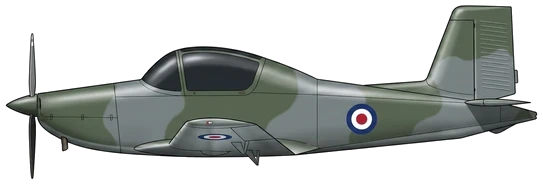
| Crew | 2 (student, instructor) |
| Length | 7.2 m (23.6 ft) |
| Wingspan | 7.9 m (26.0 ft) |
| Height | 2.6 m (8.5 ft) |
| Wing area | 12.0 m² (129.0 sqft) |
| Empty weight | 770 kg (1,698 lbs) |
| Max. takeoff weight | 1,180 kg (2,601 lbs) |
| Powerplant | 1 × Lycoming AEIO-540-L1B5 224 kW each |
| Maximum speed | 387 km/h (240 mph) |
| Operational range | 963 km (598 mi) |
| Service ceiling | 5,550 m (18,209 ft) |
| Climb rate | 9.3 m/s (30.5 ft/s) |

Description
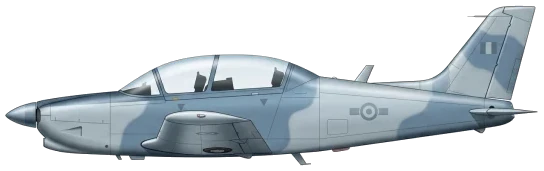
The Pacific Aerospace Corporation CT/4 Airtrainer is an all-metal, single-engine, two-seat basic training aircraft manufactured in Hamilton, New Zealand. Aero Engine Services Ltd (AESL), a predecessor of Pacific Aerospace Corporation, developed the CT/4 to meet a 1971 Royal Australian Air Force (RAAF) requirement to replace its CAC Winjeel trainers. AESL chief designer P W C Monk derived the design from the four-seat Victa Aircruiser, utilizing its stronger airframe. The first of two prototypes made its maiden flight on 23 February 1972. Production commenced following an order for 24 aircraft from the Royal Thai Air Force (RTAF). On 1 March 1973, AESL became New Zealand Aerospace Industries Ltd, which later re-emerged as the Pacific Aerospace Corporation. By 2024, a total of 155 aircraft had been built.
Design
The CT/4 features an all-aluminium construction, side-by-side seating, and is fully aerobatic. It incorporates an aerofoil-shaped bubble canopy and a larger engine than its predecessors. Structural modifications from the Aircruiser design include changes to the skin and the upgrade of the four fuselage longerons from sheet metal to extrusions. The CT/4E variant incorporates a 100 mm longer fuselage, with the wing moved 5 cm rearwards to compensate for center of gravity changes.
Operational History
The CT/4 has served as a primary trainer for several air arms. The RAAF and the RTAF were the initial operators. The Royal New Zealand Air Force (RNZAF) ordered 19 CT/4B aircraft, later replacing them and older models with 13 CT/4E aircraft before retiring the type in 2014. The RTAF ordered a total of 24 CT/4E aircraft to replace its older variants, operating the type until decommissioning in 2020. Fourteen CT/4Bs built for a Rhodesian Air Force front company under sanctions were embargoed by the New Zealand government and eventually sold to the RAAF. Other operators include the Singapore Youth Flying Club, which operated two CT/4Es between 2002 and 2010, and the Royal Thai Police, which operated a single CT/4. Private pilots and contracted training companies also operate retired military examples.
Variants
-
CT/4A: Powered by a 210 hp Continental piston engine, this initial production design comprised 75 aircraft built for the Australian and Thai air forces.
-
CT/4B: This variant featured minor updates and improved instrumentation, with 37 units built for the RNZAF, RTAF, and commercial flying academies.
-
CT/4C: This single turboprop prototype was rebuilt from a damaged CT/4B and used an Allison 250 engine with a three-bladed propeller.
-
CT/4E: This variant was powered by a 300 hp Lycoming piston engine with a three-bladed propeller, a 100 mm longer fuselage, and wings shifted 5 cm rearwards.
-
CT-4F: A single demonstrator was converted to this 300 hp variant, which featured glass cockpit avionics from the Hawker Beechcraft T-6B Texan II.
Frequently Asked Questions
What type of aircraft is the CT/4 Airtrainer?
What is the maximum speed of the CT/4 Airtrainer?
What is the range of the CT/4 Airtrainer?
When did the CT/4 Airtrainer first fly?
How many CT/4 Airtrainer have been built?
Which countries operate the CT/4 Airtrainer?
What is the service ceiling of the CT/4 Airtrainer?
- JUL 12026 Created Page created: CT/4 Airtrainer