F-101 Voodoo
Summary
| Category | Combat Aircraft |
| Origin country | 🇺🇸 United States |
| Manufacturer | McDonnell Douglas |
| First flight | 29 September 1954 |
| Year introduced | 1959 |
| Number produced | 807 units |
| Average unit price | $2 million |
Technical specifications
| Version: F-101B | |
|---|---|
| Crew | 1 pilot + 1 WSO |
| Operational range | 2,450 km (1,522 mi) |
| Maximum speed | 1825 km/h (1134 mph) |
| Wing area | 34.2 m² (368.1 sqft) |
| Wingspan | 12.1 m (39.7 ft) |
| Height | 5.5 m (18.0 ft) |
| Length | 20.6 m (67.4 ft) |
| Service ceiling | 17,800 m (58,399 ft) |
| Empty weight | 12,925 kg (28,495 lbs) |
| Max. takeoff weight | 23,770 kg (52,404 lbs) |
| Climb rate | 250.0 m/s (820.2 ft/s) |
| Powerplant | 2 x turbojets Pratt & Whitney J57-P-55 delivering 10866 kgf each |
| Ejection seat | Weber F-101 |
Current operating countries
All operators
Armament
Missiles payload:
- Air-to-Air Short-Range AIM-4 Falcon
Description
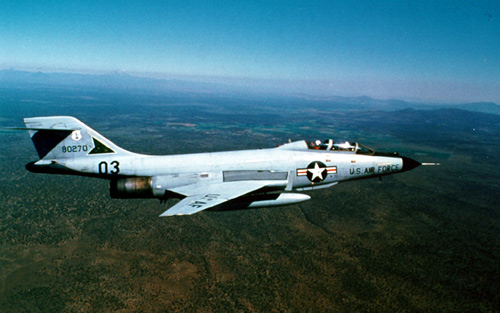
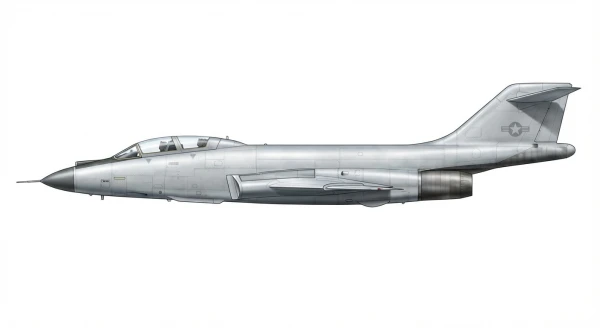
Following the cancellation of the CF-105 Arrow program in 1959, the Canadian government sought an "off-the-shelf" interceptor from the United States to address ongoing bomber threats, unofficially recognizing the inadequacy of existing Avro CF-100s and Bomarc missiles. The USAF offered 56 F-101B interceptors and 10 F-101F trainers, contingent on Canada assuming staffing and funding for 11 Pinetree Line radar stations previously managed by the USAF. An agreement was signed in June 1961, enabling the transfer of aircraft to equip five front-line squadrons and an Operational Training Unit, replacing nine CF-100 squadrons. These aircraft were manufactured by the McDonnell Aircraft Corporation of St. Louis, Missouri and originally intended for use as F-101s within the United States Air Force.
The CF-101 Voodoo, acquired to replace the Avro CF-100 Canuck, featured a design optimized for all-weather interception duties. Its aerodynamics were tailored for high-speed flight, enabling a maximum speed of Mach 1.72 at altitude. Power was provided by two Pratt & Whitney J57-P-55 afterburning turbojets, each producing nearly 17,000 pounds of thrust with afterburner, allowing for a rate of climb of over 36,000 feet per minute. Key avionics included the Hughes MG-13 fire control system.
The CF-101's primary armament was two AIR-2A Genie unguided nuclear rockets, each equipped with a 1.5 kt warhead, housed in a bay within the aircraft's belly. Supplementing this were two AIM-4D Falcon heat-seeking air-to-air missiles. The Canadian government's reluctance to accept nuclear weapons delayed the operational status of the Genies until June 1965, and these weapons remained under the custody of the USAF, requiring joint agreement between Canada and the United States through NORAD for their use.
The CF-101 Voodoo became operational with the Royal Canadian Air Force on 24 July 1961, when the first two aircraft were transferred to Canada, marking the beginning of Operation Queen's Row. Primarily serving as Canada's air defense, the Voodoos were stationed at Quick Reaction Alert facilities at various Canadian airbases, with two aircraft and their crews always on "five minute" alert, ready to intercept unidentified NORAD radar contacts, which occasionally included Soviet Tu-95 Bear bombers. Between 1970 and 1972, the original fleet of 56 CF-101s was traded back to the USAF for 66 replacements under Operation Peace Wings, where modifications were performed on the incoming fleet. By the 1980s, the CF-101 was becoming obsolete, leading to its replacement by the McDonnell Douglas CF-18 Hornet fighters; with the stand down of the Voodoo squadrons, the last nuclear weapons in Canada were returned to the US.
Main Variants:
-
CF-101B: This was the standard two-seat, all-weather interceptor fighter version operated by the Royal Canadian Air Force and Canadian Forces.
-
CF-101F: A two-seat variant equipped with dual controls, serving as a training aircraft for Voodoo pilots.
-
EF-101B: A specialized electronic jamming aircraft, with only one example being converted and briefly leased to Canada before being returned to the United States.