CF-100 Canuck
Canadian interceptor jet from the Cold War period, notable for NATO and NORAD deployments. Key figures: top speed 888 km/h, range 3,200 km, service ceiling 13,716 m, max takeoff weight 15,170 kg, unit price $1M, built 692.
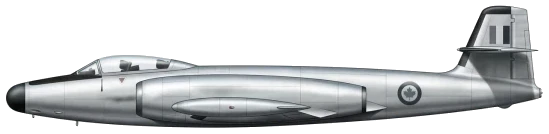
| Crew | 2 (pilot, navigator) |
| Length | 16.5 m (54.1 ft) |
| Wingspan | 17.4 m (57.1 ft) |
| Height | 4.4 m (14.4 ft) |
| Wing area | 54.9 m² (590.9 sqft) |
| Empty weight | 10,500 kg (23,149 lbs) |
| Max. takeoff weight | 15,170 kg (33,444 lbs) |
| Powerplant | 2 × turbojets Avro Canada Orenda 11 3,311 kgf each |
| Ejection seat | Martin-Baker Mk 2 |
| Maximum speed | 888 km/h (552 mph) |
| Operational range | 3,200 km (1,988 mi) |
| Service ceiling | 13,716 m (45,000 ft) |
| Climb rate | 44.5 m/s (146.0 ft/s) |
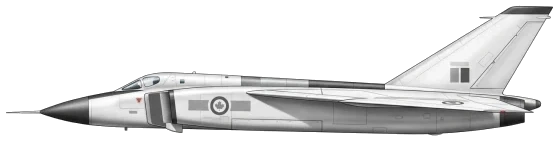
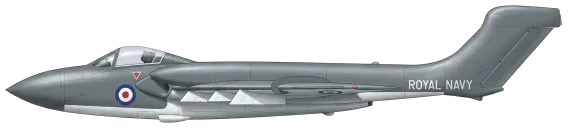
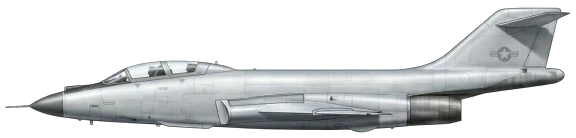
Description
The Avro Canada CF-100 Canuck is a Canadian twin-engine jet interceptor fighter designed and produced by Avro Canada. It is the only Canadian-designed fighter to have entered series production. Entering service in 1952 with the Royal Canadian Air Force, it was intended for long-range patrol and all-weather operations over the Canadian north, within NORAD and NATO. Nicknamed "Clunk" by its crews, it was the first straight-wing jet aircraft to break the sound barrier in controlled flight.
Development
Work began in October 1946, in response to an RCAF specification formalised in 1946 calling for a two-seat all-weather interceptor with a nose-mounted radar and fire-control system. An agreement was reached on 3 November 1945 for the development of a prototype, and the government contracts awarded to Avro Canada on 13 October 1946 launched the design. Edgar Atkin, Avro Canada's chief engineer, first oversaw the programme, before John Frost, formerly of de Havilland, became its chief engineer; Frost and aerodynamicist Jim Chamberlin reworked the original fuselage. On 17 May 1949, a further agreement covered ten pre-production aircraft and 30 Orenda turbojets.
The Mark 1 prototype, serial 18101, made its first flight on 19 January 1950 from Malton, Ontario, flown by Squadron Leader Bill Waterton. The second prototype, 18102, flew in July 1950 and was destroyed on 5 April 1951, an accident that killed test pilot Bruce Warren and led to the suspension of the programme and the dismissal of several members of the design team. Five Mk 2 pre-production aircraft (18103-18107) were fitted with Orenda 2 engines. On 18 December 1952, Squadron Leader Janusz Żurakowski reached Mach 1.0 in a dive from 9,100 m in the Mk 4 prototype. The RCAF placed a first order for 124 Mk 3s in September 1950; Mk 4 orders reached 510 aircraft. In total, 692 CF-100s were built, including 53 for Belgium.
Design
The CF-100 is a straight-wing two-seater powered by two turbojets. The two prototypes used 28.9 kN Rolls-Royce Avon RA 3s, replaced on the pre-production and production aircraft by the Canadian-designed Orenda, in Orenda 2, 8, 9, 11 and 14 versions depending on the variant. The Mk 3 carried the APG-33 radar; the Mk 4 introduced the larger APG-40 radar. The Mk 5 received 1.06 m wingtip extensions and an enlarged horizontal tail for high-altitude flight. Flight testing showed a short take-off run and a high rate of climb, but crews criticised the heaviness of the controls, hence the nickname "Lead Sled". Designed for 2,000 flying hours, the airframe proved capable of more than 20,000.
Armament
The Mk 3 was armed with eight .50 inch Browning M3 machine guns with 200 rounds per gun, housed in a forward-firing ventral pack. The Mk 4 retained this armament and added two wingtip pods each containing up to 29 folding-fin 70 mm Mk 4/Mk 40 "Mighty Mouse" rockets. The Mk 5 dispensed with the machine guns and kept only the two rocket pods. A small number of Mk 5s were modified to Mk 5M standard to carry AIM-7 Sparrow II air-to-air missiles.
Operational History
The CF-100 served with nine RCAF squadrons at its peak in the mid-1950s. Between 1956 and 1962, four squadrons were deployed to Europe with 1 Air Division under the NIMBLE BAT ferry programme, replacing units flying the Canadair Sabre; for a time, the CF-100 was the only NATO fighter capable of operating in zero visibility. North American-based aircraft kept a natural metal finish, while those based in Europe received a British-style disruptive camouflage. The USAF evaluated the type in the early 1950s for an all-weather interdiction requirement, but rejected it for insufficient range and payload in favour of the English Electric Canberra. Belgium acquired 53 Mk 5s, in service from 1957 to 1964 with 11, 349 and 350 Squadrons; no other export customer was found. From 1961, the CF-100s were withdrawn from the interceptor role in favour of the CF-101 Voodoo and reassigned to aerial reconnaissance, training and electronic warfare, notably with 414 Squadron at CFB North Bay. Final retirement came in 1981.
Variants
- CF-100 Mk 1: The two prototypes, powered by Rolls-Royce Avon RA 3s.
- CF-100 Mk 2: Ten pre-production aircraft with Orenda 2 engines, including two dual-control Mk 2Ts.
- CF-100 Mk 3: First production version for the RCAF, armed with eight Browning M3s, 70 built in the Mk 3A (Orenda 2, 21 aircraft) and Mk 3B (Orenda 8, 45 aircraft) sub-variants.
- CF-100 Mk 4: Version with the APG-40 radar combining machine guns and rocket pods, built as the Mk 4A (Orenda 9, 137 aircraft) and Mk 4B (Orenda 11, 141 aircraft).
- CF-100 Mk 5: High-altitude version with enlarged wings and tail, without machine guns, powered by the Orenda 11 or 14, 332 built and produced as the Mk 5D (electronic warfare) and Mk 5M (Sparrow II).
Frequently Asked Questions
What type of aircraft is the CF-100 Canuck?
What is the maximum speed of the CF-100 Canuck?
What is the range of the CF-100 Canuck?
When did the CF-100 Canuck first fly?
How many CF-100 Canuck have been built?
Which countries operate the CF-100 Canuck?
How much does a CF-100 Canuck cost?
What is the service ceiling of the CF-100 Canuck?
- AUG 302026 Updated Description updated
- AUG 52026 Updated Thrust updated
- JUL 232026 Updated Sources and cross-references refreshed
- APR 72026 Updated Sources and cross-references refreshed
- JAN 242026 Updated Thrust updated