CF-105 Arrow
Canadian interceptor fighter, developed during the Cold War, cancelled before operational deployment. Key figures: top speed 2,103 km/h, range 483 km, service ceiling 16,154 m, max takeoff weight 31,120 kg, unit price $3M, built 5.
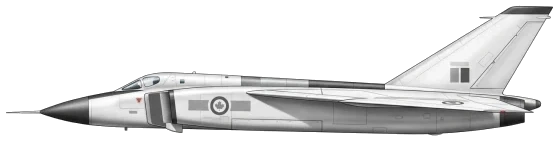
| Crew | 2 |
| Length | 23.7 m (77.8 ft) |
| Wingspan | 15 m (49.2 ft) |
| Height | 6.3 m (20.5 ft) |
| Wing area | 113.8 m² (1224.9 sqft) |
| Empty weight | 22,245 kg (49,042 lbs) |
| Max. takeoff weight | 31,120 kg (68,608 lbs) |
| Powerplant | 2 × turbojets Pratt & Whitney J75-P-3 10,659 kgf each |
| Ejection seat | Martin-Baker Mk 5 |
| Maximum speed | 2103 km/h (Mach 2.0) |
| Operational range | 483 km (300 mi) |
| Service ceiling | 16,154 m (52,999 ft) |
| Climb rate | 84.0 m/s (275.6 ft/s) |
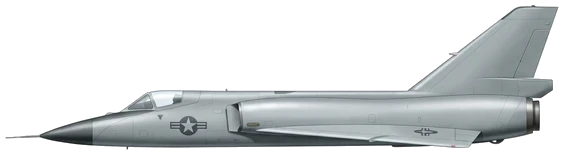

Description
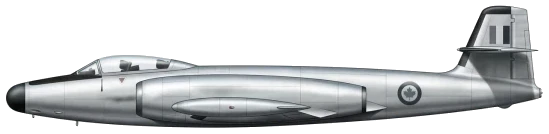
The Avro Canada CF-105 Arrow was a twin-engine, two-seat delta-wing interceptor developed by Avro Canada for the Royal Canadian Air Force. Intended to replace the CF-100 Canuck and counter Soviet high-altitude bombers approaching over the Arctic, it first flew on 25 March 1958 and was cancelled on 20 February 1959 before entering service. Five Mk 1 airframes were completed; all aircraft, engines, tooling and drawings were ordered destroyed two months after cancellation.
Development
Design studies began in 1952 with the swept-wing CF-103, abandoned after a CF-100 exceeded Mach 1 on 18 December 1952. RCAF Specification AIR 7-3 of April 1953 called for a two-crew twin-engine interceptor cruising at Mach 1.5 at 70,000 ft, with 200 nmi radius on high-speed interception and operation from a 6,000 ft runway. Avro submitted the C105 in May 1953, a shoulder-wing derivative of the earlier C104/2 delta study; a 1,200 sq ft wing was selected from five candidates. The July 1953 go-ahead was followed by CA$27 million in December for flight modelling, and in March 1955 by a CA$260 million contract for five Mk 1s and 35 Mk 2s. Avro adopted the Cook-Craigie plan, building from production tooling without hand-built prototypes. Nine one-eighth-scale free-flight models were launched on Nike boosters over Lake Ontario from Point Petre, with two more from Wallops Island. RL-201 was rolled out on 4 October 1957, the day Sputnik 1 was launched, and reached Mach 1.90 in level flight during testing. Landing gear collapses occurred on 11 June and 11 November 1958.
Design
The airframe used a semi-monocoque structure with a multi-spar wing, with magnesium and titanium employed around the engines and in fasteners. The wing had a drooped leading edge, a half-span dog-tooth, slight negative camber, and area-rule shaping including a tailcone and thinned intake lips. The Arrow used a 4,000 psi hydraulic system and a fly-by-wire control system with pressure transducers in the stick, supplemented by an artificial-feel unit that reproduced hydraulic back-pressure. The Rolls-Royce RB.106 was cancelled in 1954 and the Wright J67 in 1955, leading to Pratt & Whitney J75-P-3 engines of 23,500 lbf with afterburner in the Mk 1 and the Orenda PS-13 Iroquois of 30,000 lbf for the Mk 2. The Hughes MX-1179 fire control system was replaced in 1956 by the RCA-Victor Astra, itself cancelled in September 1958.
Armament
Weapons were housed in an internal belly bay occupying over a third of the fuselage. Planned loads included two AIR-2A Genie unguided nuclear rockets, up to eight AIM-4 Falcon or three AIM-7 Sparrow II missiles, or four 1,000 lb bombs. The CARDE Velvet Glove radar-guided missile was dropped in 1956 as unsuitable for supersonic launch.
Variants
- Mark 1: Development and flight-test version with two Pratt & Whitney J75 engines; five completed.
- Mark 2: Iroquois-powered production variant with Hughes/Falcon fire control; RL-206 reached taxi trials only.
- Mark 2A / Mark 3: Projected versions with 39,800 lbf engines, 17,000 lb higher maximum takeoff weight and a 70,000 ft ceiling.
- Mach 3 study: Modified Mk 2 design with revised inlets and carbon steel and titanium structure.
Frequently Asked Questions
What type of aircraft is the CF-105 Arrow?
What is the maximum speed of the CF-105 Arrow?
What is the range of the CF-105 Arrow?
When did the CF-105 Arrow first fly?
How many CF-105 Arrow have been built?
Which countries operate the CF-105 Arrow?
How much does a CF-105 Arrow cost?
What is the service ceiling of the CF-105 Arrow?
- AUG 302026 Updated Description updated
- AUG 142026 Updated Per-engine thrust corrected against the engine variant the entry names
- JUL 232026 Updated Sources and cross-references refreshed
- APR 72026 Updated Sources and cross-references refreshed
- JAN 242026 Updated Thrust updated
- JAN 122026 Updated Range updated in a site-wide editorial pass