F/A-18 Hornet
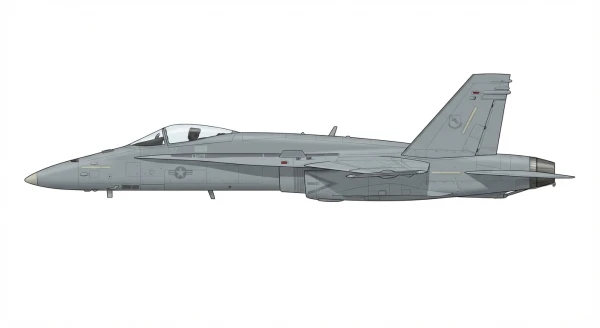
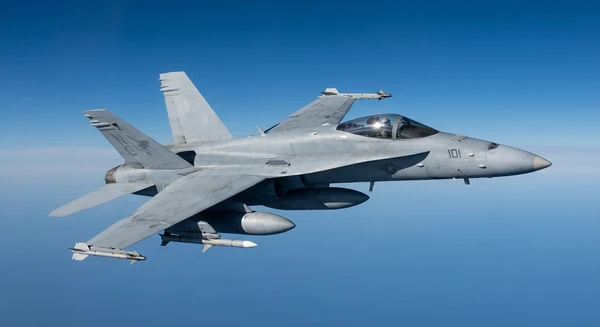
American carrier-capable multirole strike fighter, designed in the late 20th century, deployed extensively in a variety of combat roles. Key figures: top speed 1,915 km/h, range 2,017 km, service ceiling 15,000 m, max takeoff weight 23,541 kg, unit price $29M, built 1,480. In service with 7 air forces as of 2026 — United States (179), Canada (92), Spain (81) and 4 others.
| Crew | 1–2 (1 on the C, 2 on the D) |
| Length | 17.1 m (56.1 ft) |
| Wingspan | 12.3 m (40.4 ft) |
| Height | 4.7 m (15.4 ft) |
| Wing area | 38 m² (409.0 sqft) |
| Empty weight | 10,433 kg (23,001 lbs) |
| Max. takeoff weight | 23,541 kg (51,899 lbs) |
| Powerplant | 2 × General Electric F404-GE-402 afterburning turbofan engines 8,051 kgf each |
| Ejection seat | Martin-Baker Mk 14 |
| Maximum speed | 1915 km/h (Mach 1.92) |
| Operational range | 2,017 km (1,253 mi) |
| Service ceiling | 15,000 m (49,213 ft) |
| Climb rate | 250.0 m/s (820.2 ft/s) |
-
 United States
179
United States
179
-
 Canada
92
Canada
92
-
 Spain
81
Spain
81
-
 Finland
61
Finland
61
-
 Kuwait
33
Kuwait
33
-
 Switzerland
30
Switzerland
30
-
 Malaysia
7
Malaysia
7
- Anti-Radiation AGM-88 HARM
- Air-to-Surface AGM-65 Maverick
- Air-to-Surface AGM-84 Harpoon
- Air-to-Surface AGM-84H/K SLAM-ER
- Air-to-Surface Raytheon AGM-154 JSOW
- Air-to-Air Medium-Range AIM-7 Sparrow
- Air-to-Air Medium-Range AIM-120 AMRAAM
- Air-to-Air Short-Range Raytheon AIM-9 Sidewinder
Recent Events — F/A-18 Hornet
7 events →
Description
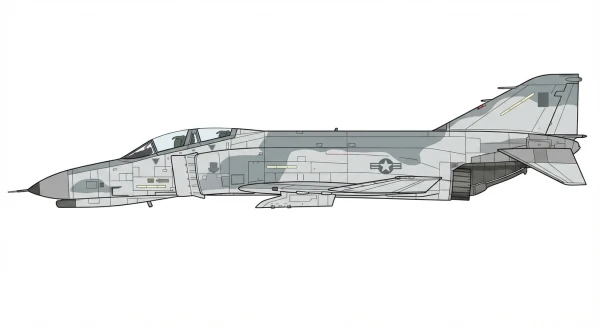
The McDonnell Douglas F/A-18 Hornet emerged from the U.S. Navy's requirement in the 1970s for a lower-cost, multirole aircraft to replace aging A-4, A-7, and F-4 airframes. Following a congressional mandate to evaluate competitors from the Air Force's Lightweight Fighter program, the Navy selected the Northrop YF-17 prototype. McDonnell Douglas, with its expertise in carrier aircraft, was partnered with Northrop to extensively redesign the YF-17 for naval operations. This involved strengthening the airframe and undercarriage, adding folding wings and a tailhook, increasing fuel capacity, and installing the first digital fly-by-wire system in a production fighter. This development was not without challenges, including a notable legal dispute between the two manufacturers over export sales, which was settled in 1985. The first F/A-18A flight occurred on November 18, 1978, leading to a production run that delivered 1,480 A/B/C/D variants until manufacturing ceased in 2000.
Design
The F/A-18 is a twin-engine, mid-wing tactical aircraft renowned for its exceptional maneuverability and high angle-of-attack performance, achieved through features like large leading-edge extensions (LEX), canted vertical stabilizers, and a sophisticated digital fly-by-wire system with quadruple redundancy. Its cockpit design was pioneering, making extensive use of multifunction displays that allowed a single pilot to seamlessly switch between fighter and attack roles. It was also the first Navy aircraft to incorporate a digital multiplexing avionics bus, facilitating easier upgrades. A key design principle was ease of maintenance; the General Electric F404 engines were engineered for exceptional reliability and could be replaced by a four-person team in under 20 minutes, significantly reducing downtime compared to its predecessors.
Armament
The Hornet is armed with an internal 20mm M61A1 Vulcan cannon and features nine external hardpoints capable of carrying up to 13,700 pounds of ordnance and external fuel tanks. The aircraft's weapon systems support a comprehensive multirole capability. For air-to-air combat, it can be armed with AIM-9 Sidewinder, AIM-7 Sparrow, and AIM-120 AMRAAM missiles. Its air-to-surface loadout is extensive, including AGM-65 Maverick missiles, AGM-88 HARM anti-radiation missiles, and stand-off weapons like the AGM-84H/K SLAM-ER. Furthermore, it is capable of deploying a wide range of munitions such as Joint Direct Attack Munition (JDAM) kits, Paveway laser-guided bombs, and conventional Mk 80 series bombs, supported by targeting pods like the AN/AAS-38 NITE Hawk or LITENING for precision strikes.
Operational History
Entering service with the U.S. Marine Corps in 1983 and the U.S. Navy in 1984, the Hornet first saw combat during operations against Libya in 1986. Its versatility was prominently demonstrated during the 1991 Gulf War, where it successfully engaged and destroyed enemy fighters before proceeding to strike ground targets on the same sortie, establishing records for aircraft availability and reliability. The aircraft has served continuously in numerous global theaters, including Bosnia, Kosovo, and Iraq. In addition to its service with U.S. forces, the F/A-18 has been a critical asset for the air forces of several nations, including Australia, Canada, Finland, Spain, and Switzerland. While the U.S. Navy retired its final active-duty F/A-18C in 2019, the Hornet continues its service with the U.S. Marine Corps and international operators.
Australia's fleet showed how far the airframe could be stretched. The Royal Australian Air Force took delivery of 75 aircraft — 57 F/A-18A and 18 F/A-18B — between 1985 and 1990, and from 1999 ran them through the Hornet Upgrade Program (HUG), a three-phase effort completed in 2012 that kept the original A and B designations. Phase 1, from 2000 to 2002, replaced the mission computers, navigation system and radios and cleared the aircraft for the ASRAAM in place of the AIM-9 Sidewinder. Phase 2 substituted the AN/APG-73 radar for the original AN/APG-65 and added the Joint Helmet Mounted Cueing System, Link 16 datalink, a new countermeasures dispenser and updated cockpit displays across the whole fleet between January 2005 and December 2006, then fitted the ALR-67 radar warning receiver and integrated the AN/AAQ-28 LITENING targeting pod by 2007. Phase 3 tackled airframe fatigue, the ten most worn aircraft receiving new centre fuselages by June 2010. Upgraded Hornets flew combat sorties over Iraq in 2003 and against ISIL between 2015 and 2017; the type was retired on 29 November 2021 after almost 408,000 flight hours, 25 airframes going on to Canada.
Variants
- F/A-18A: The original single-seat, carrier-capable multirole fighter and attack aircraft.
- F/A-18B: A fully combat-capable, two-seat variant of the F/A-18A, primarily utilized for pilot training.
- F/A-18C: An upgraded single-seat model featuring improved radar, modern avionics, and compatibility with advanced munitions like the AIM-120 AMRAAM missile.
- F/A-18D: The two-seat version of the F/A-18C, often configured with a specialized rear cockpit for a Weapons and Sensors Officer in all-weather strike roles.
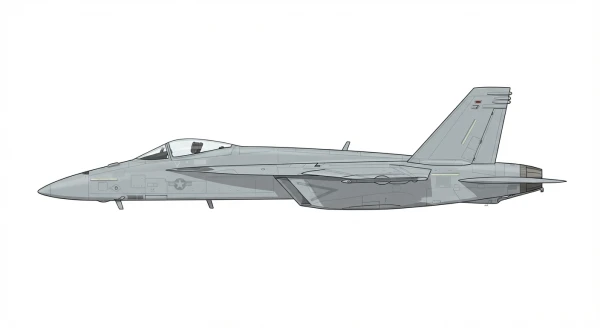
- F/A-18E/F Super Hornet: An extensively redesigned and larger successor, featuring a new airframe, more powerful engines, and upgraded avionics.
Frequently Asked Questions
What type of aircraft is the F/A-18 Hornet?
What is the maximum speed of the F/A-18 Hornet?
What is the range of the F/A-18 Hornet?
When did the F/A-18 Hornet first fly?
How many F/A-18 Hornet have been built?
Which countries operate the F/A-18 Hornet?
How much does a F/A-18 Hornet cost?
What is the service ceiling of the F/A-18 Hornet?
- SEP 102026 Updated Operational history expanded with the Australian Hornet Upgrade Program and the RAAF fleet history
- AUG 52026 Updated Thrust updated
- JUL 232026 Updated Sources and cross-references refreshed
- JUN 262026 Updated Bombs added; missiles updated
- APR 72026 Updated Sources and cross-references refreshed
- JAN 242026 Updated Thrust updated
- JUL 112025 Updated Specifications and description reviewed