Leonardo Falco
Italian tactical unmanned aerial vehicle, developed in the early 2000s, designed for medium-altitude, medium-endurance intelligence, surveillance, target acquisition, and reconnaissance missions. Key figures: top speed 216 km/h, range 200 km, service ceiling 5,000 m, max takeoff weight 420 kg, unit price $8M. In service with 2 air forces as of 2026 — Pakistan (26), Turkmenistan (3).
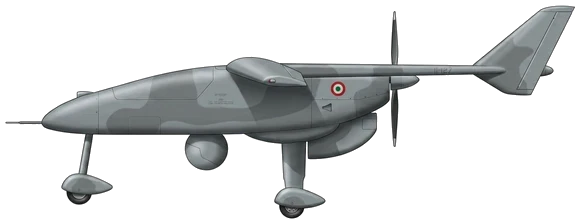
| Length | 5.3 m (17.2 ft) |
| Wingspan | 7.2 m (23.6 ft) |
| Height | 1.8 m (5.9 ft) |
| Max. takeoff weight | 420 kg (926 lbs) |
| Powerplant | 1 × Gasoline engine 48 kW each |
| Maximum speed | 216 km/h (134 mph) |
| Operational range | 200 km (124 mi) |
| Endurance | 14 hours |
| Service ceiling | 5,000 m (16,404 ft) |
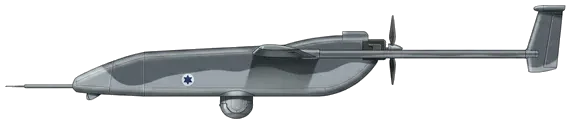
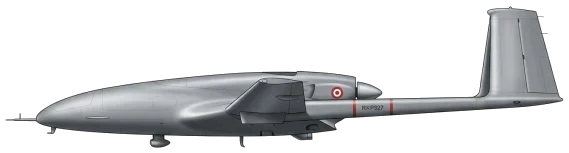
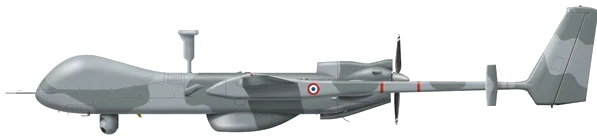
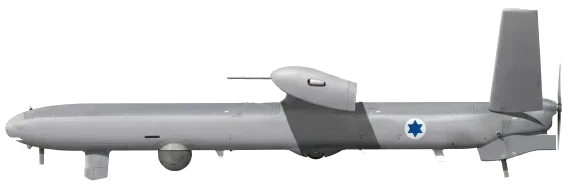
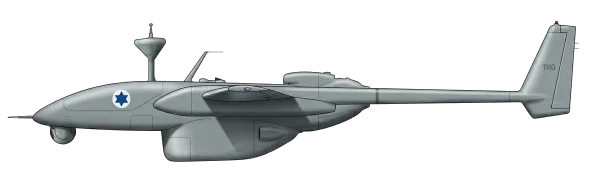
Description
The Falco is a family of tactical, medium-altitude, medium-endurance unmanned aerial vehicles (UAVs) designed and produced by Galileo Avionica (later Selex ES, now Leonardo) for intelligence, surveillance, target acquisition, and reconnaissance (ISTAR) operations. The baseline Falco conducted its maiden flight in December 2003, with flight control validation completed in September 2004 and platform qualification finalized in October 2004. By July 2012, more than 50 Falco air vehicles were operational worldwide.
Design
The standard Falco system consists of a ground control station, a ground data terminal, ground support equipment, and four UAVs. The baseline air vehicle has a length of 5.25 meters, a wingspan of 7.2 meters, a maximum takeoff weight of 420 kg, and is powered by a 48 kW (65 hp) gasoline engine, though production variants utilized an 80 hp powerplant. It has an endurance of 8 to 14 hours and a 5,000-meter service ceiling. Sensor payloads include the EOST 46 electro-optical/infrared turret, Gabbiano 20 multi-mode surveillance radar, and PicoSAR active electronically scanned array radar. It also carries the SAGE electronic warfare suite for emitter classification and geolocation, and can be configured with chaff and flare dispensers.
Armament
While the baseline Falco and Falco EVO are unarmed, the Astore variant is developed specifically for strike missions. It features two under-wing hardpoints to carry two Turkish-made Roketsan Cirit 70 mm laser-guided missiles. A Falco was also displayed at the 2023 Paris Air Show carrying a Brimstone missile.
Operational History
Pakistan was the launch customer, ordering five systems (25 UAVs) in 2007, and began licensed manufacturing at the Pakistan Aeronautical Complex in 2008. The Pakistani military deployed the Falco during 2009 security operations in the Swat Valley to locate insurgent infrastructure. In 2013, the United Nations acquired five Falco UAVs for deployment in the Democratic Republic of Congo. Other operators include Saudi Arabia, Turkmenistan, Jordan, and Bangladesh. In June 2017, Syrian MiG-23 fighters shot down two Jordanian-operated Falco UAVs near Daraa using R-24R missiles.
Variants
-
Falco: Baseline tactical UAV featuring a 7.2-meter wingspan, a 70 kg payload capacity, and a gasoline engine.
-
Falco EVO: Enlarged version with a 12.5-meter wingspan, a 100 kg payload capacity, a heavy fuel engine, and an endurance of over 20 hours.
-
Falco XN: A variant purchased by Turkmenistan in 2011.
-
Astore: An armed derivative of the Falco EVO equipped with two under-wing hardpoints for Roketsan Cirit 70 mm laser-guided missiles.
Frequently Asked Questions
What type of aircraft is the Leonardo Falco?
What is the maximum speed of the Leonardo Falco?
What is the range of the Leonardo Falco?
When did the Leonardo Falco first fly?
Which countries operate the Leonardo Falco?
How much does a Leonardo Falco cost?
What is the service ceiling of the Leonardo Falco?
- AUG 202026 Updated Unit price filled (8.0 $M) for the UAV inventory weighting.
- JUL 272026 Updated Name updated
- JUL 232026 Updated Sources and cross-references refreshed
- JUL 62026 Created Page created: Falco