Fuji T-7
Japanese single-engined turboprop primary trainer aircraft, developed in the late 20th century and operated by the Japan Air Self-Defense Force. Key figures: max takeoff weight 1,585 kg, built 49. In service with 1 air force as of 2026 — Japan (49).
| Crew | 2 |
| Length | 8.6 m (28.2 ft) |
| Wingspan | 10.0 m (32.9 ft) |
| Height | 3.0 m (9.7 ft) |
| Wing area | 16.5 m² (177.6 sqft) |
| Max. takeoff weight | 1,585 kg (3,494 lbs) |
| Powerplant | 1 × Rolls-Royce 250-B17F 336 kW each |

Description
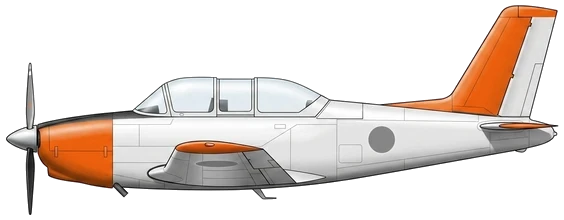
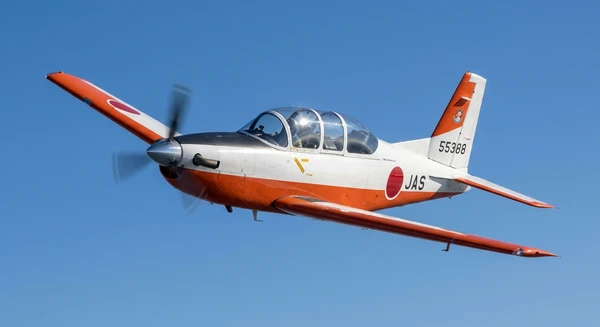
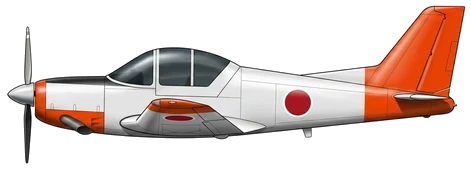
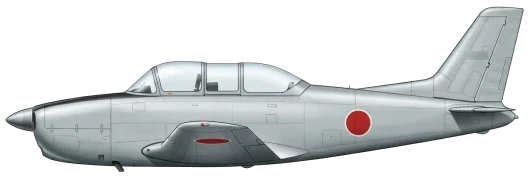
The Fuji T-7, previously designated T-3 Kai, is a primary trainer aircraft manufactured by Fuji Heavy Industries for the Japan Air Self-Defense Force (JASDF). Developed to replace the Fuji T-3, the aircraft is a modified version of the T-3 design, which itself descended from the Beech T-34 via the Fuji KM-2. The JASDF initially selected the T-7 over the Pilatus PC-7 in 1998, but the decision was cancelled and the competition restarted following a corruption scandal involving Fuji managers bribing a Japanese Liberal Democratic Party official. Fuji re-entered the aircraft in the restarted competition and won selection in September 2000.
Design
The T-7 retains the single-engined, low-winged monoplane layout of the T-3 but replaces the earlier Lycoming piston engine with an Allison 250 (Rolls-Royce 250-B17F) turboprop engine rated at 336 kW (451 hp). This engine drives a 2.12-meter diameter, three-bladed constant-speed propeller. The aircraft has a length of 8.59 meters, a wingspan of 10.04 meters, a height of 2.96 meters, and a wing area of 16.5 square meters, utilizing a NACA 23016.5 root airfoil and a NACA 23012 tip airfoil. It accommodates a crew of two and has a maximum takeoff weight of 1,585 kg.
Performance parameters include a cruise speed of 298 km/h at 915 meters and a stall speed of 104 km/h with flaps and landing gear extended. It has a wing loading of 96.1 kg/m² and a power-to-mass ratio of 0.2114 kW/kg. The takeoff distance to clear 15 meters is 608 meters, and the landing distance from 15 meters is 566 meters. Installed avionics include VHF and UHF radios, an intercom system (ICS), a transponder, and Tactical Air Navigation (TacAN).
Operational History
The first production T-7 was delivered to the JASDF in September 2002. The aircraft is operated by the JASDF Air Training Command's 11th Flight Training Wing (1st and 2nd Flight Training Squadrons) and the 12th Flight Training Wing (1st and 2nd Flight Training Squadrons, since 2005). It is also operated by the Air Development and Test Wing under the Air Development and Test Command.
Frequently Asked Questions
What type of aircraft is the Fuji T-7?
When did the Fuji T-7 first fly?
How many Fuji T-7 have been built?
Which countries operate the Fuji T-7?
- AUG 142026 Updated Short designation registered as an alternate name
- JUL 12026 Created Page created: Fuji T-7