H175 vs Z-9 Haitun
H175 vs Z-9 Haitun at a glance — top speed 315 vs 315 km/h, range 1,259 vs 1,000 km, max takeoff weight 7,800 vs 4,100 kg.
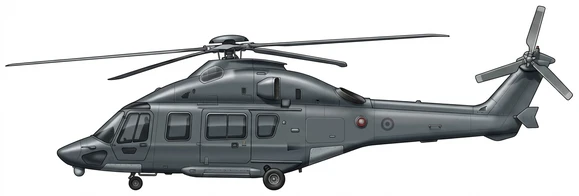
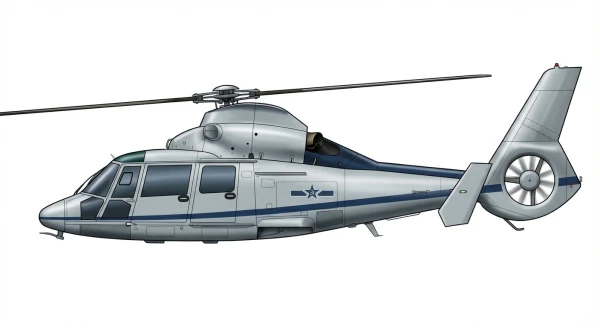
| H175 | Z-9 Haitun | |
|---|---|---|
| Origin country | 🇫🇷 France | 🇨🇳 China |
| Category | Military Helicopters | Military Helicopters |
| Manufacturer | Airbus Helicopters | Harbin |
| First flight | 17 December 2009 | 1 January 1981 |
| Year introduced | 2014 | 1994 |
| Number produced | N/A | 200 units |
| Average unit price | -- | -- |
| Wing area | 172.0 m² | -- m² |
| Wingspan | 14.8 m | 11.9 m |
| Height | 5.3 m | 3.5 m |
| Length | 18.1 m | 13.7 m |
| Maximum speed | 315 km/h | 315 km/h |
| Operational range | 1,259 km | 1,000 km |
| Service ceiling | 6,000 m | 6,000 m |
| Max. takeoff weight | 7,800 kg | 4,100 kg |
| Empty weight | 4,603 kg | 2,050 kg |
| Total thrust | 2 x 1,324 kW | 2 x 544 kW |
Detailed Comparison
The Airbus H175 and Harbin Z-9 occupy divergent weight classes and procurement generation timelines, pitting a modern 7-ton super-medium airframe against a 4-ton legacy light utility design. The Z-9 operates as a militarized, localized derivative of the 1970s Aérospatiale AS365 Dauphin. The H175—designated AC352 in China—is a 2008 joint venture product where Harbin Aviation Industry Group (HAIG) transitioned from assembling licensed parts to manufacturing airframes alongside Airbus.
Development and Design
Harbin’s Z-9 program began in 1980 through a production patent for the AS365. It required 12 years to reach a 70% domestic component threshold with the Z-9B in 1992. The design relies on a conventional teardrop airframe and a Fenestron tail rotor, which Harbin modified from 13 to 11 all-composite blades. The Airbus/AVIC joint venture for the H175 distributed the engineering load: Airbus integrated the systems and Helionix avionics suite with 4-axis dual-duplex autopilots, while HAIG manufactured the airframe, gearboxes, and the five-blade Spheriflex rotor system. To bypass Western export restrictions for military applications, China's AC352 variant replaces the European 1,324 kW Pratt & Whitney PT6C-67E engines with domestic 1,800 shp Turbomeca/AECC WZ-16 turboshafts.
Specifications and Performances
The H175’s 7,800 kg maximum takeoff weight (MTOW) nearly doubles the Z-9’s 4,100 kg. This mass differential dictates payload parameters; the Z-9 lifts 1,900 kg internally (10 troops), while the H175 accommodates up to 18 personnel. Despite the mass difference, both aircraft reach a maximum speed of 315 km/h. The Z-9 relies on twin 544 kW WZ-8A turboshafts, limiting its hover-out-of-ground-effect performance in high-altitude/high-temperature environments compared to the H175’s 1,324 kW output. The H175 also holds a 259 km range advantage over the Z-9 (1,259 km versus 1,000 km).
Deployment and usage
The Z-9 is heavily proliferated within the People's Liberation Army as a primary light utility and naval rotorcraft. The Z-9C operates from Type 054 frigates for anti-submarine warfare (ASW), while the Z-9WA functions as a light attack platform armed with AKD10 air-to-ground missiles, HJ-8 anti-tank munitions, and TY-90 MANPADS. It has secured export contracts in Pakistan (Z-9EC for ASW) and multiple African nations due to its low acquisition cost. The H175 currently operates purely as a civilian offshore transport and parapublic search-and-rescue asset, with fleets flown by the Royal Thai Police and Hong Kong Government Flying Service. Airbus is pitching the militarized H175M for the UK’s New Medium Helicopter requirement, but the platform currently has zero combat history.
Conclusion
Militaries with restrictive budgets requiring armed overwatch and shipborne ASW must select the Z-9. Its integration of anti-tank and anti-ship munitions makes it an off-the-shelf light attack asset, and its 4-ton footprint allows it to operate from smaller corvettes. However, for troop transport, heavy logistics, and extended radar-equipped search-and-rescue missions, the H175/AC352 is the necessary airframe. The Z-9 is completely outclassed in payload and avionics automation by the H175, making the Airbus/AVIC platform the default choice for pure transport and utility requirements.